






 Portuguese
  Spanish


Kenisson Morais Brito, 18 years old, from Barra do Choça and a student at SESI School, created AnisGuard, a natural fennel fungicide that reduces post-harvest coffee fungus by up to 83.8%, costs 4 times less, and won an award at ISEF 2026, the world’s largest science fair.
That fennel that many people have in their kitchen cupboard, used to make tea, has just become a cutting-edge weapon against a silent enemy of coffee. This was done by an 18-year-old from the interior of Bahia, who took the extract from the common plant and turned it into a natural fungicide capable of eliminating up to 83.8% of coffee fungus, spending a fraction of the price of synthetic pesticides. This achievement earned him an award at the largest pre-university science fair on the planet.
The story was told by Jornal Correio on May 30, 2026. The protagonist is Kenisson Morais Brito, from Barra do Choça, in southwestern Bahia, and a student at SESI Anísio Teixeira School in Vitória da Conquista. His project, named AnisGuard, took 4th place at ISEF 2026, held in the United States, and had previously won first place at the largest science fair in Brazil. His school is part of the SESI network, technical and linked to industry, and not a public school, as sometimes circulated.
From the kitchen to the laboratory: how fennel became a fungicide
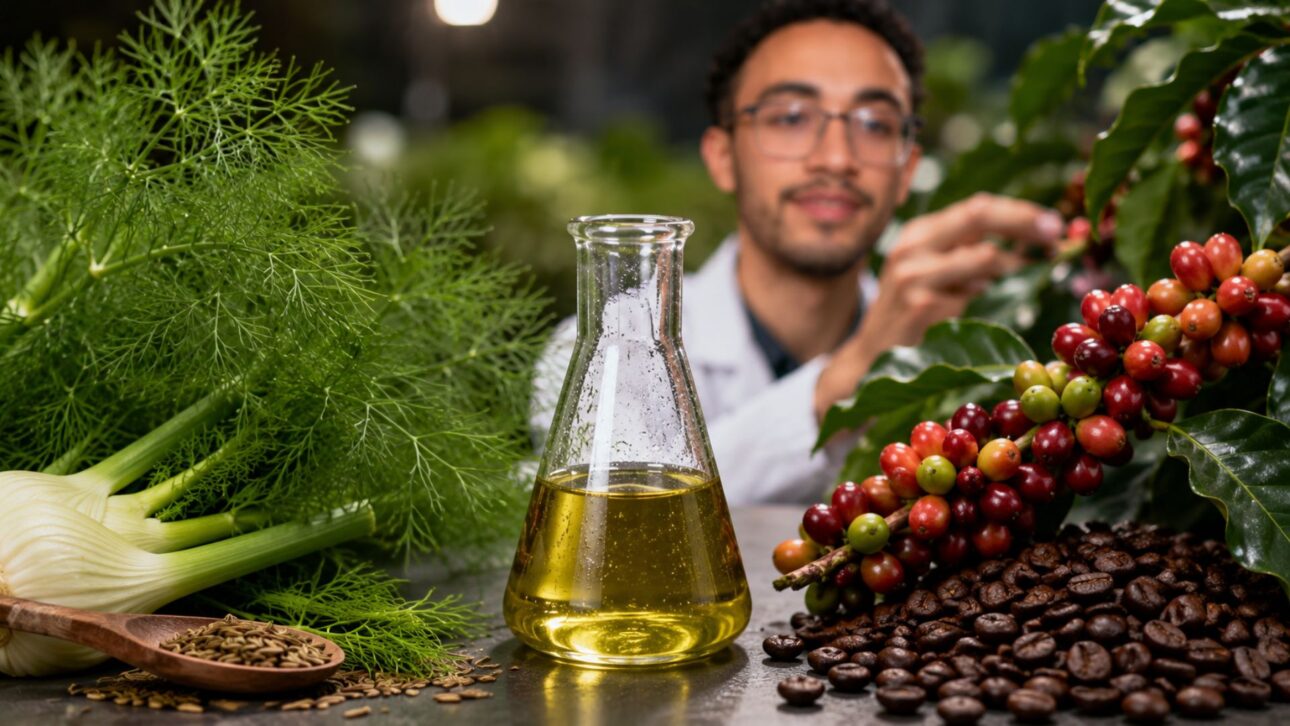
Kenisson extracted compounds from fennel, whose scientific name is Pimpinella anisum, and discovered in them a potent antifungal action. Applied in the washing of grains after harvest, this extract attacks the coffee fungus before it spoils the production. It is the tea plant turning into a natural agricultural defense.
-
Father Mobilizes 28 Scientists and 16 Labs to Seek New Treatments for Son’s Medulloblastoma After Being Told Nothing More Could Be Done

-
Brazilians Earn Up to $120 an Hour Training AI Systems, Despite Lacking Programming Skills or Degrees

-
In Alaska’s -40°C Cold, a Scientist-Turned-Farmer Uses Vegetables’ Heat to Store Food Without Power
-
Oil Company Robots Discover 3,300-Year-Old Canaanite Shipwreck in the Mediterranean, Proving Ancient Mariners Navigated Open Seas Using Stars Long Before Historians Thought




The target of AnisGuard has a name: Penicillium spp., a fungus that contaminates coffee beans in the post-harvest period and causes losses and quality decline. Instead of combating it with industrial chemical fungicide, the young man used nature itself. In this case, fennel doesn’t season food, it protects the crops, in a clear example of nature and engineering working together.
The charm of the invention lies in transforming something mundane into a high-value solution. No one looks at a package of fennel and imagines a natural fungicide capable of rivaling laboratory products. It was exactly this leap, from the trivial to the scientific, that caught the evaluators’ attention and made the project stand out among thousands of others.
83.8% of fungi eliminated and cost 4 times lower
The numbers are what give weight to the discovery. In tests, the fennel extract reduced up to 83.8% of the fungal load in coffee beans, a performance comparable and, in some aspects, superior to traditional synthetic fungicides. For a kitchen plant-based pesticide, it’s an impressive result.
The advantage doesn’t stop at effectiveness. The method is also much cheaper, with potential cost up to 4 times lower than conventional chemical products. For the small coffee producer, who lives on tight margins, paying a quarter of the price for protection that works can be the difference between profit and loss.
There is also a third gain, more technical but important. The natural fennel fungicide tends to reduce the risk of the coffee fungus developing resistance, a common problem when the same chemical poison is always used. Effective, cheap, and more sustainable, AnisGuard combines the three attributes that agriculture seeks and rarely finds together.
AnisGuard: the name and the science behind the project
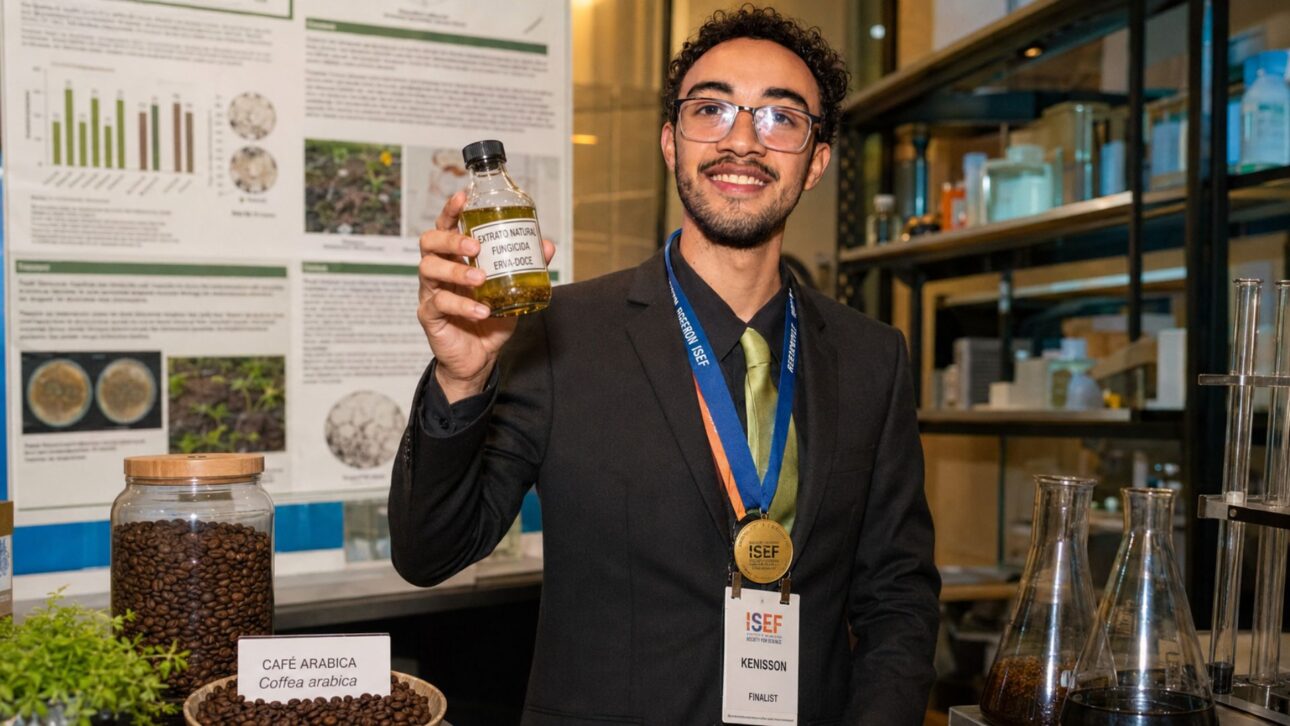
It is called “AnisGuard: multifaceted evaluation of Pimpinella anisum extract as a natural fungicide, biofertilizer, and cost-effective alternative in controlling Penicillium spp. in post-harvest coffee”. In other words, the fennel extract not only serves to kill fungi, it also acts as a biofertilizer, combining functions in a single product.
Behind the student was qualified guidance, and this deserves recognition. AnisGuard was developed by Kenisson with guidance from Professor Winne Katharine Souza Rocha and co-guidance from Gislaine Amorim Santos. It wasn’t a school fair guess, it was research conducted with method, with bioassays and rigorous measurement of results on the coffee fungus.
This rigor is what separates curiosity from real innovation. The project identified the bioactive compounds of fennel responsible for the antifungal action and proved the effect in the laboratory. The science there is real, and it was precisely this that took the natural fungicide from a student from the countryside to the international circuit.
From the interior of Bahia to the world podium
The recognition came in two stages, and both are significant. First, at FEBRACE 2026, the largest science and engineering fair in Brazil, held at USP, where AnisGuard took first place in Agricultural Sciences and was also chosen as the best project from Bahia. This result guaranteed Kenisson a spot to represent the country abroad.
Then came the ultimate stage. At ISEF 2026, the Regeneron International Science and Engineering Fair, held from May 9 to 15 in Phoenix, Arizona, the project won 4th place in the Plant Sciences category, with a prize of $600. According to the Ministry of Science, Technology and Innovation, Brazil took 21 students to the fair, and nine of them returned with eight awards in total.
The Brazilian presence had official support. Juana Nunes, director of Popularization of Science, Technology, and Scientific Education at MCTI, attended the event and highlighted that fairs like ISEF 2026 are where young people have real contact with science and where the scientific future of the country is formed. For a boy from Barra do Choça, sharing this stage with the best young scientists in the world is quite a turnaround.
Who is Kenisson, the young man behind the project
Behind the awards is a teenager driven by curiosity. At 18, Kenisson says that the invention was born from looking at the problems around him. “The conception process was very much based on observation and scientific curiosity. I wanted to understand how science could solve real problems in my community”, he told Jornal Correio. Coffee is precisely one of the economic drivers of the region where he lives.
The international experience at ISEF 2026 had a significant impact on the young man. “Being alongside the best young scientists in the world was something surreal and very inspiring”, said Kenisson, who studies at SESI School, a technical institution focused on industry-related education. For him, the contact with researchers from various countries showed that the science done in the countryside has the same value as that done in major centers.
What stands out the most in his speech is the notion of purpose. “Today, I see scientific research as a tool capable of transforming realities and generating social impact”, summarized the student. And he completed with the phrase that became a symbol of the story: “Being awarded internationally showed me that the science done in Brazil, even in the interior of Bahia, has the potential to reach the world.”
Why this matters for Brazilian coffee
Brazil is the largest coffee producer on the planet, and any gain in the field has a huge effect. The losses caused by fungi post-harvest are an old and costly problem, which directly attacks the quality of the bean that will reach the cup. A cheap and natural alternative against coffee fungus speaks directly to the pockets of thousands of producers, from large to family-owned.
The issue of sustainability strongly enters this debate. Reducing the use of chemical fungicides means less residue in food, less impact on the soil, and less risk for those applying the product. A natural fennel fungicide points to cleaner agriculture, aligned with what the market and consumers have been demanding from Brazilian coffee.
And there is the symbolism of where the solution came from. It wasn’t born in an agro multinational, but from the mind of a student from the interior of Bahia, with fennel and scientific method. If AnisGuard advances from the laboratory to the field, it will be proof that true innovation can sprout from anywhere, including a kitchen and an 18-year-old.
What does Kenisson’s story say about Brazilian science?
In the end, the case unites everything that usually moves and inspires. An 18-year-old from the interior of Bahia took a common plant, turned it into a natural fungicide that eliminates up to 83.8% of coffee fungus at a quarter of the price, and brought Brazil to the podium of ISEF 2026, the world’s largest science fair. It’s talent, it’s method, and it’s proof that opportunities, not brains, are lacking in the interior of the country.
And you, did you know that the fennel in your cupboard had this potential, and do you believe that inventions like AnisGuard should receive more support to move from the laboratory to the field? Share in the comments what you think about the future of this type of science made in Brazil.









Be the first to react!