






 Portuguese
  Spanish


The journey of Gabriel Fernandes Mello Ferreira shows how a school research project in Itajaí turned into an environmental solution against invisible particles in water, gained international recognition, and brought together young science, basic sanitation, and Brazilian innovation.
A Brazilian student from Itajaí, in Santa Catarina, transformed an increasingly present concern in science into an impactful project: a filter capable of retaining microplastics in water treatment plants. The name behind the idea is Gabriel Fernandes Mello Ferreira, who started the research at Colégio São José and gained national and international prominence.
The striking fact lies in the size of the solution itself. According to the technical material presented at the Stockholm Junior Water Prize, the prototype was made with simple materials, such as PVC pipes, a plastic container, 300 µm nylon mesh, and aquarium pumps, with an approximate cost of R$ 450.
Later, the young man also appeared as a scholarship holder linked to the Líderes Estudar program, from Fundação Estudar, and a student at New York University Shanghai, in China. A journey that began at a science fair and entered a much larger debate: how to improve water quality in the face of contamination by plastic waste.
-
Brazilian Teen Develops Cost-Effective Natural Fungicide from Kitchen Herb, Wins Top Prize at World’s Largest Science Fair

-
Father Mobilizes 28 Scientists and 16 Labs to Seek New Treatments for Son’s Medulloblastoma After Being Told Nothing More Could Be Done

-
Brazilians Earn Up to $120 an Hour Training AI Systems, Despite Lacking Programming Skills or Degrees
-
In Alaska’s -40°C Cold, a Scientist-Turned-Farmer Uses Vegetables’ Heat to Store Food Without Power



The idea was born in Itajaí and targeted an unnoticed problem
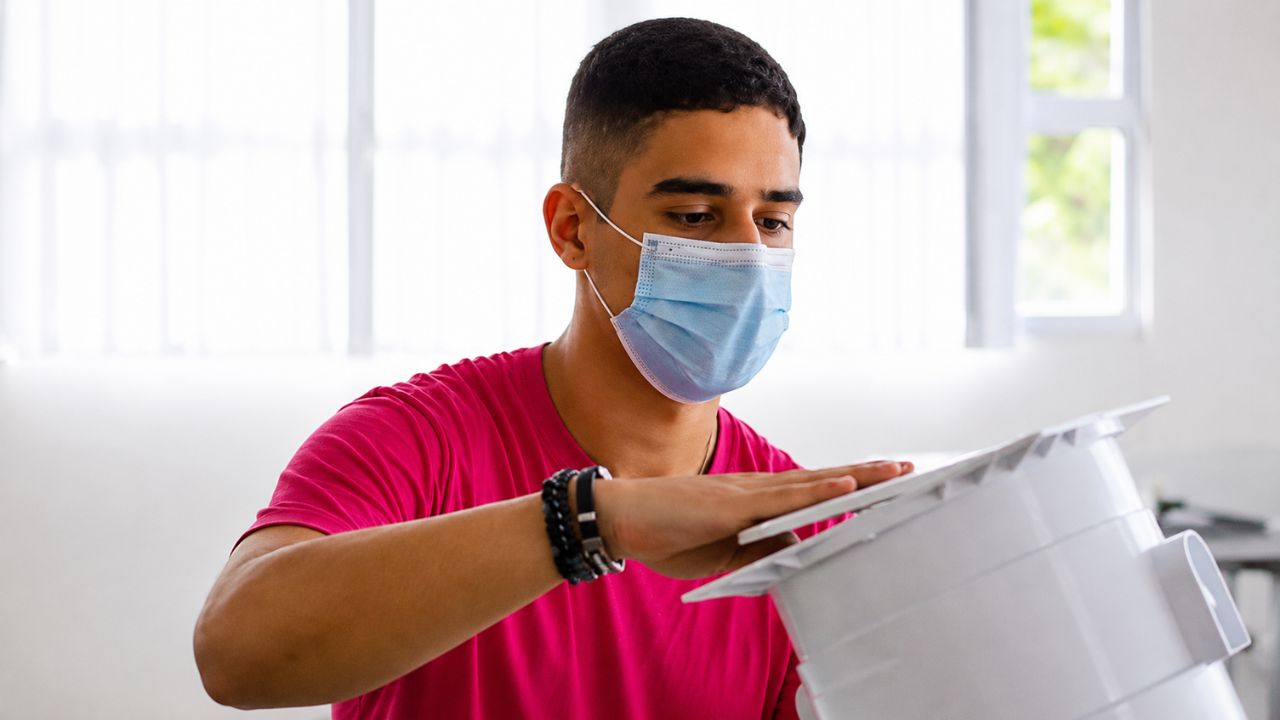
Gabriel’s project was named “Development of a Microplastic Retention Mechanism in Water Treatment Plants.” According to Colégio São José, the research was developed under the guidance of Professor Fernanda Poleza and focused on a sensitive point of sanitation: the absence of a specific stage to capture microplastics in many conventional plants.
The proposal was not to create a domestic filter. The objective was to design a structure adaptable to WTAs, Water Treatment Plants, where large volumes undergo impurity removal processes before reaching the population.
In the project’s technical study, Gabriel started from a common characteristic of these particles: many tend to remain on the water’s surface due to their lower density. From this, the mechanism was designed to capture this surface layer and direct it to a structure with nylon mesh.
Tubes, mesh, and pumps became a low-cost solution
The operation presented by Gabriel is straightforward. A type of skimmer captures the surface water, carries the flow through tubes, and directs the liquid to a plastic cylinder with a mesh bottom. The water passes through, while the particles are retained.
According to the Stockholm Junior Water Prize report, the test version cost about R$ 450. The estimate for a full-scale version was around R$ 500, a value that helps explain why the project attracted attention.
The studied point for installation was a channel between the decanter and the filter at the São Roque Treatment Station in Itajaí. The location was chosen because it would be after the removal of larger particles, reducing the risk of clogging, and would allow filtering the water surface without requiring major changes to the WTP structure.
Tests showed high retention, but there is a difference between the published numbers
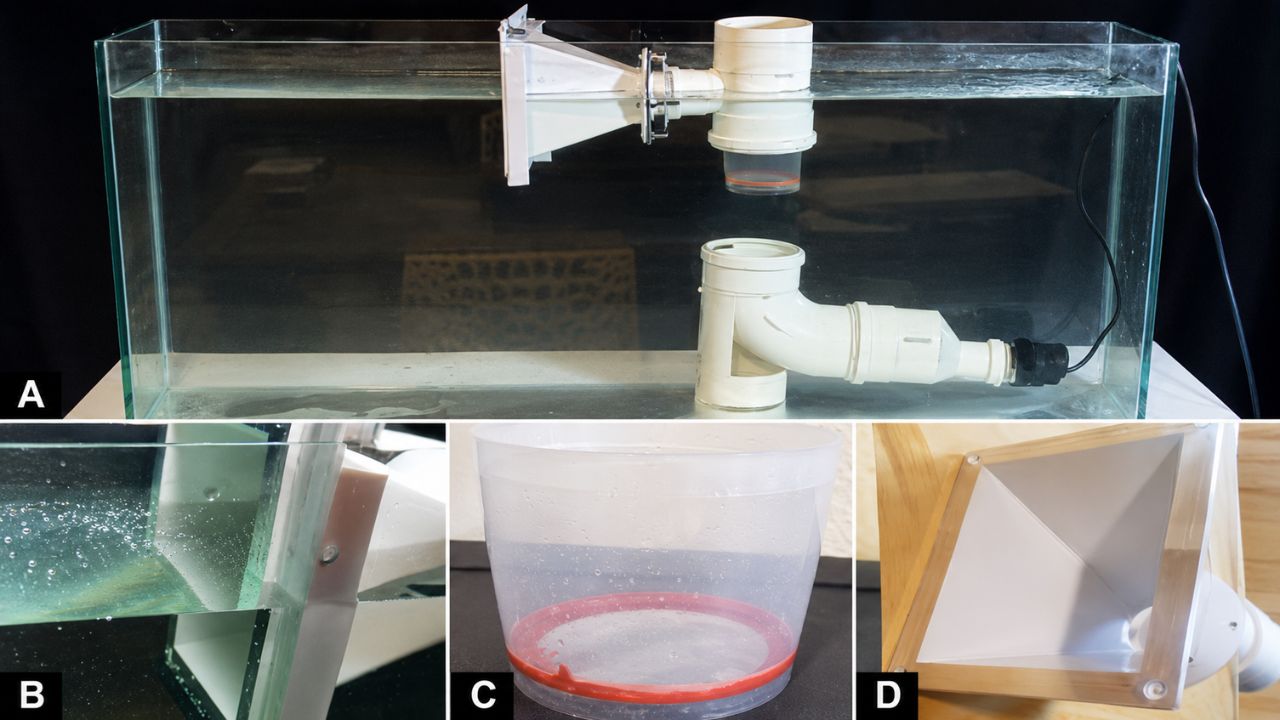
During the pandemic, Gabriel was unable to perform the first stage directly at the station. Therefore, he simulated the conditions on a reduced scale, using an aquarium and pumps with different flow rates.
The technical material indicates that the increase in water flow improved retention and that almost all microparticles equal to or larger than 300 µm were trapped in the mesh. Meanwhile, Colégio São José cited 80% efficiency in a publication about the project.
Subsequent reports mentioned performance of up to 100%, but the safest editorial path is to say that the filter showed high efficiency in simulations. The very contrast between the numbers shows how the invention moved from the school environment to a broader technical discussion.
From science fair to international award
Before gaining projection outside Brazil, Gabriel had already been awarded at FEBRACE 2021, the Brazilian Science and Engineering Fair. The institution reported that that edition gathered 345 finalist projects, 716 students, 482 guiding teachers, and 295 schools from all states and the Federal District.
The project achieved 3rd place in Engineering and recognition for Santa Catarina. Colégio São José also reported that the research was among the finalists to represent Brazil in the Stockholm Junior Water Prize.
In 2021, Gabriel represented the country in the Stockholm Junior Water Prize, an international competition aimed at young people aged 15 to 20 with projects related to water challenges. The main winner that year was Eshani Jha from the United States, but Gabriel won the People’s Choice Award.
According to the Stockholm Water Foundation, more than 55,000 people participated in the popular vote. Brazilian sources indicate that Gabriel’s project received more than 26,000 votes, securing the victory in this category.
Invention was linked to the supply of Itajaí and Navegantes
The regional impact also became part of the story. Brazilian reports, including Só Notícia Boa and Portal 49, pointed out that the system was adopted or announced for a station responsible for about 70% of the supply of Itajaí and Navegantes, in Santa Catarina.
This point requires caution. The submitted research did not provide a recent and official confirmation from Semasa about the current operation of the filter in 2025 or 2026. Therefore, the most accurate way is to state that the technology was announced in reports as applied or linked to the ETA of the region.
The connection with companies in the sector also appeared in a publication by Águas de São Francisco do Sul, associated with Aegea SC. The note states that Gabriel and Professor Fernanda Poleza made a technical visit to companies in the group, at a time when the project was undergoing a patenting process and there was an intention for industrial-scale production.
From the water of Santa Catarina to the university in China
The most recent chapter of the journey expands the story. The Estudar Foundation lists Gabriel Fernandes Mello Ferreira among the Estudar Fellows of 2024, linked to New York University Shanghai. The Millennium Fellowship 2025 profile presents him as a student of Computer Systems Engineering at the university and a Brazilian researcher.
The page also states that at the age of 16, he developed the first microplastic filter for water treatment plants. Today, his new project mentioned in the Millennium Fellowship is called “Unequal Heat: Temperature in Rio’s Favelas” and addresses urban heat islands, socio-environmental inequality, and solutions such as green roofs and cool roofs.
The Stockholm Water Foundation also published that Gabriel continued giving lectures on microplastics, spoke to more than 600 students, and worked with Xylem on the development of the prototype created for the competition.
The case goes beyond a school invention
The topic is growing because microplastics are already a global concern. The World Health Organization has a specific report on microplastics in drinking water, evaluating their presence in the water cycle, treatment processes, and possible health impacts.
The United Nations Environment Programme estimates that between 19 and 23 million tons of plastic waste reach aquatic ecosystems every year, contaminating lakes, rivers, and seas.
In this scenario, Gabriel’s case is not just the story of an award-winning student. It is the portrait of how an idea created in school, with simple materials and low cost, can address an invisible environmental problem, bring young science closer to basic sanitation, and show that innovation can also be born far from large laboratories.


Be the first to react!