






 Portuguese
  Spanish
  4 min of reading
  0 comments


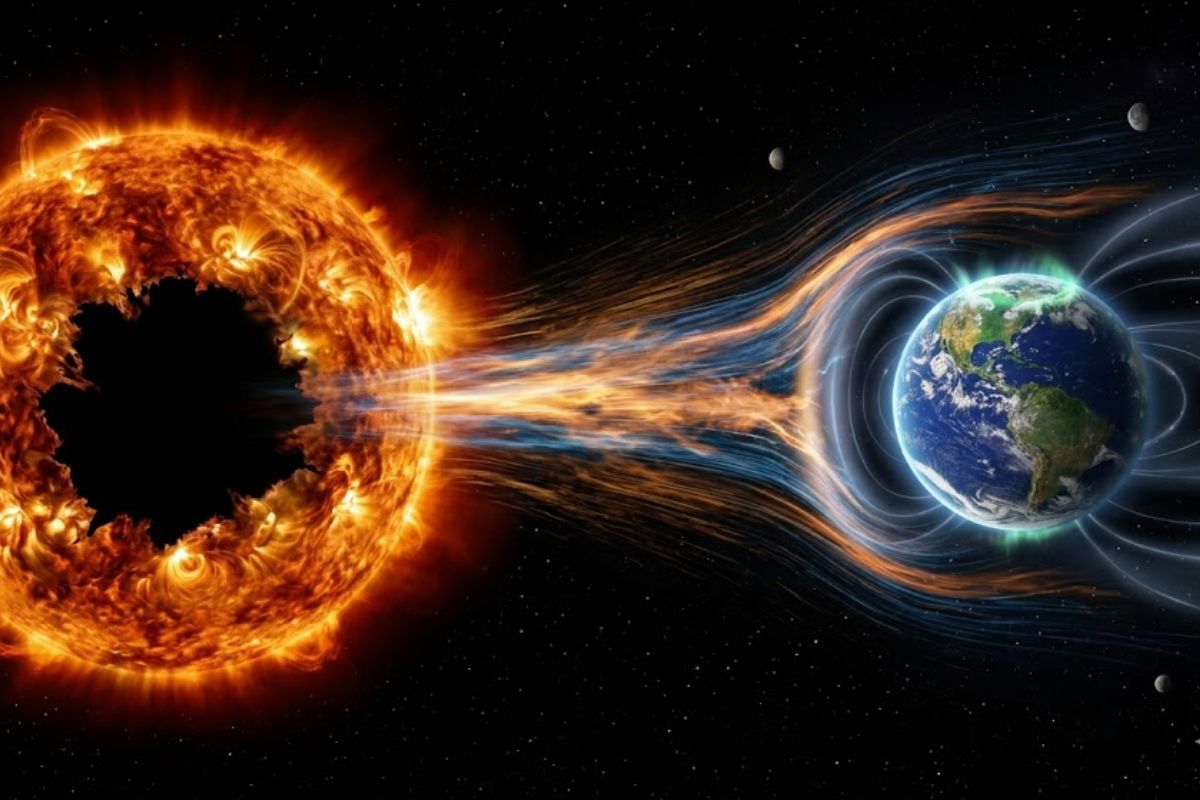
NOAA registered a huge coronal hole on the Sun that turned to face the Earth and is now releasing solar wind at up to 700 km/s, with a geomagnetic storm warning between Friday (17) and Saturday (18) that could reach G3 levels and produce visible northern lights in regions where the phenomenon rarely appears.
The GOES-19 satellite, operated by NOAA in the United States, identified a massive opening in the Sun’s corona this week, initially positioned in the northeastern sector of the star. With natural rotation, this structure called a coronal hole migrated to face our planet directly, a condition that scientists call geo-effective and allows solar wind to hit the magnetosphere with concentrated intensity. The flow of charged particles travels at speeds close to 700 kilometers per second and is expected to collide with the Earth’s magnetic field between Friday (17) and Saturday (18), according to the EarthSky.org portal. NOAA issued a moderate geomagnetic storm warning (G2), while the British Met Office considers it possible for the event to escalate to a strong level (G3).
What makes the situation more intense is a mechanism called the corotating interaction region, which arises when faster jets of solar wind catch up with slower previous currents and generate a compression zone in the interplanetary medium. This compression amplifies the impact on the magnetosphere and can prolong the disturbance for hours, favoring the formation of auroras in areas of the globe where they normally do not appear. The predicted scenario places the Earth’s magnetic field in a condition that oscillates between instability and intense activity throughout the weekend.
What is the coronal hole that formed on the Sun

Coronal holes are zones in the Sun’s outer atmosphere where magnetic field lines project outward instead of returning to the surface. This opening releases charged particles at speeds much higher than standard solar wind, forming jets that cross the solar system in just a few days. When rotation positions one of these structures facing the Earth, the flow hits the magnetosphere directly.
-
13-year-old Indian girl impresses the world by leading the planting of 200,000 trees in over 120 locations and gaining international recognition while still in childhood.

-
Coral reefs gain new hope after scientists identify 165,000 km² with potential to resist heat in 71 countries, serve as living recovery banks, and protect food, jobs, and coastlines of nearly 1 billion people under climate threat.

-
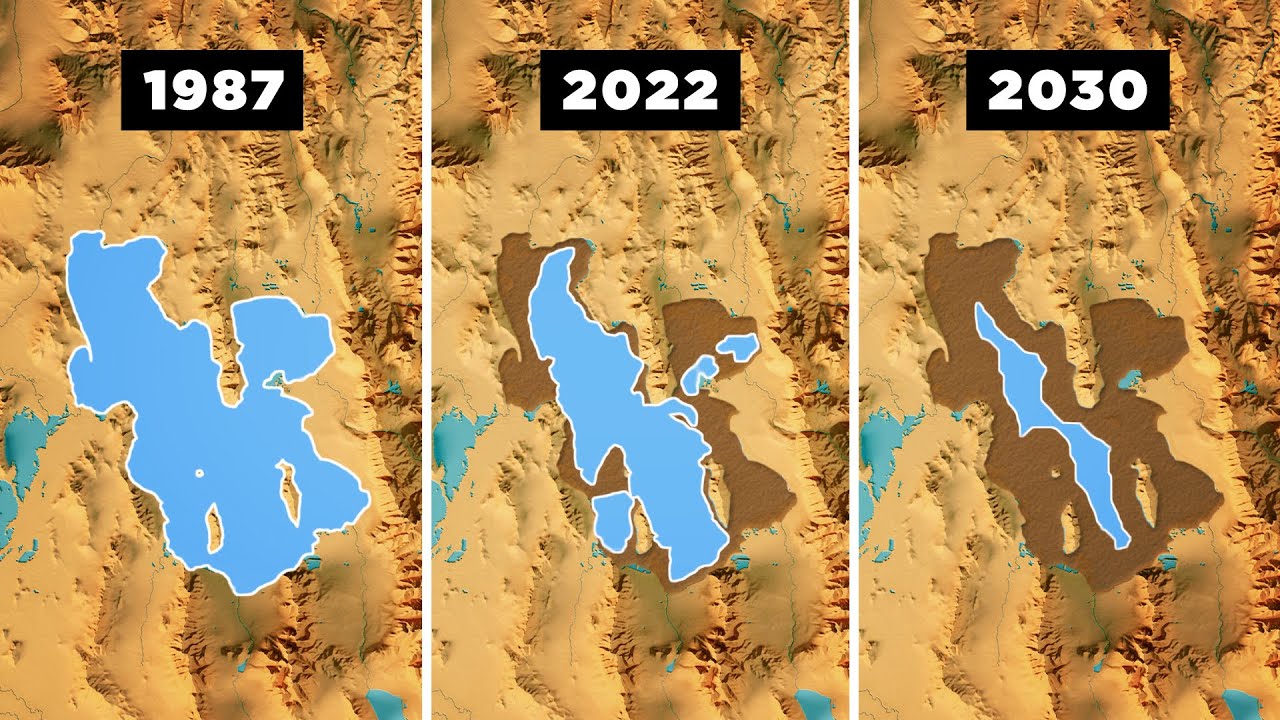
An American giant could disappear in five years: Utah’s Great Salt Lake has already shrunk by two-thirds, exposing a bed full of arsenic, and scientists are calling its collapse an “environmental nuclear bomb” about to explode over a city of more than a million people.
-
Children give more meaning to life, but not more happiness: study with over 5,500 people in 10 countries reveals surprising discovery about well-being, relationships, and the true impact of parenting throughout life.




The images from GOES-19 show that the hole identified this week occupies a considerable area on the Sun’s disk. NOAA classified the event as significant, and the volume of ejected material suggests that the consequences for the Earth’s magnetosphere may exceed those observed in recent episodes. The geo-effective position taken throughout the week is the factor that transforms solar wind from a distant phenomenon into a concrete threat to the stability of satellites, electrical grids, and navigation systems.
Geomagnetic storm: what can happen when solar wind hits Earth

The geomagnetic storm scale ranges from G1 (weak) to G5 (extreme). NOAA issued a formal statement projecting a G2 level, while the UK Met Office assesses that the impact could rise to G3 if the flow of particles from the Sun strengthens in the coming hours. At the moderate level, fluctuations in high-latitude power grids and degradation of GPS signals are already expected. At the strong level, the effects spread to communication and navigation systems over broader ranges.
The magnetosphere acts as a barrier that deflects most of the solar wind, but in more powerful events, this shield undergoes temporary deformations. The compression zone formed by the corotational interaction prolongs the disturbance and makes the evolution of the geomagnetic storm less predictable. NOAA maintains continuous satellite monitoring and updates its forecasts as data on the speed and density of the flow from the Sun arrives in real time.
Northern lights may appear in regions where they rarely show up
One of the most spectacular results of the collision between solar wind and the magnetosphere is the formation of auroras. The particles that penetrate the magnetic field are directed towards the poles, where they collide with oxygen and nitrogen molecules in the upper atmosphere and release luminous energy in the green, red, and purple tones that characterize the phenomenon. In geomagnetic storm events above G1, auroras can be seen at latitudes significantly farther from the poles than usual.
The Met Office published an aurora projection for the Northern Hemisphere indicating that the spectacle may reach regions where occurrences are rare. For those intending to observe, the recommendation is to find a location with a clear horizon, a cloud-free sky, and away from city lights. NOAA also provides real-time maps indicating the extent of the auroral oval, allowing monitoring of whether the aurora is expanding to lower latitudes as the geomagnetic storm evolves.
Lirid meteor shower coincides with the solar event
The weekend holds a rare astronomical overlap. As the solar wind shot from the Sun reaches Earth, the Lyrid meteor shower is also underway, with activity expected between April 16 and 25. The peak intensity is expected to occur in the early hours of Wednesday (22), but it is already possible to catch some bright trails on the previous nights.
Unlike the aurora, the Lyrids are independent of latitude and magnetic conditions: all you need is a dark, cloudless sky. The point from which the meteors seem to radiate is in the constellation Lyra, but the streaks of light can appear in any direction in the sky. For those who have a clear night this weekend, there is a rare possibility of witnessing aurora and meteors simultaneously, two phenomena of distinct origins that the Sun and cosmic debris provide at the same time.
And you, will you try to observe the sky this weekend to see the aurora or the Lyrids? Have you ever witnessed any phenomenon caused by solar activity? Share in the comments.






-

1 person reacted to this.