






 Portuguese
  Spanish


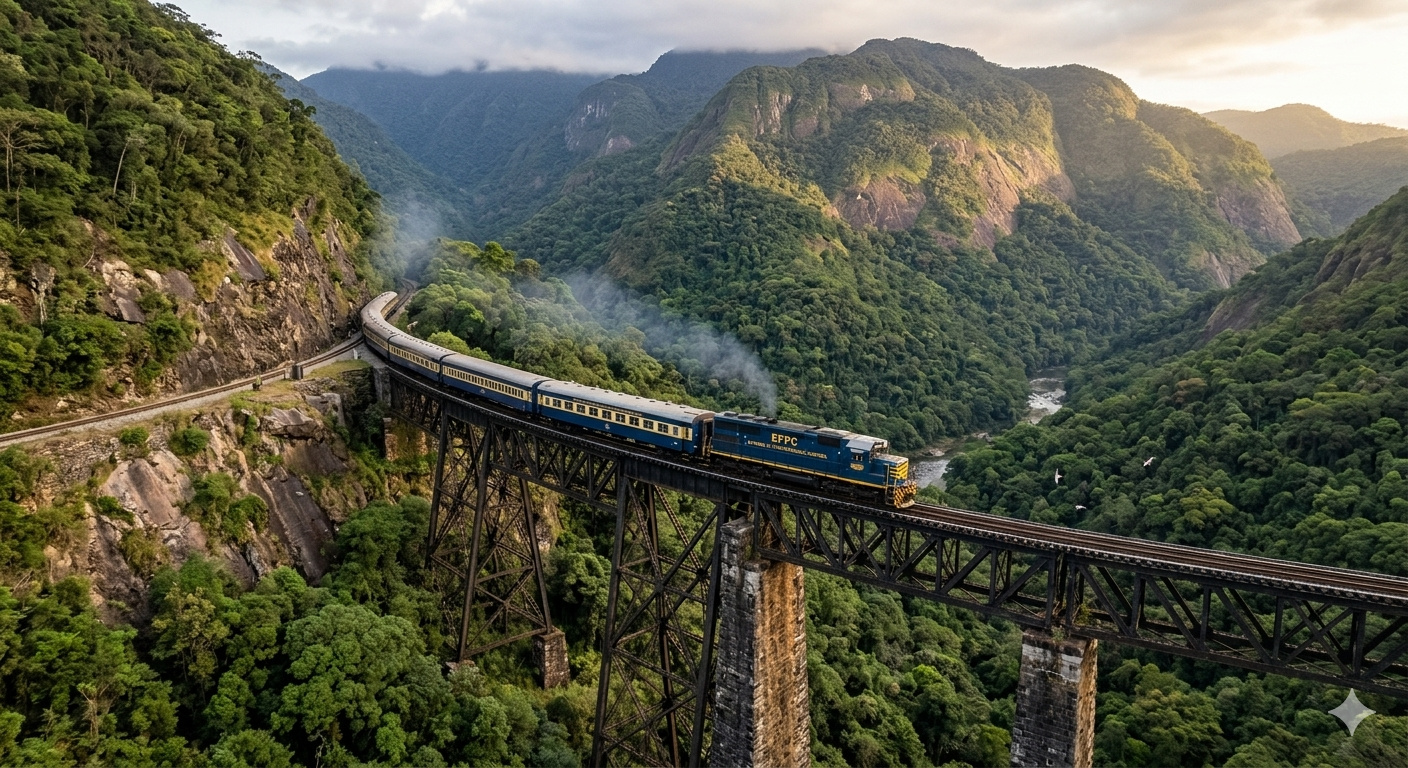

Paranaguá-Curitiba Railway completes 140 years as one of Brazil’s greatest railway works, with 108.2 km, 13 tunnels, 41 bridges, preserved Atlantic Forest, and a history marked by extreme engineering, tourism, and thousands of workers dead in the Serra do Mar.
According to the Government of the State of Paraná, the Paranaguá-Curitiba Railway completed 140 years in 2025, consolidating itself as a landmark of national railway engineering and a living historical heritage of Brazil. With 108.2 kilometers of extension amidst the largest continuous preserved area of Atlantic Forest in the country, the railway connects Curitiba to the Port of Paranaguá through a route that includes 13 tunnels, 41 bridges, dozens of small bridges, and emblematic works such as the Carvalho Viaduct and the São João Bridge.
The British newspaper The Guardian included the railway among the ten most beautiful rail journeys in the world. What its tourist fame doesn’t always show is that, before becoming a postcard, this work was considered impossible by European engineers, cost the lives of thousands of workers, and had its first chief engineer abandoning the project at kilometer 45.
The railway that today takes tourists through Atlantic Forest landscapes and transports strategic cargo between the coast and the Paraná plateau was born from an extreme challenge: crossing the Serra do Mar with tracks, bridges, tunnels, and viaducts in an era without modern machinery, on unstable, humid, and almost vertical terrain.
-
Mother Who Called Herself a ‘Pinterest Failure’ Learned Wood Furniture Restoration from Videos, Now Earns Around $15,900 Monthly

-
Denmark Constructs World’s Largest Immersed Tunnel to Connect with Germany, Sinking 217-Meter Concrete Sections in the Baltic Sea
-
Low-Cost Concrete Panel House Goes Viral: Investor Reveals Prefabricated Kit Structure for Around $1,500, Assembled in 30 Days, with Plans for Rental and Resale Income

-
Polymeric Mortar Revolutionizes Brazilian Construction with Efficient, Clean Application and Uniform Finish



The Rebouças Brothers and the origin of the Paranaguá-Curitiba railway in the 19th century
The idea of the Paranaguá-Curitiba railway was born in 1865 with André Rebouças, one of Brazil’s first Black engineers. Son of a self-taught father and grandson of an emancipated enslaved woman, André and his brother Antônio Rebouças studied engineering in Rio de Janeiro during the full period of slavery.
Observing a map, André realized that Antonina, on the Paraná coast, was on the same line as Asunción, Paraguay, forming a route of enormous logistical value. The War of the Triple Alliance prevented the immediate advancement of the project, and Antônio died in 1874 without seeing the work begin.

In 1875, by imperial decree, the starting point was defined as Paranaguá. When D. Pedro II laid the cornerstone on June 5, 1880, he granted a special request from the Rebouças and expressly prohibited the use of slave labor in the construction, a rare decision for a period when abolition was still eight years away.
Serra do Mar was the obstacle that made engineers consider the railway impossible
Building about 110 kilometers of railway through the Serra do Mar in 1880 was considered technically impossible. The terrain was steep, unstable, covered by dense forest, and subject to torrential rains, fog, landslides, and sudden erosions.
The Italian engineer Antonio Ferrucci was the first to take charge of the work and abandoned the project at kilometer 45, declaring the undertaking impractical. A curved tunnel section in Rochedinho collapsed during the works, necessitating an emergency replacement with a viaduct.
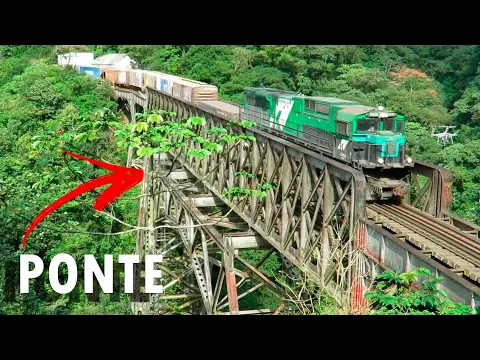
This change gave rise to the Carvalho Viaduct, today one of the railway’s postcards. The structure was set on five masonry pillars embedded directly into the living rock, in a section where the tracks seem suspended over the void of the Serra do Mar.
João Teixeira Soares took over the railway and brought the work to Curitiba
It fell to the Brazilian engineer João Teixeira Soares, then just 33 years old, to take over the direction of the work and see the project through to the end. He reorganized the construction and divided the advancement of the tracks into three simultaneous fronts.

The fronts were Paranaguá-Morretes, with 42 kilometers, Morretes-Roça Nova, with 38 kilometers, and Roça Nova-Curitiba, with 30 kilometers. This strategy allowed accelerating a work that faced technical obstacles throughout almost its entire route.
The construction mobilized about nine thousand workers, including German, Polish, Italian immigrants, and freed Africans. It was this workforce that opened tunnels, erected bridges, and laid tracks in one of the most challenging regions of Brazilian railway engineering.
Paranaguá-Curitiba Railway overcomes almost 955 meters of altitude in the Serra do Mar
The most challenging section of the Paranaguá-Curitiba Railway is the ascent of the Serra do Mar. In about 40 kilometers between Morretes and Borda do Campo, the train overcomes almost 950 meters of elevation gain over a relatively short distance.
Almost one kilometer of this section was literally laid on cliffs, with the track supported by metallic structures over the void. The steel bridges were imported from England and assembled on site without the use of modern machinery.

According to historical records cited in the base text, workers maneuvered pieces weighing up to 500 tons on the mountain slopes. The railway combines tunnels, bridges, viaducts, and rock cuts in a sequence that still impresses with its technical audacity.
Tunnels, bridges, and viaducts transformed the railway into a landmark of national engineering
In total, 14 original tunnels were opened, 13 of which are still in use. The largest of them measures 457 meters and is located at the highest point of the railway, at 952 meters of altitude, in Roça Nova.
Tunnel 5 has a rare peculiarity: a side window that connects the interior of the tunnel to the cliff face. From there, it is possible to see Antonina Bay on the horizon and Morretes in the valley below.
In addition to the tunnels, the railway features 41 bridges, dozens of small bridges, and works such as the São João Bridge and the Carvalho Viaduct. This collection of railway engineering marvels explains why the Paranaguá-Curitiba is still considered one of Brazil’s most daring constructions.
Five thousand workers are estimated to have died during the construction of the railway in the Serra do Mar
The human cost of the work was brutal. Of the estimates that range between 9,000 and 10,000 recruited workers, approximately five thousand are estimated to have died during the five years of construction.
Deaths occurred due to malaria, explosive accidents, landslides, falls, diseases, and precarious safety conditions. The crossing of the Serra do Mar required extreme human effort, in a period when modern labor laws did not yet exist.
On February 2, 1885, the railway was inaugurated. The first journey between Paranaguá and Curitiba lasted nine hours, a gigantic advance compared to the days-long journeys required by the Estrada da Graciosa before the arrival of the tracks.
Paranaguá-Curitiba Railway transformed Paraná’s economy and strengthened the Port of Paranaguá
Upon arriving at Curitiba station, the first train was greeted by over five thousand people. The inauguration marked a profound change in the circulation of goods, people, and wealth in Paraná.
Yerba mate, Paraná’s main export product in the 19th century, began to be transported in volumes and at speeds that animal traction would never allow. The Port of Paranaguá gained even greater importance for Southern Brazil.
Cities like Morretes grew around the stations created by the train. The railway ceased to be merely an engineering work and began to function as an axis of economic, logistical, and urban development for Paraná.
Paranaguá-Curitiba Railway today unites cargo transport, tourism, and preserved Atlantic Forest
What is most surprising about the Paranaguá-Curitiba Railway is not just that it was built in 1885. It is that it continues to function 140 years later, without its main original engineering structures having been replaced due to structural incapacity.

Today, the railway operates under two regimes. Rumo Logística maintains daily cargo transport between Paranaguá and Curitiba, moving grains, fertilizers, and containers through the corridor that connects the port to the interior of the South and Southeast.
At the same time, Serra Verde Express operates the tourist train between Curitiba and Morretes. The route combines engineering history, preserved Atlantic Forest, and landscapes that make many passengers describe the sensation of flying over the Serra do Mar.
Carvalho Viaduct symbolizes the impossible railway that still crosses the Serra do Mar
The Carvalho Viaduct was born from a technical problem: the collapse of a tunnel that needed to be replaced by a bolder engineering solution. Today, it is the most precise symbol of the entire railway.
The structure represents a work that seemed impossible, built in a place where it seemed impossible to build. More than a century later, it continues to cross the Serra do Mar with tourists, cargo, and the memory of thousands of workers.
The Paranaguá-Curitiba Railway has survived time, humidity, cliffs, and the weight of history. Among tunnels, bridges, viaducts, and the Atlantic Forest, it remains one of the greatest proofs that 19th-century Brazilian engineering faced the impossible with stone, steel, calculation, and human sacrifice.


