Portuguese
  Spanish


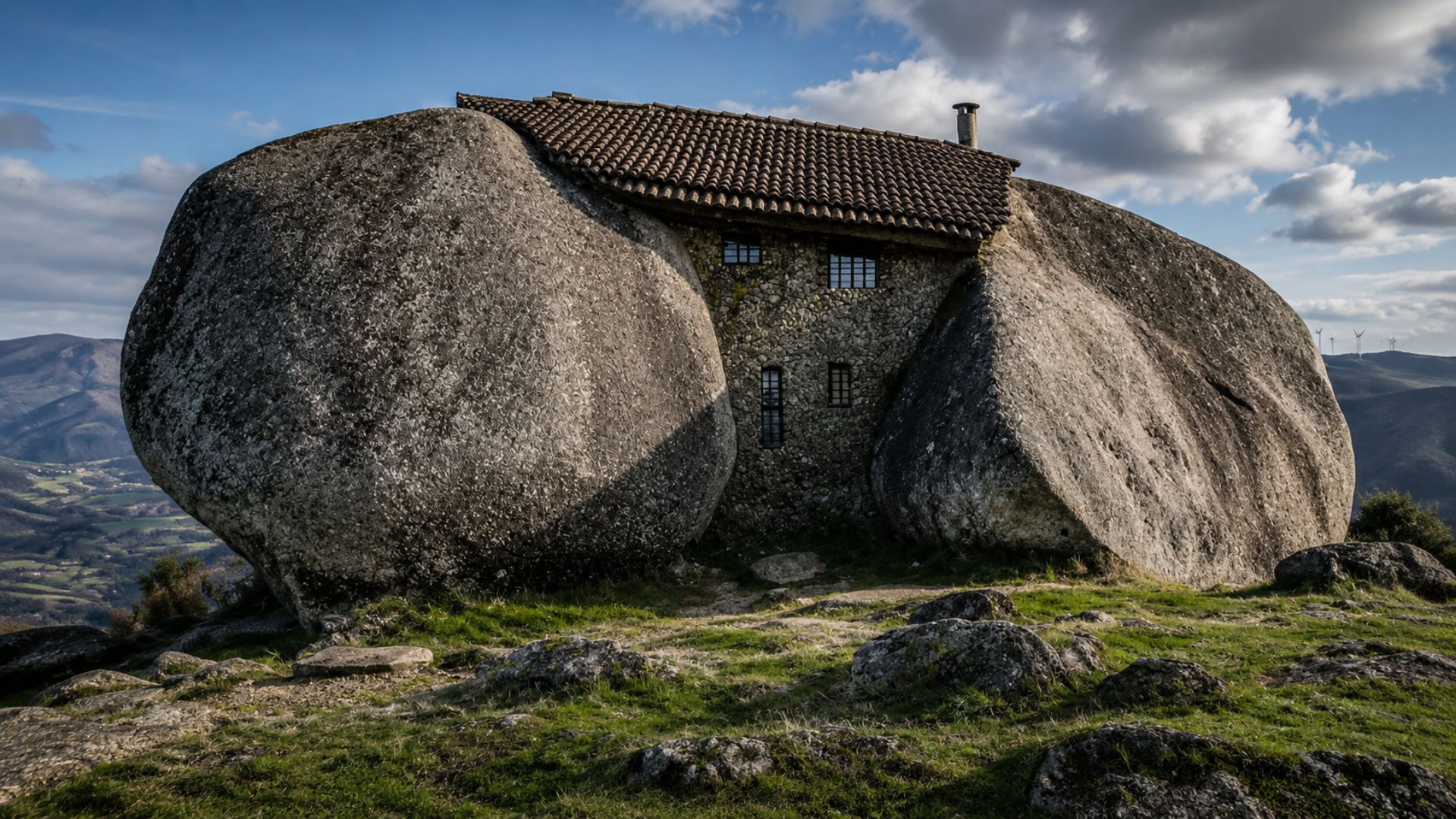

Built as a weekend retreat by a textile engineer from Guimarães, the Casa do Penedo became a social media sensation in 2015 and was included in the Rally of Portugal route. So many curious visitors came that the windows were replaced dozens of times, gained bulletproof glass, and the door today is made of steel, weighing 400 kilos.
A house built between four granite blocks in Portugal over 50 years ago draws attention for its prehistoric appearance and the intelligent use of stone, which helps regulate the internal temperature naturally. Known as Casa do Penedo, it is located in the Serra de Fafe, in the north of the country, and has become a curiosity phenomenon, but the fame ended up bringing vandalism and too many tourists, leading the owner to transform the property into a small museum.
The construction began in 1972 and was completed in October 1974, after about two years of work. It was conceived by a textile engineer from the city of Guimarães, who wanted a weekend retreat for the family to relax amidst the mountains. Instead of removing the huge rocks on the land, he decided to build the house between them, using the granite blocks as part of the structure itself.
Four stones that become walls and roof

Four large granite blocks form the base, walls, and roof of the construction at different points, so that the house seems to sprout from the ground itself, almost invisible from a distance, as if it were a natural camouflage in the mountainous landscape.
-
Son of Poor Farmers Fled Home Four Times Seeking Work, Founded Hyundai, and Transformed It into a Global Industrial Giant in Over 190 Countries

-
13-Year-Old Raises Funds to Build Well, Transforming Lives in Cambodian Community Lacking Clean Water

-
Man with Metal Detector Finds Medieval Silver Seal in England, Uncovers 2,000-Year-Old Roman Gem with ‘Richard’s Secret’

-
Thailand Converts 8 Tons of PET Bottles into 3,500 School Backpacks, Showcasing Circular Economy with Over 40 Factories Involved





Inside, the property has two floors connected by a wooden staircase. On the ground floor are the kitchen and a small living room, and on the upper floor, the sleeping area. Each room has a different shape, adapted to the geometry of the rocks. A curious detail is that even the sofa was custom-made in concrete and eucalyptus wood, weighing hundreds of kilos, in harmony with the robustness of the ensemble.
The stone as a natural air conditioner
What is most interesting nowadays is not just the exotic look, but the simple engineering behind the thermal comfort. The large mass of granite acts as a natural temperature regulator: during the day, the stone gradually absorbs heat; at night, it slowly releases this heat, helping to keep the indoor environment more stable.
In practice, this reduces the need for artificial heating or cooling systems, making the house an interesting example of efficiency in regions with variable climates. This principle, known as thermal inertia, has been known for centuries and explains why stone buildings tend to be cool in the summer and cozier in the winter, without relying on expensive technology.
A house without electric light


One of the most surprising aspects of the Casa do Penedo is that, despite becoming a symbol of alternative living, it has no electricity or running water, even though it is close to a wind power generation park. The property is registered as a mountain shelter, and the idea was always to create a rustic retreat, away from urban conveniences.
Even so, the house is equipped with the basics for comfort, including a fireplace and a pool carved directly into the surrounding rock. The absence of electricity, far from being a problem, reinforces the idea of disconnection and simplicity that motivated its construction, at a time when no one imagined that this discreet retreat would become a global attraction.
When fame became a problem
The turning point in the story happened around 2015, when photos of the house hit social media and went viral, drawing immediate comparisons to the Flintstones’ house, the classic Stone Age family cartoon. The location also became part of the Rally of Portugal route, turning the site into a magnet for tourists, curious visitors, and unfortunately, vandals.
The result was a nuisance for the family. According to reports, the owner, Vítor Rodrigues, even had people peeking through the windows and opening the door to enter without permission. On Sundays, the house seemed like a pilgrimage site. With the vandalism, the windows needed to be replaced between 20 and 30 times, until they opted to install bulletproof glass, metal bars, and a steel door weighing about 400 kilos.
From refuge to museum
Faced with the impossibility of using the house as a peaceful retreat, the solution found was to transform it into a small museum. Today, the Casa do Penedo houses photos and relics that tell the story of the construction and the surrounding landscape itself, welcoming visitors who need to schedule their visit in advance, since the land has been fenced off and free access is no longer allowed.
The transformation into a museum ended up preserving the property and, at the same time, organizing the flow of visitors that was previously chaotic. Thus, the house that was born as a dream of tranquility in the countryside gained a new function, keeping alive the curiosity it arouses in people from all over the world, now in a more controlled and safe way for the heritage.
A lesson in sustainable architecture
More than a tourist curiosity, the Casa do Penedo has entered the debate on sustainable architecture and low-impact housing. It shows that sustainability does not always depend on cutting-edge technology and can arise from a simple decision: to take advantage of what nature already offers, instead of fighting it, reducing the use of industrialized materials and waste.
In times of expensive construction, high energy consumption, and the search for more durable solutions, examples like this help to rethink the way we build. Integration with the land, the use of local materials, and the utilization of the stone’s thermal properties are principles that contemporary architecture, including in Brazil, has been rescuing in bioclimatic projects, which seek comfort with less environmental impact.
The Casa do Penedo is proof that simple ideas can become extraordinary. What started as the dream of a weekend retreat among four stones turned into a world icon of creativity and harmony with nature, albeit at the cost of its owners’ privacy. Among the rustic charm, intelligent engineering, and the prehistoric aura, it has stood firm for more than half a century, reminding us that sometimes the best solution is to build with the landscape, not against it.
And you, would you live in a house built between four granite blocks like the Casa do Penedo? What did you think of this idea of using the stone itself to naturally climatize the environment? Leave your comment, tell us what enchanted you most about this construction, and share the article with those who love architecture, travel, and curiosities around the world.