Portuguese
  Spanish


Showyan is a Japanese carpenter who documents house construction on his own YouTube channel. Scott Wadsworth, an American contractor with four decades of experience, watched the series and declared that this Japanese carpenter operates on another level, expanding horizons he thought he had already fully explored.
Scott Wadsworth is no novice. He has four decades of building, framing, and finishing wooden structures in North America, with hundreds of projects under his belt and a formed opinion on almost everything involving wood, tools, and construction sites. When he finally watched the channel of the Japanese carpenter Showyan, after months of recommendations from viewers, he paused the video halfway and stayed silent for a moment. “Wood is wood, sharpening is sharpening, hammers are hammers, and men are men. But it is certainly interesting to see how this guy does what he does, where he does it, and with the tools he has. It expands my horizons.”
The series he reviewed was the third season of Showyan’s channel, documenting the complete construction of a residential house in Japan. Five months of work. From the foundation to the interior finishing, with the camera on in almost every stage. The result was a knot-free cedar structure, with hand-cut joints, plane finish, and details that Wadsworth paused, replayed, and commented on with growing amazement.
Five months, hand-cut joints, and no visible screws
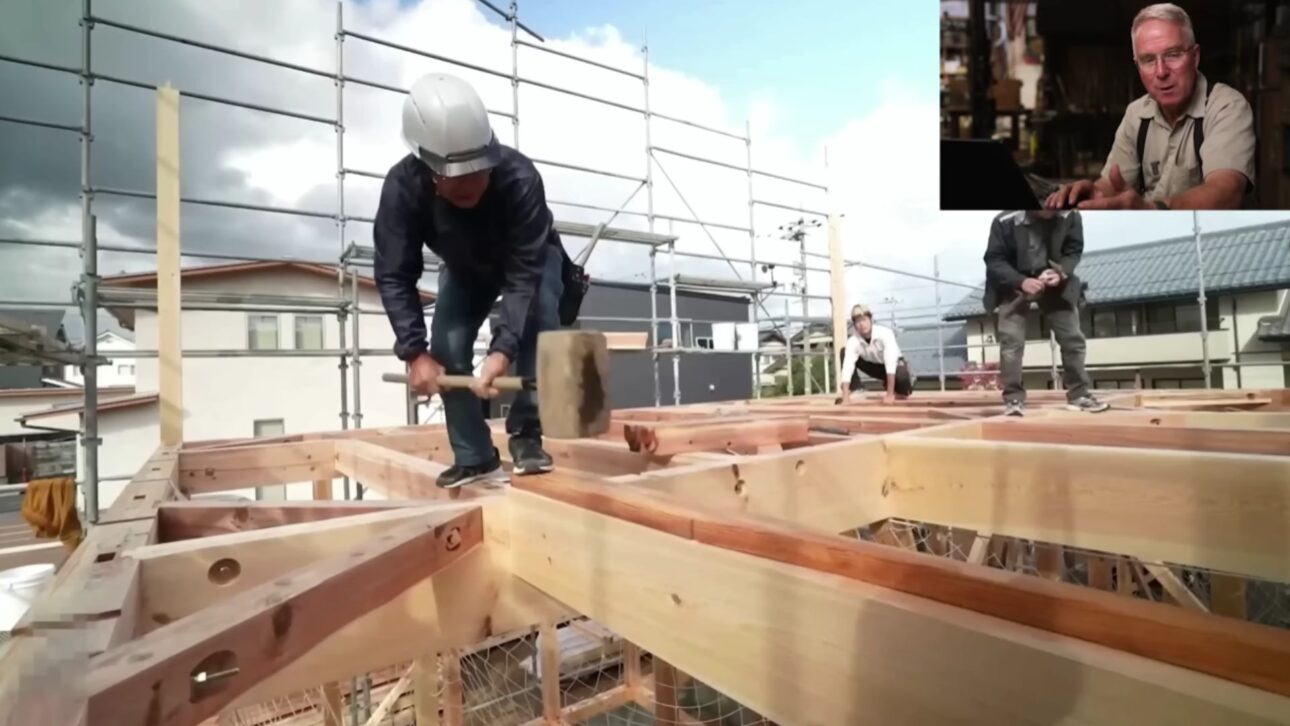
All the joints and connections that appear in the structural assembly had been hand-cut weeks before, individually, off-site. When the day came to raise the structure, the Japanese carpenter positioned each piece in a process that Wadsworth compares to solving a three-dimensional puzzle that only the builder knows by heart.
-
On the world’s highest navigable lake, the Uros people have hand-built around 100 floating straw islands, living on them for 3,000 years without concrete or foundations.

-
Newly Completed Brazilian Highway in the Serra da Rocinha Becomes a 16.5 km Cycling Challenge and Boost for Local Tourism

-
Innovative Mortar Technique Enhances Porcelain Tile Stability, Reduces Buckling and Detachment Risks, and Provides Durable Finish Under Heavy Use

-
Giant Robots Build Entire Neighborhood of 100 3D-Printed Homes in the U.S., Showcasing Technology’s Impact on Construction Industry



The pressure of this, in Showyan’s own words, was enormous. Any cutting error made weeks before would only be revealed at the time of assembly, in front of the entire team. A poorly calculated joint would mean redoing it. Showyan admitted he got nervous when someone mentioned his name during assembly. But the pieces fit together. Each one of them. Wadsworth paused the video at this moment and remained silent for a few seconds.
Knot-free cedar, hand planing, and a finish that sandpaper can’t reach
The wood used in the construction is Japanese cedar, and Wadsworth was particularly intrigued by the almost total absence of knots in the pieces. Throughout the video, as the internal panels were installed and the finishing boards appeared, he was looking for imperfections and rarely found any. He raised the question aloud: would this house be for the wealthiest one percent of Japan? Is it a common construction? What percentage of the Japanese population aspires to have something like this?
The finish of the surfaces also caught attention. Showyan uses hand planes to achieve the final result, removing very thin, almost translucent shavings until the surface is exactly as it should be. Wadsworth, who works with a sander to achieve the final finish, noted that the Japanese carpenter was planing to the finish, not close to the finish. The difference between the two approaches is subtle in description and enormous in result.
The curved handrail he himself admitted he wasn’t sure would look good
At a certain point in the series, Showyan installs a staircase handrail with a curved design. Before revealing the result, he says the idea was his, not the owner’s. He admits he wasn’t sure if the design would work. When the handrail is in place, he evaluates it himself and declares he made the right choice by challenging himself. Wadsworth paused the video at this part and simply commented: “Wow.”
The handrail would not comply with American building codes. Wadsworth acknowledged this and immediately said he didn’t care, because the result was simply perfect. This is the standard that runs throughout the series: the Japanese carpenter repeatedly solves problems with solutions that a Western contractor would hardly attempt, not for lack of skill, but for lack of cultural and aesthetic reference to get there.
Manual tools, electricity, and the question Wadsworth couldn’t answer


One of the points that Wadsworth explored with the most curiosity was the combination of manual and power tools that Showyan uses without hierarchy between them. Japanese chisels, hand planes, and steel hammers share space with cordless screwdrivers, electric planers, and construction cranes. The choice always seems to be for the most suitable tool for each moment, without attachment to one method or the other.
Wadsworth also noted the almost total absence of plywood in the project, both in the roof and in the internal finish. All he saw was solid wood glued panels or individual boards. He asked the viewers directly: does this happen because Japan does not manufacture plywood on a large scale? Is it a matter of tradition? Of material availability? There was no answer. But the question itself reveals how much the Japanese construction that Showyan documents operates outside the parameters that a four-decade veteran considers normal.
The son by his side and the permanence of the craft
In some moments of the series, Showyan appears with his son by his side. Wadsworth noticed this and mentioned it briefly, without much elaboration. But the comment remained: this guy is strong, intelligent, and is teaching his son. There is something in the way traditional Japanese construction is passed on that goes beyond technique, and Wadsworth, without needing to say it explicitly, demonstrated recognizing this throughout the entire review.
At the end of the video, he asked viewers to visit Showyan’s channel, called Showyan Japanese Carpenter, subscribe, and leave comments of appreciation. The conclusion he drew from five months of construction condensed into hours of video was simple and direct: wherever humans are and however they create the things that protect them from nature, there is always something to learn from each person. The Japanese carpenter from Osaka proved this point without needing subtitles.
The content is from the Essential Craftsman channel, by Scott Wadsworth, on YouTube.
Have you ever watched a video on Japanese construction or carpentry that changed your way of seeing woodworking? Or do you have any craft tradition from Brazil or another country that you consider on the same level? Leave it in the comments.