Portuguese
  Spanish


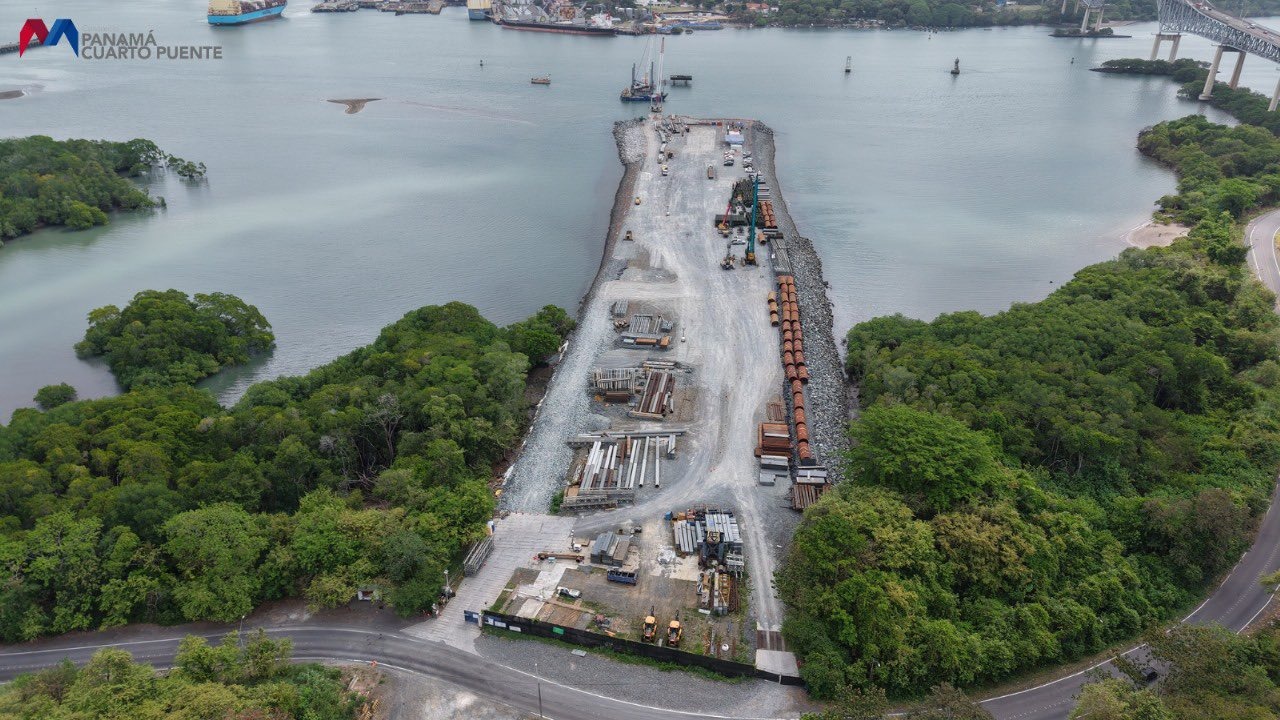


Fourth Bridge over the Panama Canal advances with six lanes, metro integration, and billion-dollar investment.
In Panama, one of the region’s most strategic infrastructure projects is starting to take shape: the Fourth Bridge over the Panama Canal. The project was conceived to address a growing problem in the metropolitan area of Panama City, the intense congestion between the capital and the western region of the country. The project includes the construction of a new crossing over the canal, one of the most important points of global trade. More than just a bridge, it is a structural intervention on one of the busiest logistical routes on the planet.
With an estimated investment between US$ 1.4 billion and values close to US$ 2 billion after revisions, the project has undergone technical and financial adjustments over the years, reflecting the complexity of the work.
Structure with six lanes and integration with mass transport expands the function of the crossing
The Fourth Bridge is designed to go beyond a simple road connection. The structure will feature six traffic lanes, distributed for light and heavy vehicles, in addition to space reserved for integration with high-capacity public transport.
-
Giant Robots Build Entire Neighborhood of 100 3D-Printed Homes in the U.S., Showcasing Technology’s Impact on Construction Industry

-
Helsinki Residents Receive Water That Travels 120 Kilometers Through a Hidden Rock Tunnel from a Lake Before Treatment

-
Brazil’s Sertão Region Nears Completion of Latin America’s Longest Artificial River, Transforming Water Access in Drought-Prone Ceará
-
Pre-mixed stabilized mortar set to revolutionize construction in 2026: extends usability to 36 or 72 hours, boosts productivity, and minimizes waste in building projects.



The project includes a connection with the metro system of the city, allowing the bridge to function as a multimodal corridor.


This feature significantly expands the impact of the work, which will not only act on road mobility but also on collective urban transport.
Panama Canal imposes technical challenges that increase construction complexity
Building over the Panama Canal involves unique challenges. The canal is not just a waterway, but an active route through which large vessels transit daily.
This requires the bridge to be designed not to interfere with navigation, maintaining appropriate height and spans for ships.
Additionally, the environment presents conditions of wind, humidity, and corrosion that demand specific structural solutions.
Project seeks to relieve pressure on existing crossings and improve urban mobility
Currently, the connection between Panama City and the western region relies on bridges and infrastructures that are already overloaded.
Population and economic growth have significantly increased vehicle flow, creating frequent congestion.
The new project emerges as an alternative to redistribute this flow, reducing travel time and increasing the capacity of the road network.
This improvement has a direct impact on the quality of life of the population and the efficiency of cargo transport.
Billion-dollar investment reflects the strategic importance of the work for the national economy
The high value of the project is directly linked to its economic relevance. The Panama Canal is one of the country’s main assets, responsible for connecting global trade routes.
The improvement of infrastructure around the canal strengthens its strategic position, facilitating land access and integrating regions.
Moreover, the work is expected to generate jobs and stimulate sectors related to construction and engineering.
Participation of international companies highlights the global dimension of the project
The execution of the Fourth Bridge involves international consortia, including large companies in the construction field.
This type of partnership is common in high-complexity projects, where the following are necessary:
- Specialized technical knowledge
- High financial capacity
- Experience in large-scale works

The presence of global companies reinforces the technical demanding level of construction.
Project is part of a broader urban expansion and modernization strategy
The project is part of a set of initiatives aimed at modernizing Panama City’s infrastructure. Among the objectives are: Improve urban mobility; Integrate public transport and Increase logistical efficiency.
These actions seek to keep pace with the city’s growth and its regional economic importance. As is common in large-scale projects, the Fourth Bridge underwent revisions over time.
These adjustments involved:
- Cost redefinition
- Project alterations
- Contractual negotiations
These changes reflect the complexity of executing a project of this scale in an active and strategic environment.
What’s at stake with the construction of a new crossing over the Panama Canal
The new bridge represents more than a mobility solution. It alters the dynamics of access to the canal, impacts the local economy, and strengthens the infrastructure of one of the most important points in global trade.
At the same time, it shows how large urban centers need to adapt their infrastructure to keep pace with growth and demand.
The Fourth Bridge raises a relevant question about urban planning. Large-scale infrastructures can alleviate bottlenecks, but they can also stimulate new flows and demands over time.
The project is still underway, but it already represents one of the most important interventions in the region. The direct question remains: to what extent can a single bridge transform the mobility of an entire city connected to one of the planet’s most strategic trade routes.