Portuguese
  Spanish


Workers were digging electrical cables in Hostynne when the shovel hit metal. The buried object was a historic church bell, in a surprising state of preservation, that still produces sound after decades under Polish soil.
It was an ordinary, routine work, with no promise of surprise. On May 22, 2026, a team of workers was digging trenches on the shoulder of Municipal Road No. 111324L, in the village of Hostynne, in eastern Poland, to install street lighting cables. The shovel hit metal. The metal was not a pipe, not a structure, nothing anticipated in the project. It was a church bell — intact, with an iron clapper inside, producing sound when struck.
The object was buried about 230 meters from the historic Church of Hostynne. No one had reported its existence before, despite previous construction and agricultural activities in the same area. For decades, the bell was just a few meters below the surface while tractors passed above, without anyone knowing.
A bell that still rings — and kept its secrets underground
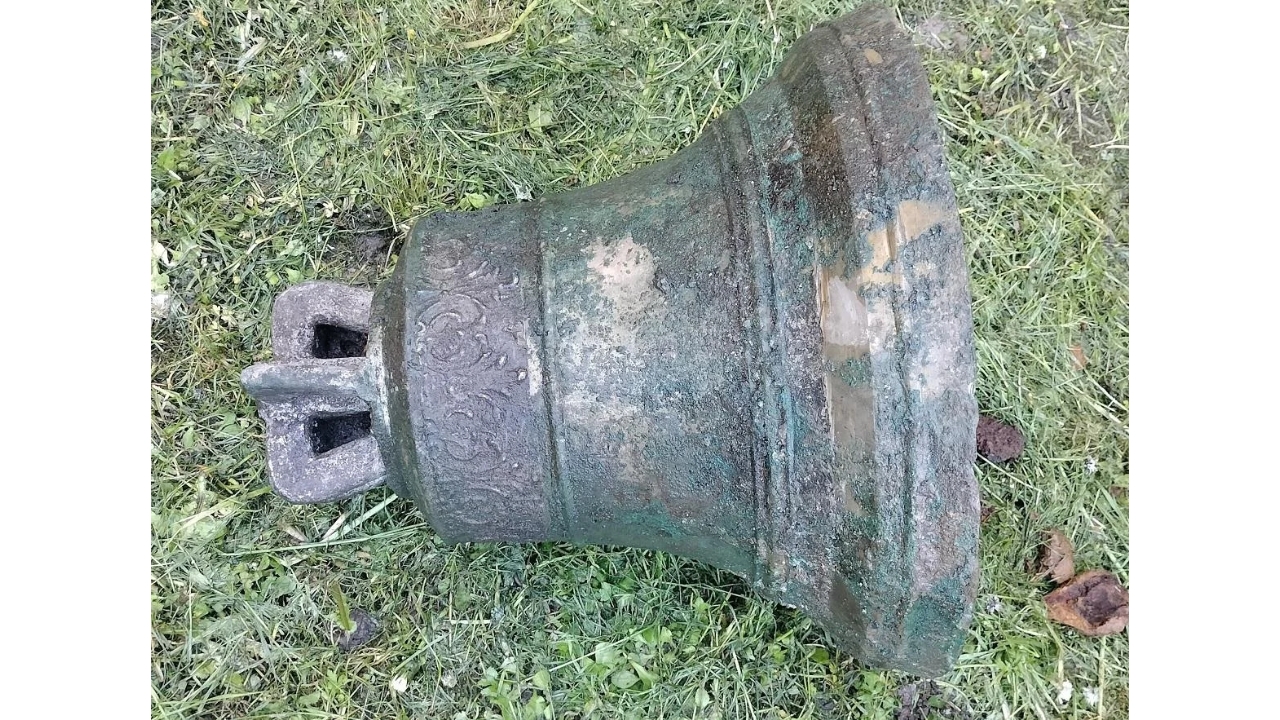
After the discovery, the local authorities isolated the area and called the Conservator of Monuments of the Lublin Voivodeship, who sent specialists to inspect both the artifact and the exact excavation site. What they found surprised the researchers: an object in remarkable state of preservation.
-
Brazilian Man Ingeniously Transforms Air Fryer into Functional Speaker with Radio and Volume Controls

-
Rows of “stone balls” emerge at low tide on California beach, with formations up to 1.5 meters aligned like a Pacific bowling alley

-
Japan Installs 800 Cameras in Tohoku Mountains Amid Rising Bear Attacks

-
Workers Installing Fiber Optics in French Town Discover 75 WWII-Era Concrete Training Bombs, Each Weighing 250 Kilograms




Cast in brass, the bell measures 41 centimeters in height and 43 centimeters in diameter at the mouth. The iron clapper remains intact inside. No cracks or structural damage were identified. Tests conducted on-site confirmed what seemed unlikely: the bell still produces a clear and uniform tone — softened by prolonged contact with the soil, but unmistakable.
Decorative elements survived the years of burial. A band of floral ornaments encircles the crown of the bell, and raised rings appear at the bottom. Corrosion covers part of the surface, but experts believe that cleaning and conservation efforts may reveal inscriptions, casting dates, or manufacturer marks still hidden.
Centuries of conflict engraved in the history of Hostynne
To understand why a bell might have been buried there, it is necessary to know the centuries of turmoil that shaped that region. Hostynne appears in written records for the first time in 1394. Documents from 1472 already mentioned a church on the site, probably a wooden structure destroyed by Tatar invasions in the early 16th century.
In 1732, a new wooden church dedicated to Saint George was erected with the support of the noble Jerzy Michał Sapieha. In the 19th century, the temple was transformed into an Orthodox church, and between 1889 and 1890 the wood was replaced by a brick construction. Researchers suspect that the newly found bell dates precisely from this period of reconstruction, when new churches received bells and liturgical furniture.
The World War I hypothesis — and the metal confiscated for war
The reason why the bell was buried remains unknown. The most raised hypothesis by experts points to 1915, when Austro-Hungarian forces occupied the region and systematically confiscated bronze and brass objects for military use. According to conservators, residents may have hidden the bell to save the sacred metal from the war furnace, but no documentation confirms this version so far.
Other time windows are also considered by researchers. Campaigns against Orthodox churches swept the region between the 1920s and 1930s. The Second World War brought a new round of destruction, occupation, and forced displacement. Experts do not rule out any of these periods as a possible time of burial.
The disappearance of memory — how a war erased the trace of the bell
The silence surrounding the bell is not accidental. Stories about hidden bells circulated among the residents of Hostynne for generations, passed in hushed tones from family to family. But these stories lost their thread after the Ukrainian population of Hostynne was displaced in the post-war period.
The deportations of 1946 emptied the community that kept the living memory of where the objects had been buried. The families who knew left, and the secrets went with them. The church itself suffered heavy damage during the Second World War, and when it was reconsecrated by the Roman Catholic Church, it underwent renovations in 1964 that removed Orthodox architectural elements — erasing yet another layer of the building’s original history.
What happens now with the bell
The Monument Conservator of the Lublin Voivodeship has taken custody of the artifact. The authorities of the Werbkowice commune announced that the bell will be restored and displayed to the public in a specially designed shelter at the future Werbkowice Crisis Management Community Center.
Experts hope that deep cleaning will reveal still invisible information — dates, foundry names, or religious inscriptions — that may definitively connect the object to the Church of Hostynne and, perhaps, identify who buried it and at what exact moment in history.
Whoever hid the bell knew they were risking their own life to guard something they considered sacred. They never returned to retrieve it. Decades of wars, deportations, and silence passed over that metal until a common shovel opened the ground and returned what history had swallowed.