Portuguese
  Spanish


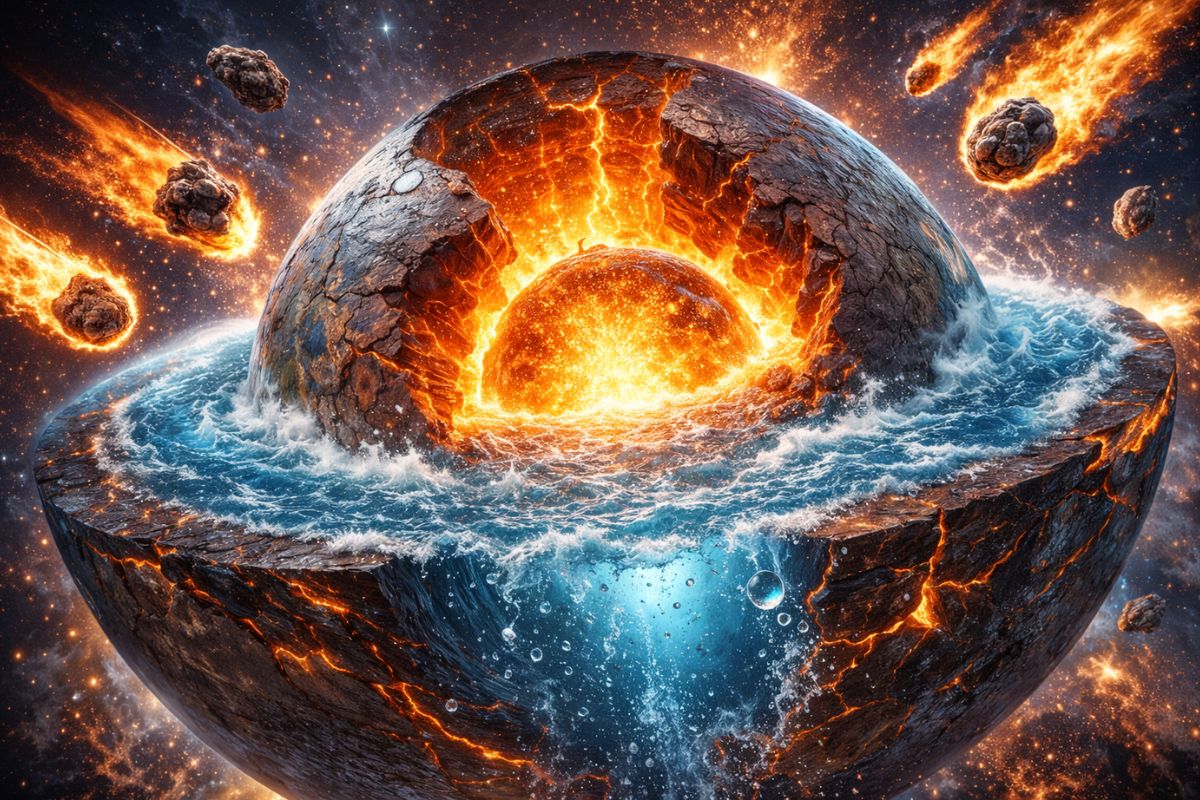


A research published in Nature Communications found that the Earth’s core contains between 0.18% and 0.49% of hydrogen and up to 1.37% of carbon, representing more than 95% of the total stocks of these elements on the planet. The study also reveals that carbonaceous meteorites were essential to provide the water that exists today on Earth.
The Earth’s core holds a secret that challenges intuition: most of the water and carbon that exist on the planet are not in the oceans, the atmosphere, or the forests, but thousands of kilometers deep, trapped in the liquid iron that makes up the center of our world. A study conducted by researchers at the University of California, Riverside, and published in Nature Communications used high-pressure experiments in diamond anvil cells to simulate the conditions of the Earth’s core formation and found that more than 95% of all hydrogen and more than 97% of all carbon on the planet may be stored in the core, incorporated into liquid iron under extreme pressures and temperatures.
This discovery changes the way scientists understand the composition of the Earth’s core and the origin of the essential elements for life. The models developed by the team show that the building blocks of our planet cannot be explained solely by enstatite chondrites, the type of meteorite that most closely resembles the isotopic composition of Earth. The contribution of carbonaceous chondrites, water- and carbon-rich meteorites that likely arrived in the final stages of the planet’s formation, was necessary to explain the amounts of hydrogen and carbon that the Earth’s core contains today.
What researchers found in the Earth’s core
Scientists conducted ten distinct fusion experiments at pressures between 33 and 56 gigapascals and temperatures of up to 4,760 Kelvin, conditions that reproduce the environment where the Earth’s core formed billions of years ago. For the first time, they simultaneously measured how hydrogen and carbon distribute between liquid metal and molten silicate, discovering that these two elements interact strongly when together in liquid iron, which significantly alters the results compared to previous measurements made separately.
-
For the first time, scientists have seen the ocean floor open up in real-time—plates moving apart by two meters in a few days and 160 million cubic meters of lava emerging on the seafloor.

-
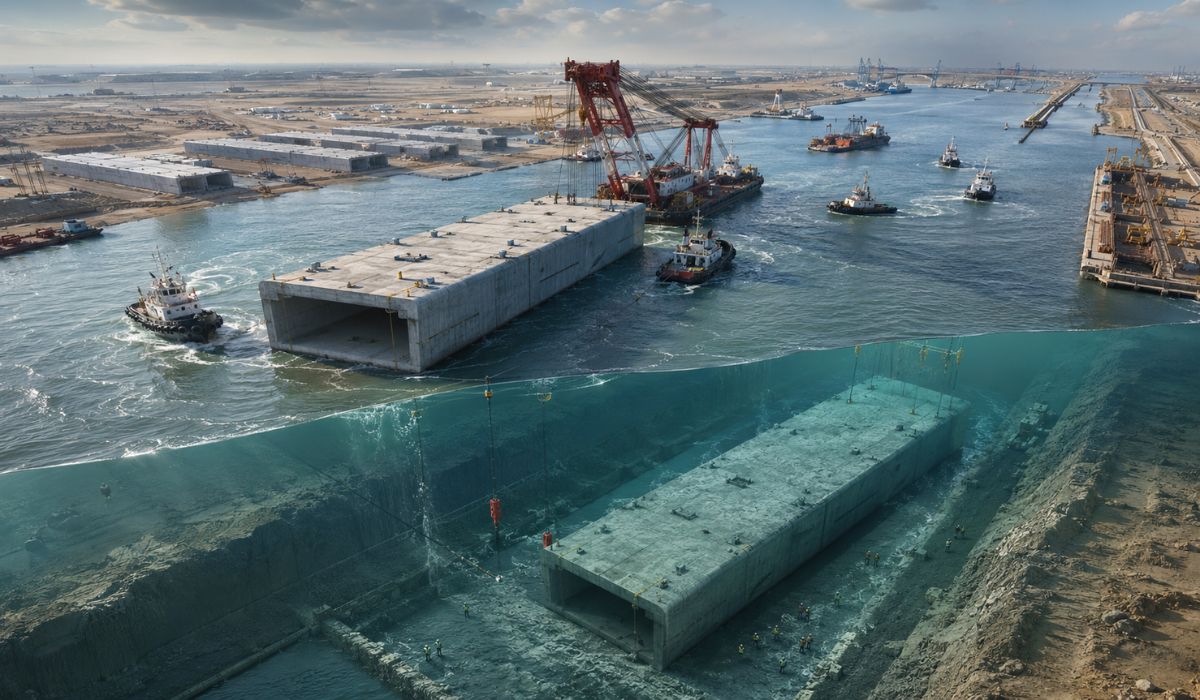
Iraq floats and sinks under an arm of the Euphrates 10 giant concrete boxes of 46,000 tons and 125 meters each to assemble a 2.4 km submerged tunnel and open a new land route between Asia and Europe.

-
Scientists use more than 20,000 artificial birds and solar speakers to “trick” seabirds, reactivate nesting routes, and revive a colony on an island that seemed abandoned.
-
She spent 73 years breathing inside an iron lung, survived the aftereffects of polio, and became the last woman in the United States dependent on the equipment before dying at 78 years old.



This interaction is the key to the research. When hydrogen and carbon coexist in liquid metal, each one’s affinity for iron decreases compared to what is observed in isolation, meaning that previous estimates about the composition of the Earth’s core were calculating incorrect amounts of these elements. With the new partition coefficients, models indicate that the Earth’s core contains between 0.18% and 0.49% of hydrogen by weight and between 0.19% and 1.37% of carbon by weight, making it the largest reservoir of these elements on the planet.
Why most of the Earth’s water is in the core and not in the oceans
The entire ocean contains a tiny fraction of the total hydrogen on the planet compared to what is dissolved in the Earth’s core. The hydrogen present in the core amounts to between 0.53% and 1.40% of the Earth’s total weight in the form of water, an amount that surpasses by orders of magnitude everything that exists on the surface, in the atmosphere, and in the mantle combined. The reason is that hydrogen is strongly siderophile under high pressure, meaning it has a great affinity for iron, and during the planet’s formation, it was dragged to the center along with the metal that separated from the silicate.
This discovery does not mean there is a hidden liquid ocean inside the planet. The hydrogen in the Earth’s core exists as atoms dissolved in liquid iron, occupying spaces between the iron atoms under pressure and temperature conditions that do not allow the formation of water as we know it on the surface. But from a planetary accounting perspective, the Earth’s core is where the overwhelming majority of the hydrogen in our world resides, a fact that fundamentally changes the understanding of the water cycle on a geological scale.
The origin of the meteorites that brought water and carbon to Earth
One of the most relevant results of the study is about the origin of these elements. The models show that enstatite chondrites, the type of meteorite that most closely resembles the isotopic composition of Earth, do not contain enough water to explain the amounts of hydrogen found in the Earth’s core and mantle. This means that Earth needed contributions from carbonaceous chondrites, meteorites coming from more distant regions of the solar system that carry significantly larger amounts of water and carbon.
The researchers combined their partition data with the four-stage accretion model proposed by Dauphas and collaborators, which uses isotopic compositions to reconstruct how Earth was assembled. The results indicate that up to 53% of the water and up to 72% of the carbon on the planet may have come from non-carbonaceous materials, such as enstatite chondrites and ordinary chondrites. The remainder was provided by carbonaceous chondrites that arrived mainly in the last 25% of Earth’s formation, a scenario that resolves the apparent contradiction between the planet’s isotopic composition and its abundance of volatiles.
How the study changes the understanding of the Earth’s core formation
Previous research had already estimated the amounts of hydrogen and carbon in the Earth’s core, but the results were inconsistent because they measured the partitioning of the two elements separately. This study is the first to simultaneously measure how hydrogen and carbon behave in liquid iron under core formation conditions, and the discovery that they interact strongly with each other partially invalidates previous estimates.
In practice, the presence of carbon in liquid metal reduces the amount of hydrogen that iron absorbs, and vice versa. The partition coefficients obtained when the two elements are measured together are markedly different from those obtained separately, which explains why previous studies reached contradictory conclusions about the composition of the Earth’s core. With the new data, scientists can model more accurately not only the current composition of the core but also the history of how the planet formed and where the ingredients that made life possible came from.
What the study means for the understanding of water and carbon on the planet
The central conclusion is that the Earth’s core is the main reservoir of both hydrogen and carbon on the planet, with more than 95% of the total stocks of both elements. Multi-stage formation models, which are more realistic than simplified models, indicate that Earth as a whole contains between 0.53% and 1.40% of water by weight and between 0.07% and 0.44% of carbon by weight, amounts that need to be explained by a combination of different types of meteorites that accumulated over millions of years.
Beyond geology, the research has implications for the search for life on other planets. If most of a rocky planet’s water can be trapped in its core during formation, the amount of water available on the surface depends not only on how much water the planet received but also on how it was distributed between the metallic core and the silicate mantle. The Earth’s core hides most of the essential ingredients for life, and understanding how this happened here can help predict where else in the universe these ingredients reached the surface.
The Earth’s core hides more than 95% of all the water and carbon on the planet. Did you imagine that most of the Earth’s water is not in the oceans? What else surprises you about the interior of our planet? Leave your opinion in the comments.