Portuguese
  Spanish


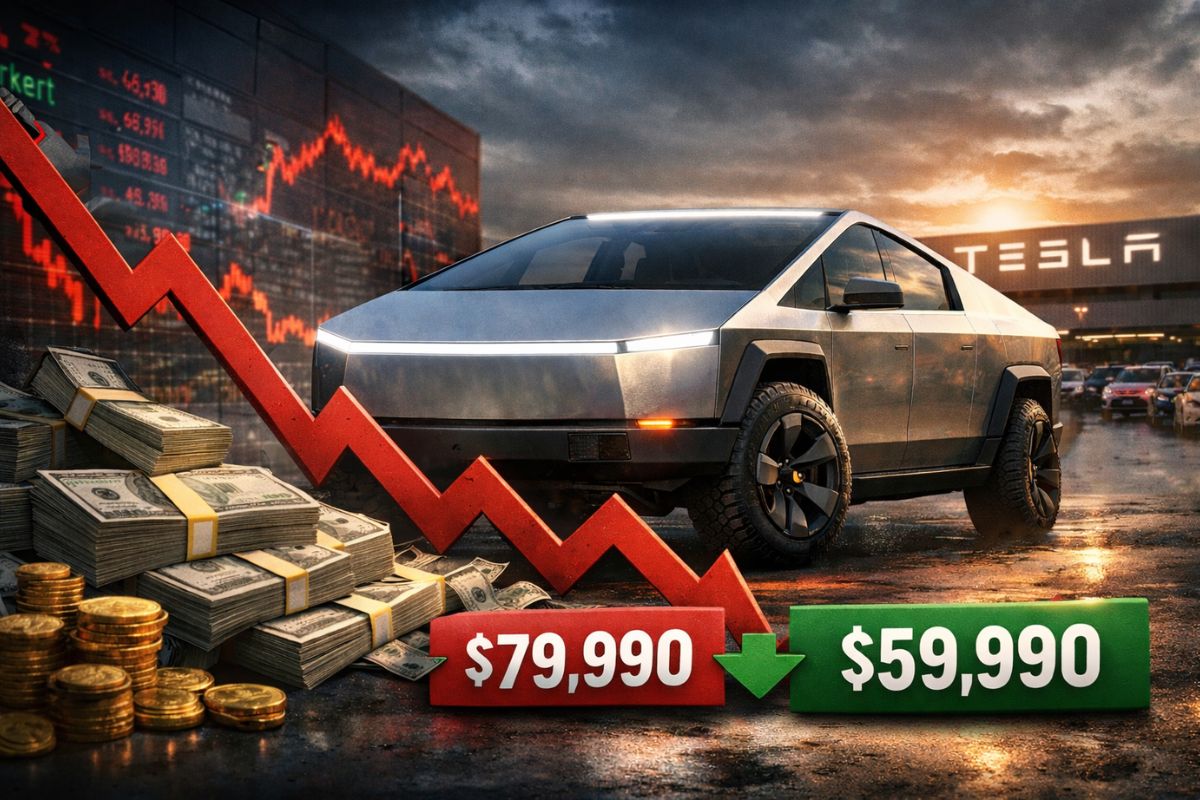


With weak sales and smaller incentives, Tesla repositions the Cybertruck in the U.S.: the entry-level version drops to US$ 59,990, the Cyberbeast falls to US$ 99,990, and other models receive up to US$ 15,000 in discounts, while in Brazil, imports remain close to R$ 1 million in retail.
Tesla decided to adjust the price of the Cybertruck as if trying to stop a bleeding: by opening the discount faucet, the automaker aims to rekindle interest in a pickup that has become a symbol of technology but faces demand below expectations. When a brand of that size cuts so deep, the message typically goes beyond the showroom.
In the United States, the new version starts at US$ 59,990, well below the previous US$ 79,990, and the top-of-the-line Cyberbeast drops from US$ 114,990 to US$ 99,990; meanwhile, other configurations receive discounts of up to US$ 15,000. In Brazil, without an official operation, the path remains independent imports, with prices approaching R$ 1 million, which turns the pickup into a mobile showcase rather than a volume product.
The Price Cut That Redesigns the Cybertruck
Tesla’s decision to create a cheaper Cybertruck is not just a label change: it is a repositioning.
-
Fiat Strada Becomes Top Seller in June, Surpassing Onix, Polo, Hilux, and T-Cross with 107 HP Engine and 732 km Range.

-
Suitcase-sized hydrogen engine spins at 25,000 rpm, nearly doubling the efficiency of conventional cars and replacing exhaust smoke with water vapor

-
1983 Chevrolet Runs Over 100,000 km Without Gasoline, Powered by Wood Chips, Reaches 125 km/h in Airport Test

-
Workshop Converts Giant Tractor Tire Tricycle into a Three-Wheel Drive Hybrid with 36,000-Watt Electric Motor Capable of Climbing Hills




By lowering the price from US$ 79,990 to US$ 59,990 for the entry-level model, the company tries to widen the buyer funnel and reduce the gap between curiosity and purchase, especially in a segment where the final price is usually the first filter, even when there is technological appeal.
The reduction of the Cyberbeast to US$ 99,990 is also noteworthy. Discount on the top-of-the-line version smells like demand adjustment, because that is where, in theory, the most enthusiastic customer would be willing to pay more for the image, exclusivity, and complete package.
When even the “halo car” needs incentives, it’s hard to interpret the move as merely promotional.
If the decision is strategic, Tesla tries to preserve the narrative of innovation without letting the Cybertruck become too expensive for its own category.
If the decision is defensive, the discounts serve as a quick response to an uncomfortable reality: a product with a lot of attention but with lower turnover than necessary to sustain pace, factory, and margin in the long term.
The Chill of Electric Vehicles in the U.S. and China and the Domino Effect
The backdrop helps to understand why Tesla is adjusting prices now. In January, global sales of electric and hybrid vehicles fell by 3% compared to January 2025, according to data attributed to consulting firm BMI.
The most relevant detail lies in the regional breakdown: China recorded a 20% drop, and North America, a 33% decrease, with the United States having the worst registration result for electrified vehicles in January since 2022.
This context is a headwind for any manufacturer but weighs even more on those seen for years as the sector’s thermometer.
When the market slows down, consumers become more sensitive to price, financing, and total cost, and the competition tends to shift from “who is more futuristic” to “who delivers more for less”. This is precisely the type of change that pushes a company like Tesla toward short-term measures, such as aggressive discounts.
The reasons cited for the cooling also point to a structural adjustment, not just seasonal. In the United States, the withdrawal of tax incentives for electrified vehicles appears to be an important explanation for the decline. In China, in addition to subsidy cuts, a recent tax was created for the purchase of these vehicles.
When incentives decrease, the “true” price appears more prominently, exerting pressure across the entire chain, from the popular model to the aspirational car.
Still, the scenario is not uniform: Europe and other markets registered increases in sales. This reinforces that Tesla is dealing with a combination of factors, and that the Cybertruck, in particular, may be feeling the weight of a more selective market, with fewer impulse purchases and more rational comparison.
Brazil in Counterpoint and the Cybertruck as an Expensive Object of Desire
Brazil enters this story almost as a contrast. According to the G1, in 2025, the country recorded a 26% increase in sales of electric and hybrid cars, in the opposite direction of the decline mentioned for January in markets like the U.S. and China. This difference alone suggests that the appetite for electrified vehicles may grow even when other regions hit the brakes, but that does not mean all products benefit from the same boom.
Without an official Tesla operation here, the Cybertruck exists in another universe: that of independent importation, where the price can exceed R$ 1 million. The same pickup that becomes “more affordable” in the U.S. remains unattainable for almost everyone in Brazil, and this distance creates a curious effect: the model gains fame, video, curiosity, and status, but does not gain scale. It is a presence that draws attention on the streets and online, but does not actually alter the Brazilian market.
This mismatch also helps explain why the subject of “discount” resonates so much in Brazil: it is seen from the outside as a thermometer of a crisis or a strategic shift, rather than a real buying opportunity. For those following electrified vehicles in the country, the lingering question is simple and uncomfortable: if Tesla cuts prices to stimulate demand elsewhere, what would make sense in Brazil without an official network, support, and local operation?
The Leadership That Changed Hands and Elon Musk’s Agenda
There is another important element in this equation: the change at the top of the global ranking. In 2025, Tesla registered 1.64 million units sold, a 9% drop, and ceased to be the largest electric vehicle manufacturer in the world.
BYD took the lead with 2.26 million electrified vehicles sold in the same year. In narrative terms, this removes from Tesla a symbolic title it has long used as proof of strength and trend.
This type of shift usually generates two simultaneous movements within a company: tactical adjustments to achieve quick results (like pricing) and reinforcing the discourse about the future (to keep investors and fans engaged). This is where Elon Musk’s posture comes in, which, according to provided information, does not seem to bet the entire future of Tesla exclusively on selling cars.
The vision presented positions autonomous taxi service, energy storage, and domestic robots as central pillars.
Along this same path, there is an indication that factories currently associated with Model X and Model S could be used to produce robots.
When an automaker talks about robots as the destination of its factory, it is effectively saying that the identity of the business is changing. For part of the audience, this sounds like ambition; for another, it comes across as an attempt to reposition expectations in a time of commercial pressure.
Politics, Image, and Billion-Dollar Goals: What’s at Stake
The image crisis also appears as a backdrop. The described scenario indicates turbulence since Musk showed support for Donald Trump’s election, became part of the cabinet, and then saw the relationship deteriorate into a conflict that culminated in his departure from the government.
Subsequently, the former ally began attacking the economic policies adopted by the United States. Even without taking sides, it is difficult to separate brand and leadership when the leader becomes political news, and this type of noise can affect confidence, purchase intention, and risk perception.
At the same time, the relationship with shareholders seems to have a different mindset: in November 2025, Tesla’s shareholder meeting approved the payment of US$ 878 billion to Musk, conditioned on achieving goals over a 10-year horizon.
Among the cited objectives are delivering 20 million vehicles, operating 1 million robotaxis, selling 1 million robots, and achieving US$ 400 billion in operating profit.
It is a package that, on one hand, signals support for the company’s transformation into a powerhouse of AI and robotics; on the other, sets an extremely high benchmark that tends to amplify any short-term stumbles, such as sales below expectations or the need for discounts.
In this environment, the Cybertruck’s price cut can be viewed as a piece on a larger board. Tesla attempts to react to the cooling market and advancing competition without abandoning the future narrative that maintains its symbolic value. The problem is that the present demands a high price: when the market cools, the price tag becomes an argument.
Tesla chose to respond to the drop in electric vehicle sales with a clear gesture: lower prices and more aggressive discounts on the Cybertruck, even on higher-end versions.
In a market pressured by cuts in incentives and rising competition, this move could be a strategy to unlock demand or a sign that the company needs to accelerate adjustments to maintain momentum while redesigning its future in robotaxis, energy, and robotics.
And here comes the more human side of the story: for you, is a big discount an opportunity or a warning? If Tesla were to officially enter Brazil and the Cybertruck were to cost well less than R$ 1 million, would it make sense in your daily life or would it still be a “showroom car”? What weighs more in your decision: price, technology, after-sales, or how leadership behaves outside the automotive world?