Portuguese
  Spanish




Elon Musk has once again sparked the debate about the energy future of the United States by arguing that the entire energy consumption of the country could be supplied solely by solar energy. For the entrepreneur, there’s no mystery: we have a fusion reactor functioning for free for billions of years, shining above our heads. We just need to make better use of the Sun. During a conversation on the podcast The Joe Rogan Experience, the CEO of Tesla and SpaceX stated that a gigantic photovoltaic installation of approximately 160 by 160 kilometers would be sufficient to cover all of America’s energy demand.
The statement has the typical impact of Musk’s declarations, but it’s not just provocation. Although it seems grandiose, the proposal fits into a much broader global movement, involving everything from solar megaprojects on land to serious research on energy conversion in space.
The Superplant That Could Feed a Country
In discussing the subject with Joe Rogan, Musk described a simple scenario: choose a remote area, occupy about 25,600 km² with solar panels, and send that energy across the country with the support of storage systems. This statement left the host intrigued, who even asked if it was really possible to supply the entire USA from a single point. Musk was direct in responding:
-
Lenovo Unveils Legion Y700 Tablet with RGB Backlighting, 5G, and SIM Card Support

-
World’s First Nuclear Hydrogen Unit Begins Operation: Copper-Chlorine Technology with Initial Capacity of 150 Liters per Hour, Aiming for 3,000 Liters per Hour
-
Mechanics Retrofit Old Fiat Uno with BYD Electric Motor for Silent, Low-Voltage Operation Reaching Nearly 60 km/h in Home Test
-
Free Internet Begins Testing in São Paulo Metro Stations, Network-Wide Rollout Expected by 2026


“Absolutely. A large battery set would be needed, but it works. We have a giant fusion reactor in the sky.”
The entrepreneur’s vision does not come out of nowhere. It is part of a philosophy he has advocated for years, which goes far beyond words. Tesla, for instance, has already made energy storage a central pillar of the business, with lines such as Powerwall and Powerpack, designed specifically to ensure energy autonomy for homes, industries, and cities.

Tesla’s Solar Strategy and the Explosive Growth of the Sector
In 2016, Musk firmly established Tesla’s entry into the sector by acquiring SolarCity for about US$ 2.6 billion. Since then, the company has become one of the most influential names in integrated solutions that combine solar panels, batteries, and smart distribution systems.
And the timing couldn’t be more favorable for this type of expansion. According to projections from the Solar Energy Industries Association and Wood Mackenzie, the United States is expected to install 32 GW of new solar capacity just this year, a jump of 53% compared to 2022. By 2028, the estimate is that the country will surpass 375 GW of operational capacity. Europe follows a similar pace, indicating an ongoing global transformation.
Megaprojects and the Ambition to Capture Energy from Outside Earth
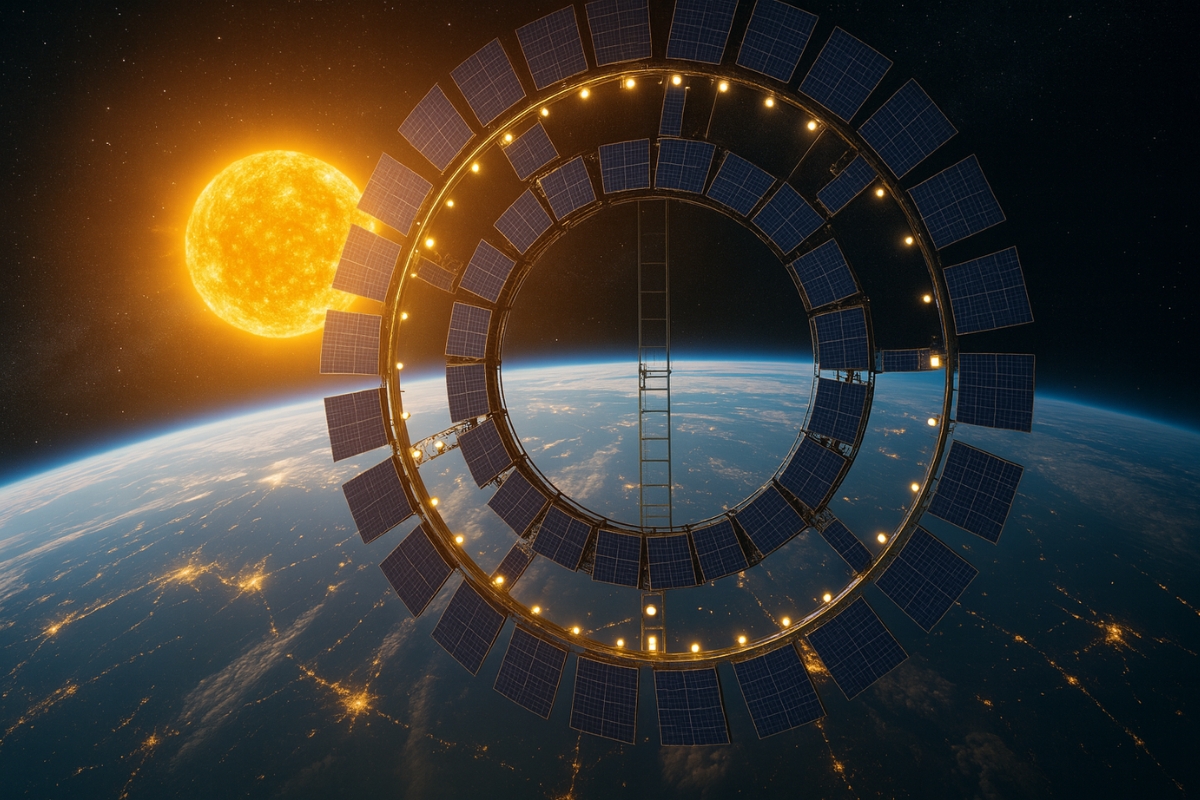
Musk’s idea is not the most futuristic on the list. While he advocates for a photovoltaic superplant installed on American soil, other agencies are studying something even bolder: to generate solar energy directly in space.
The European Space Agency (ESA) has been working for years on the hypothesis of developing SBSP (Space-Based Solar Power) systems. In practice, this would mean using enormous satellites in geostationary orbit to capture sunlight without atmospheric or climatic interference. This energy would be converted into low-density microwaves and sent to giant receiving antennas on Earth.
It may seem like science fiction, but the project is being taken seriously. The ESA initiative SOLARIS was created specifically to assess the technical and economic viability of this approach. The challenges are immense: assembling colossal structures in space, developing giant ground antennas, and studying the environmental impact of microwaves.
The Japan Aerospace Exploration Agency (JAXA) has also been researching this topic for decades. In the 1990s, JAXA’s predecessor even designed the SPS2000, a 10,000 kW system. By the 2000s, Japan proposed a conceptual module of 1 million kW, keeping interest in this type of technology alive.
NASA and China are also investigating similar solutions. In 2024, NASA confirmed internal studies on the viability of SPS, highlighting that recent technological advances could make these systems economically attractive in the near future.


The Race for Mega Solar Plants Here on Earth
While space is still a distant goal, countries like China are already constructing gigantic installations on their territory. One of the most ambitious examples is in Inner Mongolia, where 196,000 panels occupy 1.4 million square meters, forming the largest solar station ever installed in a desert.
Tesla is also involved in large-scale projects in the USA and other countries, reinforcing the idea that the sector is experiencing a phase of accelerated expansion.
When Science Fiction Inspires Real Science
No megaproject surpasses the concept of the Dyson Sphere, proposed by physicist Freeman Dyson in the 1960s. The idea was to build a structure that would completely enclose a star — in this case, the Sun — capturing nearly all its energy. Today, the sphere is a reference in discussions about advanced civilizations and has inspired numerous theoretical studies.
The comparison serves only to illustrate the magnitude of human ambition when it comes to energy. Between a 160 km superplant and the construction of orbital structures, what Musk proposes seems almost modest.