Portuguese
  Spanish


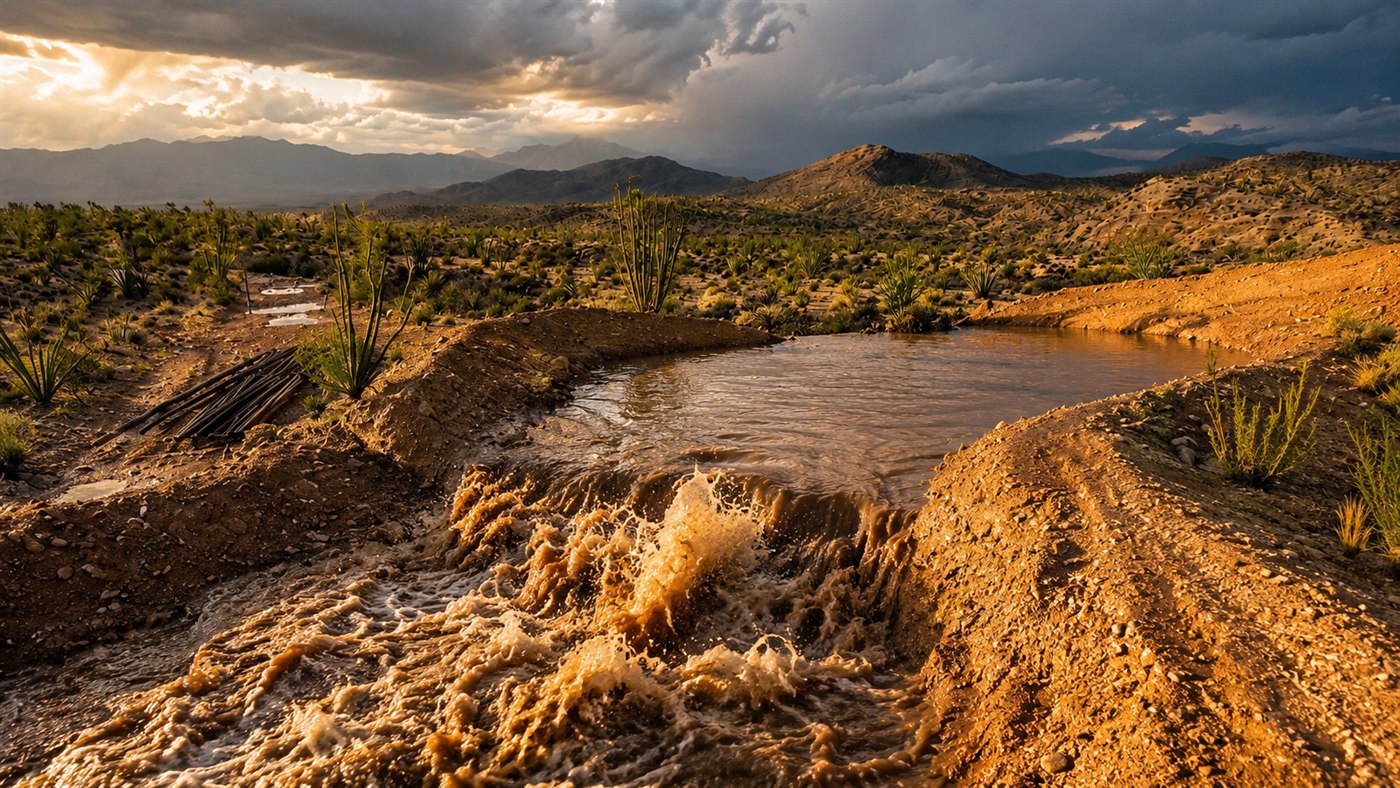

The DUSTUPS record shows the structure that held the 15 thousand gallons and drained in less than 24 hours, the 100 dikes erected by 6 volunteers in a week and the goal of planting a forest where there was only stone before
Transforming a piece of desert into a forest seems impossible, but the secret is not letting the rain go away. According to the channel DUSTUPS, in an episode published in June 2026, a single downpour filled a water catchment structure that held about 15 thousand gallons, equivalent to more than 56 thousand liters, on a remote ranch 38 miles of dirt road away.
The most impressive part came the next day. The structure, nicknamed the canyon swale, held the 15 thousand gallons and drained completely in less than 24 hours, proof that the water infiltrated the soil without drowning the roots and still left oxygen in the earth for planting, as DUSTUPS records. Water that disappears too quickly is waste; water that stays too long rots the plant. The optimal point is precisely this: fill, infiltrate, and empty.
Water catchment that becomes savings in the desert
The philosophy of the project is simple to state and difficult to execute. According to DUSTUPS, the strategy is to spread all kinds of water catchment structures across the ranch, from terraces to dikes, to slow the downpour before it descends dragging the soil and creating erosion.
-
16 kWh Solar Battery Powers Entire Home Off-Grid, Lasts Over 22 Years with 8,000 Cycles, Delivers 10,000 Watts for Appliances

-
Drones Can Now Detect Underwater Mines Hidden by Sand and Algae Using Aerial Images, Special Light, and AI

-
Helicopters Drop “Green Rain” of Seeds Over Remote U.S. Forests to Reforest 19 Hard-to-Reach Areas in Minnesota, Reviving Pine Trees Where Ground Teams Struggle to Access

-
Brazilian Man Builds Homemade Welding Machine Using Parts from Old Microwaves, Achieving Over 100 Amperes





The numbers at the start of the season are already encouraging. Just at that canyon point, the project accumulated 25 thousand gallons of water right at the beginning of the rainy season, more than the 20 thousand gallons that another structure, the “cave hole,” captured in the entire previous year, as DUSTUPS compares. It’s the difference between a desert that loses all the rain in a downpour and land that started to save each rain event like someone saving for the drought that comes after.
Small dams, gabions, and fake beaver dams
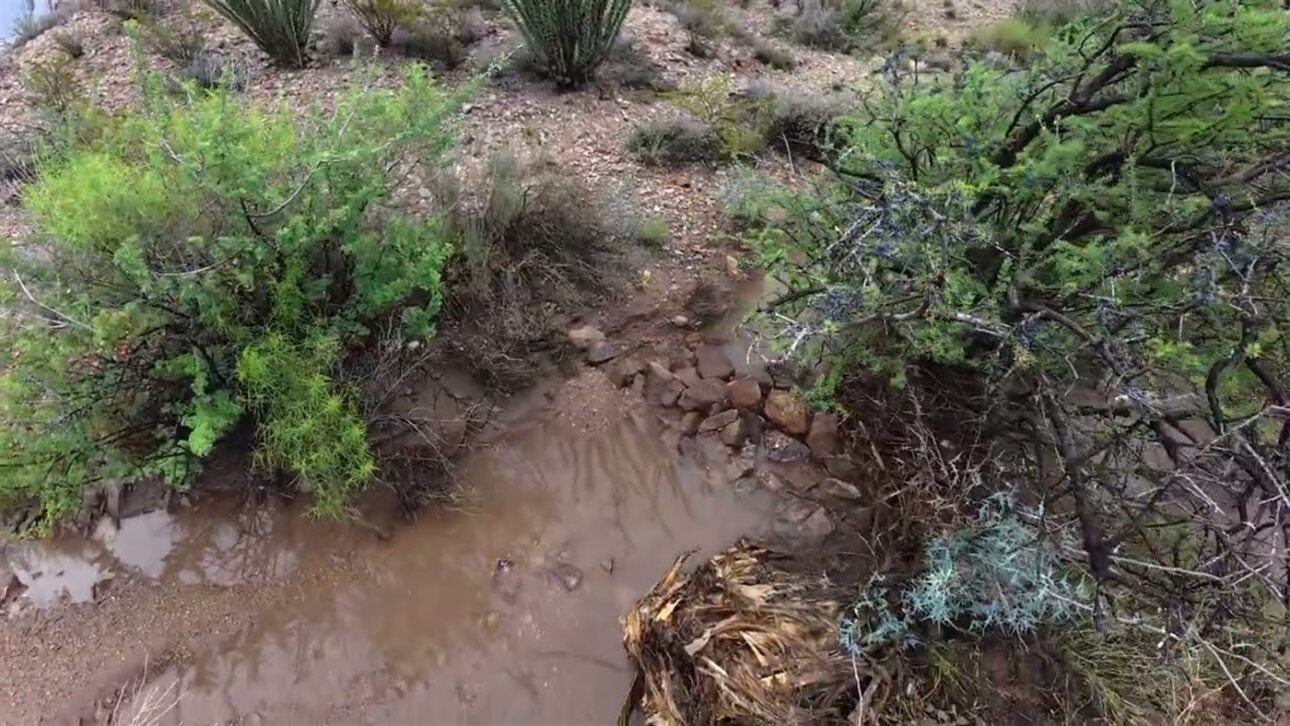
The arsenal of structures has technical names and clear functions. According to the DUSTUPS channel on YouTube, the ranch uses swales (level infiltration ditches), check dams (small containment dikes, known as barraginhas), gabions (stone cages), and the so-called BDAs, beaver dam analogs, structures that mimic the damming that beavers do in streams.
Each piece has a role in the water puzzle. The small dikes slow down and infiltrate the runoff uphill, relieving pressure on the main channel even before the water gets down there, and a gabion at the point called Lone Tree changed the course of the water to flood and nourish the tree that provides shade to the ranch, as shown by DUSTUPS. The logic is to distribute many small brakes instead of one large dam: cheaper, more resilient, and more efficient for spreading moisture across the land.
100 dikes in 3 acres erected by 6 volunteers
The work is as much about engineering as it is about teamwork. According to DUSTUPS, in April, six volunteers spent less than a week at the ranch and erected more than 100 containment dikes spread over more than 3 acres, about 1.2 hectares, the manual labor that supports the results seen in the rain.
The return appears dike by dike. After the runoff, practically all 100 dikes appeared full, with staggered pools descending the terrain in steps, each holding water at the foot of the next dike, as DUSTUPS describes. The video makes a point of reminding that the most important work is not that of the large photogenic lakes, but that of the micro-dikes in the branches, which take the force out of the water before it turns into erosion.
The forest in the desert and the 360-foot well
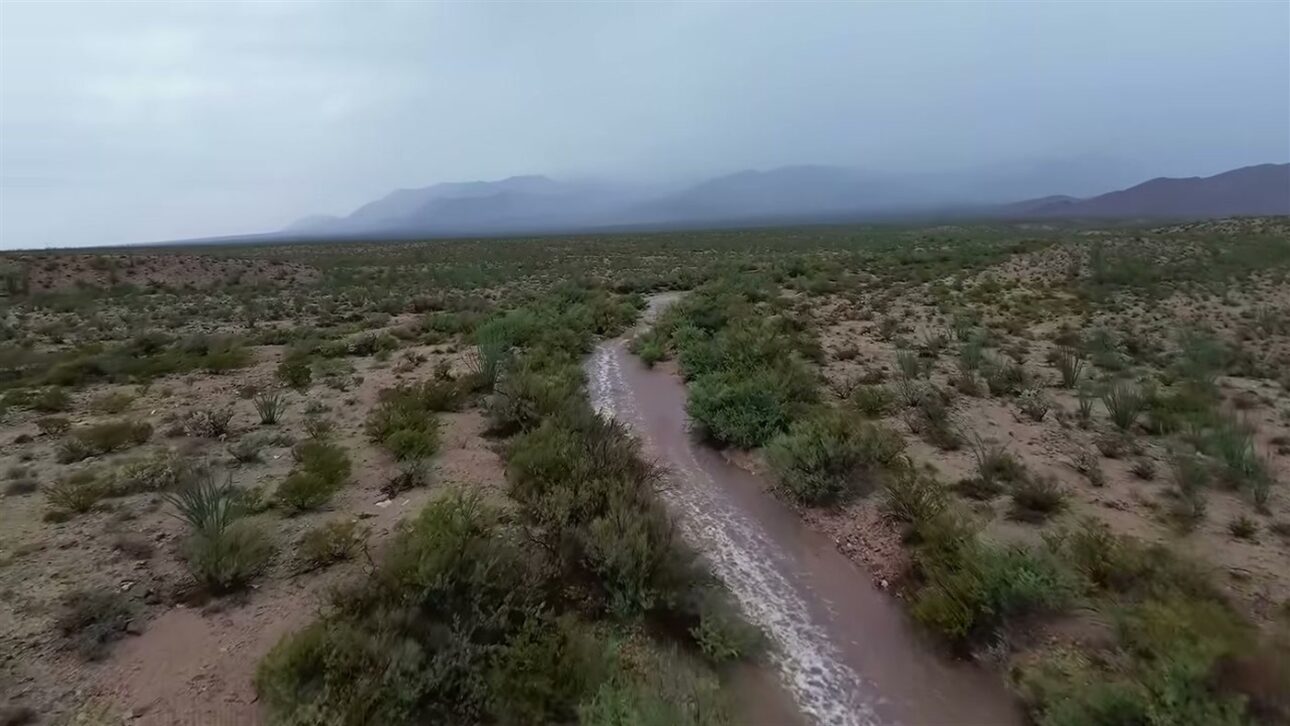
Water harvesting is a means, not an end. According to DUSTUPS, the declared goal is to build a forest in the desert, planting agroforestry lines on terraces and windbreaks, a project that can only be sustained if there is water infiltrated in the soil all year round, and not just on rainy days.
Even with all the harvesting, the demand requires reinforcement. The team was drilling a water well, on the fifth day of work and already at 360 feet deep, about 110 meters, still unsure if they would find water, as DUSTUPS reports. It is the honest portrayal of those reclaiming dry land: the surface structures hold the rain, but the forming forest still needs the underground reserve to withstand the drought.
What goes wrong also teaches
Not every experiment at the ranch works the first time, and the video does not hide the failures. According to DUSTUPS, a sandbag dam broke in the flood, but the owner treated the episode as data, not as a defeat, and explained what he learned for the next attempt.
The corrections are like a field manual. The mistake was building the sandbag dam two layers high and facing the current; next time it will be just one layer, horizontally, so the water doesn’t drag the material out of the bags, as DUSTUPS details. It’s the scientific method applied to the ground: test cheaply, observe real rain, and adjust the structure before investing more material.
Why water that stays for a short time is worth more
The counterintuitive part of the project is the water retention time. According to DUSTUPS, a structure that holds the flood for weeks would become an oxygen-deprived swamp, capable of drowning the roots of any desert plant, while one that empties too quickly doesn’t allow time for the water to infiltrate.
The balance point is the technical secret. The canyon swale filled with 15,000 gallons and emptied in less than 24 hours, exactly the window that allows the water to seep into the aquifer without rotting the soil, leaving it moist and aerated at the same time, as DUSTUPS explains. That’s why each dam is sized to retain and infiltrate, not just to accumulate: the goal is not to have a lake in the desert, but to have soil that retains moisture underneath, where the roots of the future forest will seek water long after the rain has passed. The same reasoning applies to the farmer who wants to recharge a well or a spring: the ideal structure is the one that turns a quick flood into slow infiltration, not the one that just puddles on the surface to evaporate in the next sun.
The Brazilian parallel: the semi-arid barraginhas


The ranch technique has a Brazilian counterpart. In the northeastern semi-arid and cerrado regions, the “barraginhas,” small basins that capture runoff and infiltrate it into the soil, are a consolidated public policy for coping with drought, with the same principle as the structures shown in the video.
The Brazilian scale gives the concept its dimension. The work of water harvesting with small dams, spread by agricultural research in Brazil, has already scattered thousands of these basins throughout the interior, recharging wells and springs just as the ranch structures recharge the desert’s aquifer, a notable parallel for the Brazilian rural reader. From the caatinga to the American desert, the recipe is the same: instead of chasing after water, force every drop of rain to stop and enter the ground.
The video traverses the canyon swale, the full dikes, the gabions, the Lone Tree, and the well drilling, in the midst of the flood.
The desert ranch proves that a forest does not grow from more rain, but from knowing how to hold the rain that falls. Tell us in the comments: would you make small dams on your land to not lose rainwater?