






 Portuguese
  Spanish


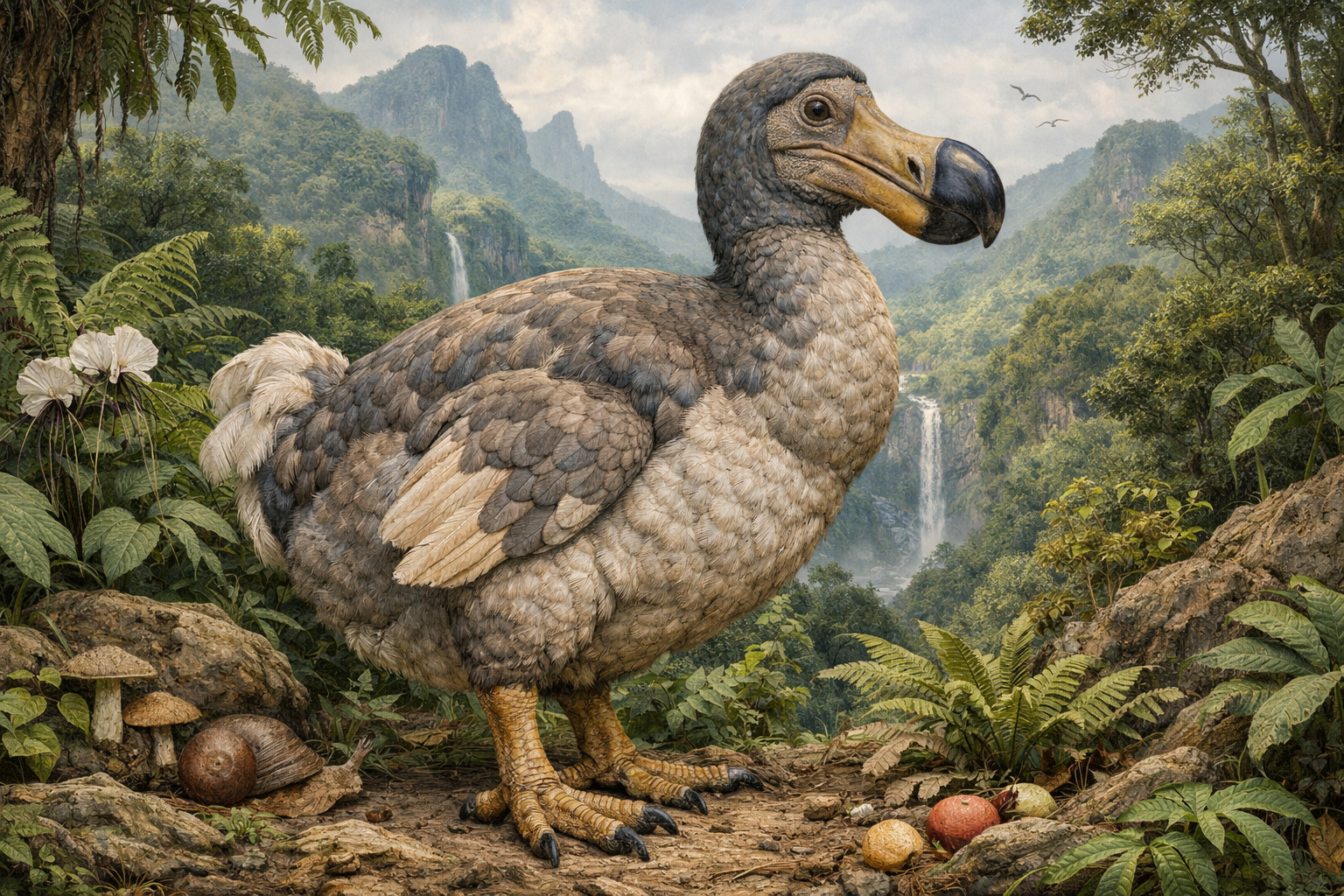


For Decades, The Dodo Was Treated As A Symbol Of Evolutionary Failure, But New Scientific Discoveries Reveal That Its Extinction Involved Complex Ecological Factors, Indirect Human Errors, And A Past Much More Resilient Than Was Imagined
Few people believe it, but the story of the dodo is far from simple or obvious. For centuries, this iconic bird was portrayed as slow, stupid, and doomed to extinction since the first contact with humans. However, recent research shows that this narrative is deeply mistaken. In practice, the dodo was not an evolutionary mistake, but rather a silent victim of abrupt environmental changes and the introduction of invasive species into a highly sensitive ecosystem.
For a long time, it was believed that the dodo’s disappearance was noticed and documented as it happened. However, the reality was quite different. When the species went extinct, no one noticed. There was no alarm, no preservation efforts, nor proper scientific records. The modern concept of extinction did not even exist at that time, which explains why the dodo’s disappearance went practically unnoticed.
This information was disclosed by scientific and documentary productions from PBS Eons, based on archaeological, paleoclimatic, and genetic studies, as well as academic articles that completely reevaluated the role of the dodo in its natural environment.
-
Brazil Secures Second Place at WorldSkills 2024 in Lyon, with 64 Young Professionals and 8 Medals, Including Gold from a Rio de Janeiro Hairdresser

-
3,000 Military Personnel from 10 Countries, Including US and Chinese Marines, Train Together in Brazil’s Savanna: Operation Formosa Becomes Largest Naval Ground Exercise Before First Cancellation Since 1988
-
UAE Sends 110 Date Palm Trees to Brazil, Signs $4 Million Deal to Boost Date Production in Bahia’s Hinterland, with Presidential Palace Receiving 10 Saplings
-
The Day the Soviet Union Forfeited Against Chile, Leading to an Uncontested Goal and a Spot in the 1974 World Cup


The First Human Contact And The Silent Disappearance

The first written records about the dodo date back to 1598, when Dutch sailors began to use the island of Mauritius in the Indian Ocean as a stopover on maritime routes. They described the bird as large, plump, unable to fly, and seemingly unafraid of humans. Although it was not considered tasty, a single dodo could feed several crew members, leading to frequent hunting of the species.
However, even with this exploitation, the dodo’s disappearance was not met with scientific concern. About 60 years after the first reports, the bird had completely vanished from the island. The last widely accepted sighting occurred around 1660, but the exact date was never confirmed. This is because, at that historical moment, no one was truly paying attention to the fate of that species.
Additionally, it is important to highlight that the notion that a species could disappear forever only began to be discussed in Western science nearly a century later, in the late 1700s. Thus, when the dodo was gone, the conceptual understanding necessary to recognize the impact of what had occurred did not yet exist.
From Myth to Science: When the Dodo Almost Became a Legend

Only in the 19th century, after the British occupation of Mauritius in 1810, did a more systematic interest in the island’s natural history arise. British naturalists began to investigate ancient reports and soon encountered descriptions so strange that they began to question whether the dodo had actually existed. For some, it seemed more like a mythical creature than a real animal, even being compared to the phoenix.
In 1816, a meeting was held with the island’s oldest inhabitants to see if anyone remembered the dodo. However, more than 150 years had passed since the last known sighting. As expected, no one had a direct memory of the bird. Only contradictory Dutch illustrations, fragmented reports, and some bones scattered in European museums remained.
It was only in 1848 that the first more structured scientific study on the dodo emerged, published by naturalists from the University of Oxford. Based on bone fragments and historical accounts, they described the animal as “strange” and of “grotesque appearance.” Still, they reached a fundamental conclusion: the dodo did indeed exist. They also suggested that the bird was related to pigeons, a hypothesis ridiculed at the time but that decades later would prove to be correct.
The 2005 Discovery That Changed Everything
For many years, this was practically all the available knowledge about the dodo. This changed dramatically in 2005, when excavations in a swamp in Mauritius revealed more than 200 dodo bones preserved in an ancient natural deposit. This find allowed, for the first time, analysis of the species within its true ecological context.
Researchers discovered that the environment where the dodo lived was anything but a stable paradise. The island’s ecosystem was marked by climatic instability, with extreme events such as cyclones and prolonged droughts. A notable example was a drought that occurred about 4,200 years ago, documented at the excavation site, which forced various animals to concentrate in search of water.
These conditions left physical marks on the dodo bones, known as lines of interrupted growth, evidence of periods when the animals faced resource scarcity. This demonstrates that, far from being fragile or incompetent, dodos were highly resilient and capable of surviving severe environmental challenges over thousands of years.
A Bird Much More Adapted Than Was Imagined
The most complete skeletons revealed impressive adaptations. The dodo had strong legs, ideal for moving around mountainous terrain, and a large skull, with well-developed olfactory regions, indicating an excellent sense of smell. These findings dismantle the image of the bird as slow or inattentive to its environment.
With advancements in ancient genetics in the last two decades, it became possible to analyze dodo DNA with greater precision. The results confirmed that it was indeed closely related to pigeons and doves, validating the hypothesis raised in 1848. This lineage evolved from a flying Asian ancestor that began crossing the Indian Ocean about 43 million years ago.
As volcanic islands emerged in the region, these birds used the archipelagos as waypoints. When Mauritius emerged from the ocean about 7 million years ago, the ancestors of the dodo settled there. With no natural predators, flight ceased to be advantageous, leading to the gradual loss of this ability — a common evolutionary process in isolated islands.
The True Cause of Extinction
Although human hunting contributed to the population decline, it was not the primary cause of the dodo’s extinction. The determining factor was the introduction of invasive species, especially rats and pigs, inadvertently brought by colonizers.
The dodo laid only one egg at a time, directly on the ground, which made its nests extremely vulnerable. Rats and pigs, highly efficient at preying on eggs, devastated the species’ reproductive capacity within a few decades. This pattern has been observed on various islands around the world, regardless of the intelligence or agility of the affected birds.
Therefore, the dodo was not extinct because it was unable to survive, but because its environment was abruptly altered by external agents. Until then, it was a successful species, perfectly adjusted to the ecological conditions of its island.
From Past to Future: The Debate on De-Extinction
Besides helping to consolidate the scientific concept of extinction, the history of the dodo now occupies the center of a modern debate: de-extinction. With advances in genetic engineering and a greater understanding of its DNA and ecology, researchers are seriously assessing the possibility of bringing the species back.
Whether this will happen or not remains uncertain. However, the dodo has ceased to be just a symbol of evolutionary failure and has come to represent a powerful warning about the indirect impacts of human action on ecosystems.
Perhaps, after all, the story of the dodo has not yet come to an end.
Was The Dodo Really Doomed To Extinction Or Does Its Story Prove That Even Highly Adapted Species Can Disappear When The Balance Of The Ecosystem Is Disrupted By Humans?





Lamentável a piada do Millor Fernandes ser realidade :
“O homem é o câncer da natureza”.