Portuguese
  Spanish


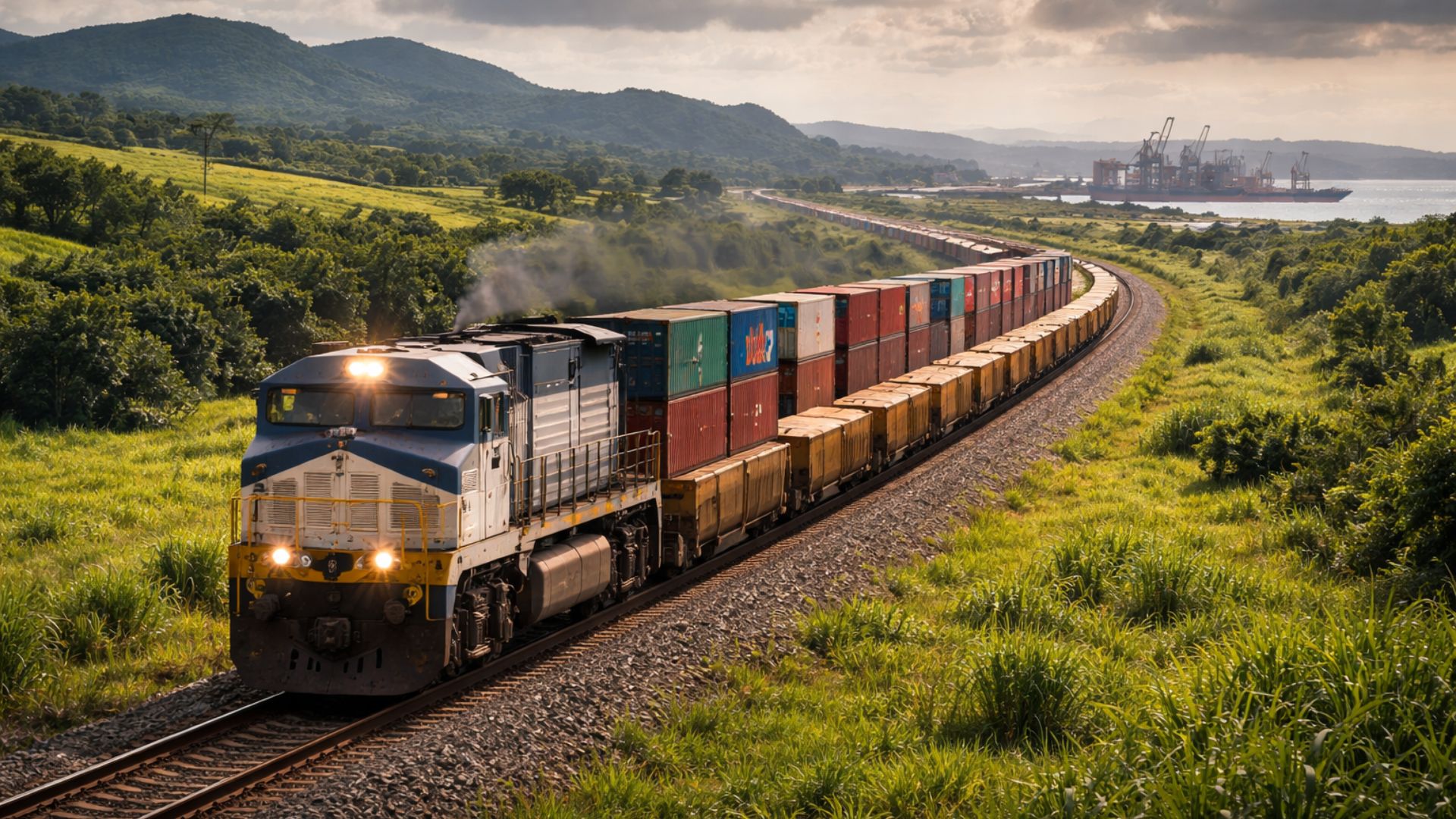

740 Km Rail Corridor Back on the Government and Market Radar, with 99-Year Concession and Promise to Increase Export Between Minas and Rio.
The federal government is preparing to offer a 740-kilometer rail corridor between Minas Gerais and Rio de Janeiro to reactivate an underutilized stretch and attract private investment with a contract of up to 99 years.
The proposal aims to facilitate the transportation of cargo such as coffee, limestone, and industrial inputs, and is part of an official estimate: annual movement, currently around 1.7 million tons, could exceed 2.5 million tons in the coming decades if the infrastructure is restored.
Named the “Minas-Rio Corridor,” the route connects municipalities in Minas such as Arcos, Lavras, and Varginha to Barra Mansa and Angra dos Reis in the state of Rio de Janeiro.
-
Trans-Siberian Railway’s New Sister Line, BAM, Stretches 4,300 km Through Permafrost and Seismic Zones in Northern Russia

-
180-Year-Old Bridge Disappears from Brazilian Farm, Found 180km Away, Sparks Investigation into Illegal Sale of Historical Heritage

-
Brazil’s Defunct Railway Network Leaves Over 100,000 Properties Abandoned for Nearly 30 Years, Facing Neglect and Safety Risks as Government Struggles to Regulate Assets Amid Degraded Stations and Unlawful Use

-
Belo Horizonte’s Beltway Project Risks Losing $5 Billion to Metro Expansion if Court Doesn’t Act Soon; State Government Plans New Lines with IDB Support





Although the line exists, the government evaluates that the stretch requires works and adjustments to resume regular operations with increased capacity.
New Legal Framework for Railways and the Public Calling Model
The structure chosen to enable the project is the “public calling” modality, foreseen in the New Legal Framework for Railways, established by Law No. 14,273 of 2021.
In practice, the model allows the public administration to offer the rail asset to the market and select an operator based on criteria related to investment and expected performance, without fully repeating the traditional bidding logic with grants.
Until then, the most common rule was the concession by public notice, with parameters defined in advance by the Union and an auction to choose the winning company.
This format typically included periodic payments to the government, linked to operational revenue or fixed amounts.

Now, according to the design presented for the Minas-Rio corridor, the exploration is conditioned to minimum investments, focusing on the recovery of the track and increasing capacity, without charging for the right to operate.
If there is more than one interested party, the winning proposal is likely to be defined by factors such as investment volume, projected logistical gains, and integration possibilities with other modes.
The idea is to encourage the private sector to assume the high initial costs, characteristic of railway works, on routes that have been “discarded” or have limited operations within the existing network.
Why The Ministry of Transports and ANTT Indicate Effective Demand
The Ministry of Transports and the National Agency for Land Transport (ANTT) believe that the corridor meets conditions that reduce investment risk.
One of the cited points is the presence of effective demand for cargo transport, in addition to already conducted technical studies and inspections indicating feasibility for resumption.
It also weighs in that the route is seen as strategic for agriculture and industry.
Southern Minas, identified as one of the main coffee-producing regions in the country, is at the center of this planning, with the expectation of creating a logistical alternative that shortens the connection between production areas and the coast.
In addition to coffee, the corridor is treated as a potential route for fertilizers, agro-industrial products, and general cargo.
Another factor that elevated the project on the federal radar was its inclusion in the Investment Partnerships Program (PPI).
With this, the government signals closer monitoring from the Civil House, an argument used to reinforce institutional predictability and reduce regulatory uncertainties that typically weigh on long-term contracts.
Centro-Atlântica Railway, VLI, and the Concession Calendar
The Minas-Rio corridor is part of the Centro-Atlântica Railway (FCA), currently operated by VLI Logística.
Even as part of this network, the stretch connecting Minas to Rio is described as almost inoperable and, therefore, appears as a candidate for a new exploration arrangement that unlocks works and returns capacity to rail transport.
At the same time, the discussion occurs amid the FCA contract calendar.
The current concession was granted in the 1990s, and according to official PPI records, the contract’s end date is August 31, 2026, which will place thousands of kilometers of tracks at the center of decisions regarding asset return, operational continuity, and system reorganization.

In this context, the government seeks to provide destination to stretches that require more investment and have remained outside the most active core of the concession.
The logic, in this case, is to separate what remains in the main contract from what can be reactivated by a new operator, with specific obligations to recover the infrastructure.
Predicted Cargo: Coffee, Limestone, Fertilizers, and Industrial Inputs
Currently, the estimated movement of the corridor is around 1.7 million tons per year, with a predominance of mineral products and industrial inputs.
Among the items mentioned in the project mapping are limestone and dolomite, as well as cargo linked to the industrial chain.
If the recovery is realized, the government’s projection is that this volume will exceed 2.5 million tons annually in the coming decades.
The leap, if confirmed, would represent a significant increase in capacity, supported by the promise of works and the expectation of cargo diversification, with room for fertilizers and agro-industrial products.
Meanwhile, the project is also described as a possible boost for regional tourism, with the prospect of stimulating travel between areas of historical interest and regions of natural landscapes.
However, the government treats the main axis as cargo transport, with possible opening for passengers depending on technical and market conditions.