






 Portuguese
  Spanish
  6 min of reading
  0 comments


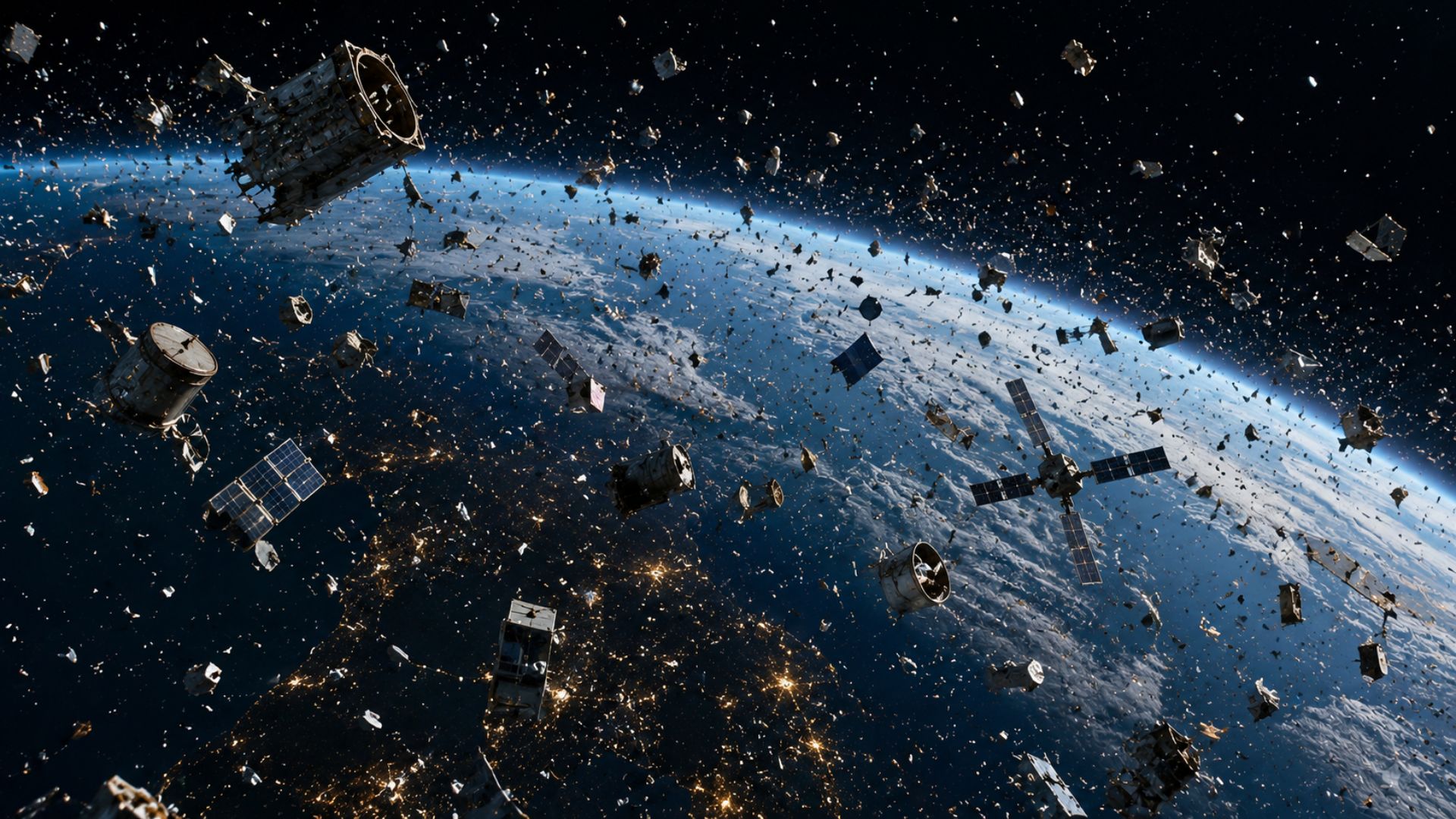
The problem is that this debris does not fall on its own nor does it decompose: what goes up, stays. And the greatest danger is not just the volume, but the speed. At 27,000 km/h, even a paint chip becomes a projectile. Worse: a large part of this material is too small to be tracked, escaping radars.
About 400 km above our heads, Earth’s orbit has turned into a massive garbage dump. There are more than 33,000 trackable objects spinning at about 27,000 km/h, of which almost half is already considered space debris, capable of destroying satellites and threatening essential services such as communications, GPS navigation, and even the safety of astronauts in orbit.
The warning was reinforced in May 2026, based on an analysis by the engineering company Accu with public data from the Space-Track website, linked to the United States space surveillance network. Before diving into the topic, an important consideration is worth noting: although the scenario is concerning, it is necessary to separate what is concrete and trackable data from what is an estimate, as different space agencies work with different numbers, making the problem serious but also surrounded by uncertainties.
Almost half of what orbits Earth is garbage

Of the 33,269 trackable objects in orbit, about 17,682 are functioning satellites, while approximately 12,550 are already fragments of space debris, which amounts to nearly seven pieces of debris for every ten active satellites, according to the analysis released based on the available public data.
-
Egypt wants to divert 10 million m³ of Nile water per day, equivalent to 4,000 Olympic swimming pools, to build a glass city in the desert and irrigate 2.28 million acres, in a project that attempts to push life out of the country’s most contested valley.

-
Brazilian military personnel spend weeks in extreme training in the Amazon and receive a badge reserved for Jungle Warriors during the celebration of the 60th anniversary of one of the most demanding and respected courses in the world.

-
After the divorce, a woman spent four years building a studio apartment with skylights, mirrors, a bathtub hidden under the sofa, and family mementos for a fresh start.

-
The “Rei do Bolão” of Fortaleza made 100 people millionaires at once in the Mega-Sena: the lottery office in Aldeota divided R$ 168 million in a pool and delivers a bet from São Paulo to Dubai.




This debris is composed of abandoned rockets, deactivated satellites, and thousands of fragments generated by collisions and explosions over decades.
The total mass of human-made material in orbit exceeds 15,800 tons, equivalent to about 40 jumbos shattered at high speed.
And there is an aggravating factor: this garbage does not degrade with rain nor is it decomposed by microorganisms, meaning what goes up tends to stay up there for a long time.
Why Speed is the Greatest Danger
More frightening than the quantity is the energy involved.
Most of these objects travel at over 27,000 km/h, and at this speed, even the smallest fragment becomes potentially lethal: it is estimated that a piece weighing just one kilogram, at 10 km/s, carries energy equivalent to about 12 kg of TNT, enough to destroy an entire satellite weighing several tons.
Therefore, experts often say that the problem is not just how much debris exists, but the density and speed of this material.
A simple flake of paint detached from a rocket can, in orbit, hit a satellite or a spacecraft with destructive force.
It is this combination of many objects traveling at extremely high speeds that turns the space around Earth into an increasingly hostile environment for the technology we depend on.
The Dreaded Kessler Syndrome

The so-called Kessler Syndrome, theorized in 1978 by NASA scientist Donald Kessler, describes a chain reaction: if two objects collide and generate thousands of fragments, these fragments can collide with others, creating even more debris, in a domino effect that could render certain orbits unusable for decades or centuries.
The most concerning aspect is that there is scientific consensus that even if no new rockets were launched from today, the amount of space debris would continue to grow, because collisions and fragmentations generate debris faster than the atmosphere can “pull them” back.
Some researchers believe that certain orbital bands, around 780 to 820 km altitude, are already near this critical point.
The Risk is No Longer Just Theory
The danger is no longer just a distant prediction.
In 2024, astronauts on the International Space Station had to take shelter after the fragmentation of a decommissioned Russian satellite, and in 2025, Chinese astronauts on the Tiangong station faced problems after a piece of debris reportedly damaged the return capsule window, episodes that show the threat is already concrete.
Recent history is also marked by events that multiplied debris all at once.
A Chinese anti-satellite missile test in 2007 generated more than 3,400 trackable fragments.
The accidental collision between the Iridium and Cosmos satellites in 2009 created about 2,300 new debris.
And a Russian anti-satellite test in 2021 added more than 1,500 fragments. Each of these episodes left a trail that continues to orbit to this day.
What We Cannot See
The most unsettling part of the problem is precisely what escapes the radars.
The European Space Agency estimates there are more than 1.2 million fragments larger than one centimeter in orbit, while NASA estimates more than 100 million objects one millimeter or smaller, numbers that are statistical projections, not exact counts, as this material is too small to be monitored.
This is where the greatest uncertainty lies: current systems only safely track objects larger than about 10 centimeters in low orbit.
Everything below that is practically invisible, although not harmless.
To complicate matters, a 2025 study warned that an intense solar storm could disrupt satellite maneuverability long enough to trigger collisions, theoretically leaving less than three days to react.
It is worth noting that this is a risk scenario raised by researchers, not a certainty.
Who Is to Blame and Why It Is Difficult to Solve
The origin of the problem is concentrated among a few actors.
About 95% of all cataloged space debris comes from three blocs: China, the United States, and the countries of the former Soviet Union, with China accounting for about 34% of tracked debris as of March 2026, followed by Russia and allies and the United States, with approximately 31% each, according to the data collected.
The root of the difficulty is also legal: the main international treaty governing the use of space dates back to the 1960s and does not prohibit, for example, the destruction of satellites with missiles.
Without a clear global policy to reduce debris, verification mechanisms, or effective sanctions, as pointed out by the UN itself, the advancement of the problem is difficult to contain, at a time when commercial constellations, like Starlink, are rapidly increasing the number of satellites in orbit.
Why This Matters for Life on Earth
It may seem like a distant problem, but it affects everyone’s daily life.
A large part of modern life depends on satellites: communications, the internet, GPS navigation used in cell phones and transportation, weather forecasts, and agricultural and environmental monitoring, including in Brazil, rely on this orbital infrastructure that space debris puts at risk.
The good news is that there are already initiatives to tackle the problem.
Agencies and companies are developing active debris removal technologies, such as the ClearSpace-1 mission by the European Space Agency, set to begin this decade, in addition to projects for capture by nets and other methods.
Operators like Starlink, in turn, claim to perform thousands of avoidance maneuvers per month to prevent collisions. These are important steps, even though the challenge of cleaning Earth’s orbit is immense and requires international cooperation.
The transformation of Earth’s orbit into a gigantic garbage dump is one of those problems that have grown silently, out of sight, but that directly threaten the technology we depend on every day.
Among traceable data and alarming estimates, what is clear is that the space around us needs rules, cooperation, and cleaning solutions before it’s too late.
It’s not about panic, but responsibility: taking care of what’s up there is, in the end, taking care of life down here.
And you, had you ever stopped to think that there is a huge garbage dump orbiting around the Earth? Do you think countries and companies will be able to solve this problem in time? Leave your comment, tell us what you think of this little-talked-about threat, and share the article with those interested in space, technology, and the future of space exploration.







Be the first to react!