Portuguese
  Spanish


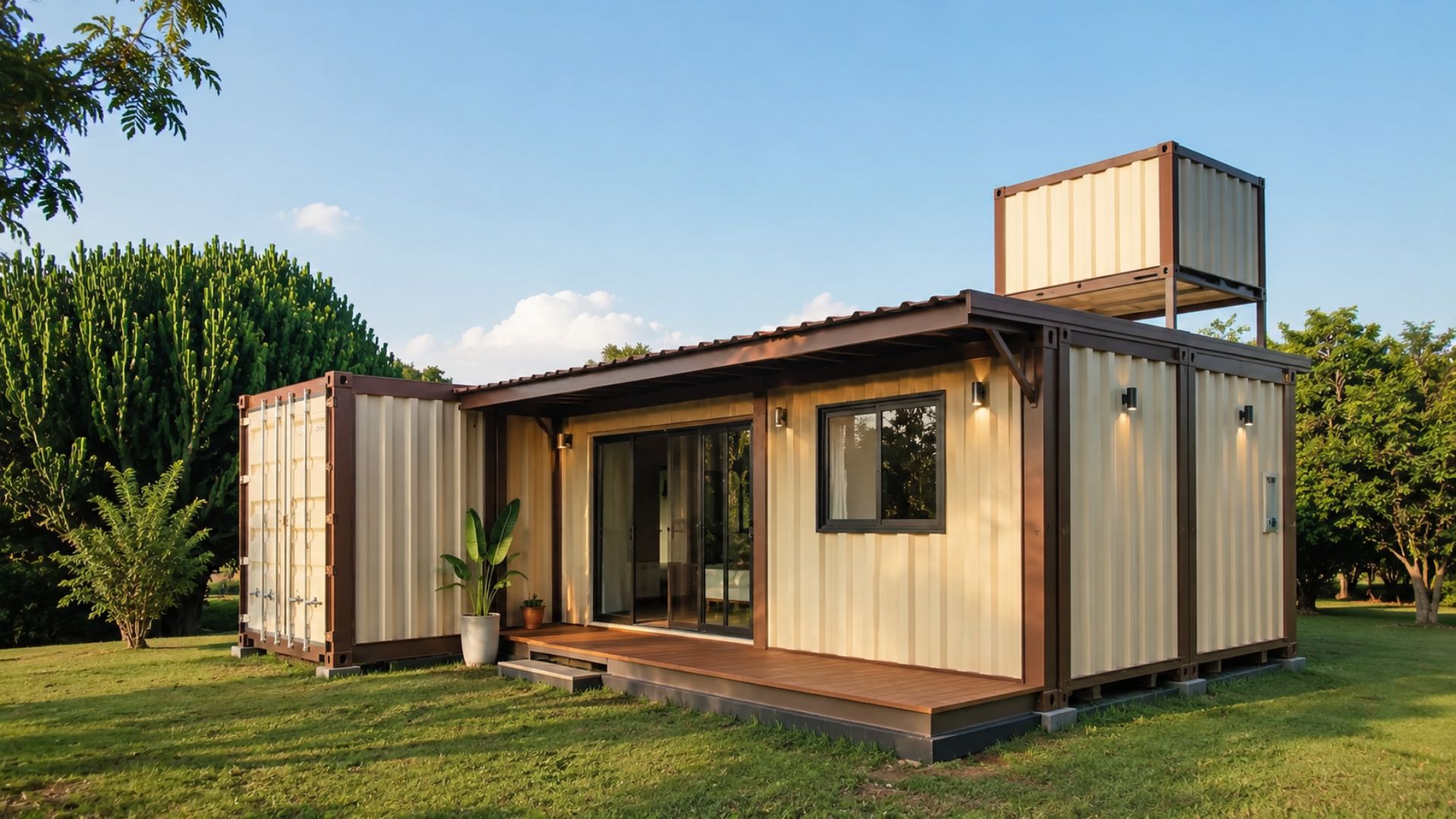

The delivery was made by Adriel Azul Containers, which considers the project the first of its kind executed by the company. The assembly used two containers side by side plus a third at a perpendicular angle, with specific structural reinforcement and personalized finishing chosen by the client Renato within his own rural property.
The combination of modular architecture and personalization gained a curious chapter in the interior of São Paulo. Adriel Azul Containers delivered in Salto, to a small farm within a gated community, a container house of 45 square meters assembled with three semi-new containers arranged in an L-shape.
The project was described by the company itself as the first of its kind executed within its portfolio. The construction required specific structural adaptations to support the angled joint, and took only five days of work on site after the partially pre-built structure was transported.
Why the container house was L-shaped

The choice of the L-shape was not aesthetic by chance. The client, identified as Renato, wanted a support house for the small farm that combined two different environments in the same structure, without occupying a conventional rectangular area.
-
28-meter, 156-ton titans traveled 20,000 km from China to the port of Santa Catarina: Portonave received 7 fully electric megacranes, part of a R$ 210 million package, to double container handling.

-
They exchanged the idea of a large house for a 35 m² warehouse, spent US$ 12,000 on the structure, and created a tiny house in Colorado with space to live and work.

-
A newly opened terminal in the middle of the Amazon has begun transporting soy and corn through Amapá, eyeing the queue of ships that is congesting the ports in the South.

-
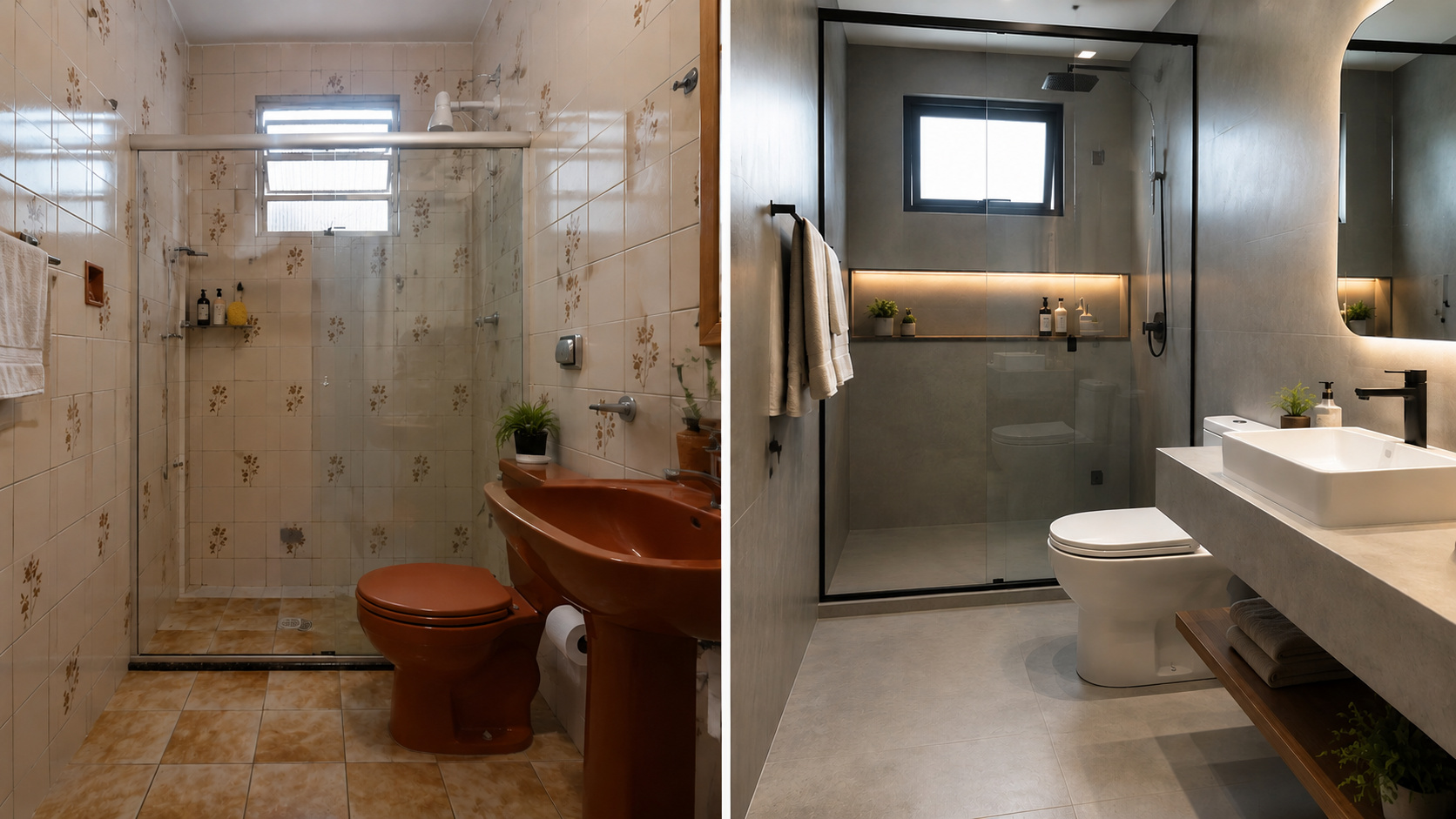
Goodbye to old tiles: renovation technique without construction transforms bathrooms in a few hours, eliminates debris, and reduces costs with coverings using special paints, high-resistance adhesives, and modern finishes that completely renew the space.


The solution used two 6-meter long modules aligned side by side, forming a main area. A third container of the same size was positioned perpendicularly to the other two, creating the characteristic L-shape angle and totaling the final 45 square meters.
This design allows for more varied room divisions than a simple rectangle. In the case of Salto, the result was a spacious social area in the main part and a separate section for the bedrooms and bathroom, connected by the angled joint.
The veranda also gained visual prominence in the project. A PVC tile roof was installed over the transition area between the modules, an aesthetic choice aligned with the facade colors and which utilizes the meeting point between the containers to protect the main entrance of the small farm.
The foundation that supports the unprecedented assembly

Receiving three L-shaped modules requires a different base than that used for a common rectangular container house. The client prepared a grade beam with concrete channels on the ground, outlining the entire perimeter of the future house.
At the ends of this beam, short piles (brocas) were driven, which increase the adherence of the assembly to the ground. This type of foundation is considered robust enough to distribute the weight of the containers without allowing settlements or subsequent movements, a problem that often compromises constructions with complex angles.
The ground preparation process ended up taking longer than the assembly of the house itself. As the project involved three L-shaped modules, the foundation had to be executed with millimeter precision, ensuring that each container landed exactly at the planned point.
The house itself was ready at the company’s shed in Itu since the first week of January, but was only transported to Salto in March. The almost two-month wait occurred precisely to allow the client to complete the foundation at the necessary pace without compromising the delivery schedule.
Five days of work on the small farm


The on-site logistics surprise those who only follow the final result. The container movement happened on a Monday, with unloading completed early in the week and the team released for other activities.
The actual assembly began the following morning. The team worked at the farm between Tuesday, Wednesday, Thursday, and Friday, totaling four intense working days on site before the official delivery of the container house to the owner.
This pace is only possible because much of the work happened before arriving on site. Electrical, hydraulic installations, painting, doors, windows, and internal coverings were executed inside the company’s shed, with pressure and energy tests performed in a controlled environment.
On site, the team focused on integrating the three modules, finishing the veranda, installing the water tank shelter, and reviewing specific points. This approach drastically reduces construction time on the client’s property, a decisive factor for those who live or work near the construction site.
The internal layout designed for comfort and function
Inside, the container house gained a layout that maximizes every available square meter. Right at the main entrance, the environment integrates the living room, dining room, and kitchen, with electrical points designed for a table, sofa, and television.
Natural lighting received special attention. Windows strategically positioned ensure cross-ventilation between the kitchen, living room, and laundry area, with external wall lights spread around to reinforce the light at night on the veranda area.
The kitchen was organized with defined space for a refrigerator, sink, and stove, and also includes a compact laundry area fitted into a strategic corner. The space provides for a washer-dryer and a small sink, plus two windows that help ventilate this wet zone.
On the opposite side of the house are the two bedrooms, both 3 meters long and with the same finishing standard. The client opted for sliding doors for the rooms, a choice that matches the internal layout planned to accommodate the furniture intended by the residents.
The bathroom with porcelain tiles and the risky bet
The bathroom became the highlight of the project in terms of finishing. The environment received complete tiling, a niche for toiletries, a shower box, toilet, washbasin, mirror, and porcelain tile flooring chosen by the client.
The choice of porcelain tiles is considered unusual in transported container houses. The risk of breakage during transit is high, which is why the company usually recommends click vinyl flooring for this type of construction, an item that comes with an official warranty after delivery.
In the case of Salto, the short distance of about 50 kilometers between the shed and the farm allowed for an exception. The house arrived on site with the porcelain intact, without any sign of cracking, but the builder recalls having faced cases where the flooring broke even within the company.
This technical decision is an important part of the conversation between manufacturer and client. Each material behaves differently in transport, and what works for short distances can become a problem for displacements of several hundred kilometers, especially on roads with uneven sections.
The structural reinforcement behind the minimalist aesthetic
The final result may seem simple, with light and neutral colors that contrast with the green surroundings of the farm. Behind this clean appearance, however, lies a more delicate engineering than most standard projects.
To create the integration between the kitchen, living room, and dining area, it was necessary to remove the sides of one of the containers and suppress the support columns of the other two. This type of modification is only feasible with specific structural reinforcement, calculated to distribute the weight differently from the original designed for maritime transport.
Without these technical adjustments, the L-shaped junction could compromise the integrity of the container house over the years. The combination of a de-structured side of one module and the absence of columns in two others requires precise calculations to prevent future deformations.
The company itself recognizes that this type of execution does not fit into a quick answer about costs. Each project requires a prior evaluation that considers transport distance, type of container used, desired finish, and characteristics of the land where the container house will be permanently installed.
The discussion about cost and privacy care
Unlike other company projects, the Salto project did not receive direct disclosure of its value. The builder preferred to keep the financial details confidential, a stance justified by the exclusive nature of the work delivered to the client.
The explanation given by the company is simple and honest. As it involves differentiated structural reinforcement, three L-shaped containers, and personalized finishing, this type of container home does not fit into a standard price list, and generalizing values could confuse potential interested parties in completely different projects.
There is also the issue of the resident’s privacy. Not every client agrees to have their home exposed as a product for sale, and the company has sought to balance this dynamic between technically publicizing the work and respecting those who prefer to keep personal details private.
This care is also reflected in initial conversations with new clients. The construction company indicates that the first question should never be about price, but rather about the type of container, desired finish, distance to the destination, and project characteristics, stages that often point to more financially viable alternative solutions.
And you, would you consider an L-shaped container home as a support solution on a farm, even knowing that it involves specific structural reinforcement and a personalized cost quite different from the standard model?
Tell us in the comments if you think personalized projects like this will become popular in the coming years, if you would buy porcelain tile flooring for a house that needs to be transported by road, and what other adaptation you would like to see in a future delivery from Adriel Azul Containers. The discussion helps to understand how far Brazilians are willing to abandon traditional masonry in exchange for the agility of the container model.