Portuguese
  Spanish





In the United States, a Portable Grill with 276 Air Jets Applies Thermal Engineering and Promises Nearly 100 Percent Combustion with Less Smoke, Sparking Interest from Over 600 Supporters Worldwide.
Fire is one of humanity’s oldest inventions. For thousands of years, the logic was the same: wood, flame, and lots of smoke. Now, a technological proposal tries to change this scenario using forced ventilation, electronic control, and a metal structure designed for high temperatures.
What seemed impossible has become a technological curiosity: applying industrial engineering to something as primitive as a campfire.
Thermal Engineering Applied to One of Humanity’s Oldest Elements
The novelty draws attention because it combines combustion and electronics.
-
A Japanese governor single-handedly stalled the construction of the world’s fastest train for nine years, and only now has he agreed to allow a tunnel excavated at a depth of 1,400 meters.

-
Almost 1 billion euros, two gigafactories, and a million-dollar public investment, Chinese company aims to turn Spanish city into Europe’s new battery hub.

-
Advancement in the industry: Brazilian company creates ultralight material comparable to steel and paves the way for hydrogen cylinders up to 70% lighter, with a direct impact on logistics, the energy industry, and national competitiveness – learn about Forza Composites

-
In Brazil’s backyard: Tesla, by Elon Musk, announces official operations in Uruguay, where electric vehicles already make up 20% of new cars but still leaves out the largest market in the region.





The portable firepit uses a system with multiple fans that direct air into the flames through 276 exit points.
In practice, this increases the oxygen available for burning and reduces particles that would normally turn into smoke.
The promised result is almost 100 percent combustion, something that, until recently, was associated with industrial systems and not camping equipment.

How the Electric System Controls the Fire in Real Time
The operation, despite being traditional, uses hardly any wood or charcoal. The difference shows up afterward.
The user controls the flame intensity by adjusting the speed of the fans, which operate at a maximum level of about 45 dB. At reduced power, the sound nearly disappears.
This control allows for regulating the burn rate, deciding the size of the flame, and even adapting the fire for cooking over a raised grill.
It’s fire under electronic command.
High-Strength Metal Structure Protects Components and Ensures Durability
The structure combines titanium alloy and aluminum alloy, materials used when there is a need for thermal resistance and lightness.
The grill, screws, and washers are made of stainless steel.
At the base, the fans and electronic components are isolated by silicone seals and thermal foam pads.
A steel mesh allows air to pass through but prevents debris from reaching the internal system.
The design shows a clear concern for structural engineering and heat dissipation.
Two Sizes and Battery Power Expand the Concept of Electrification in Camping
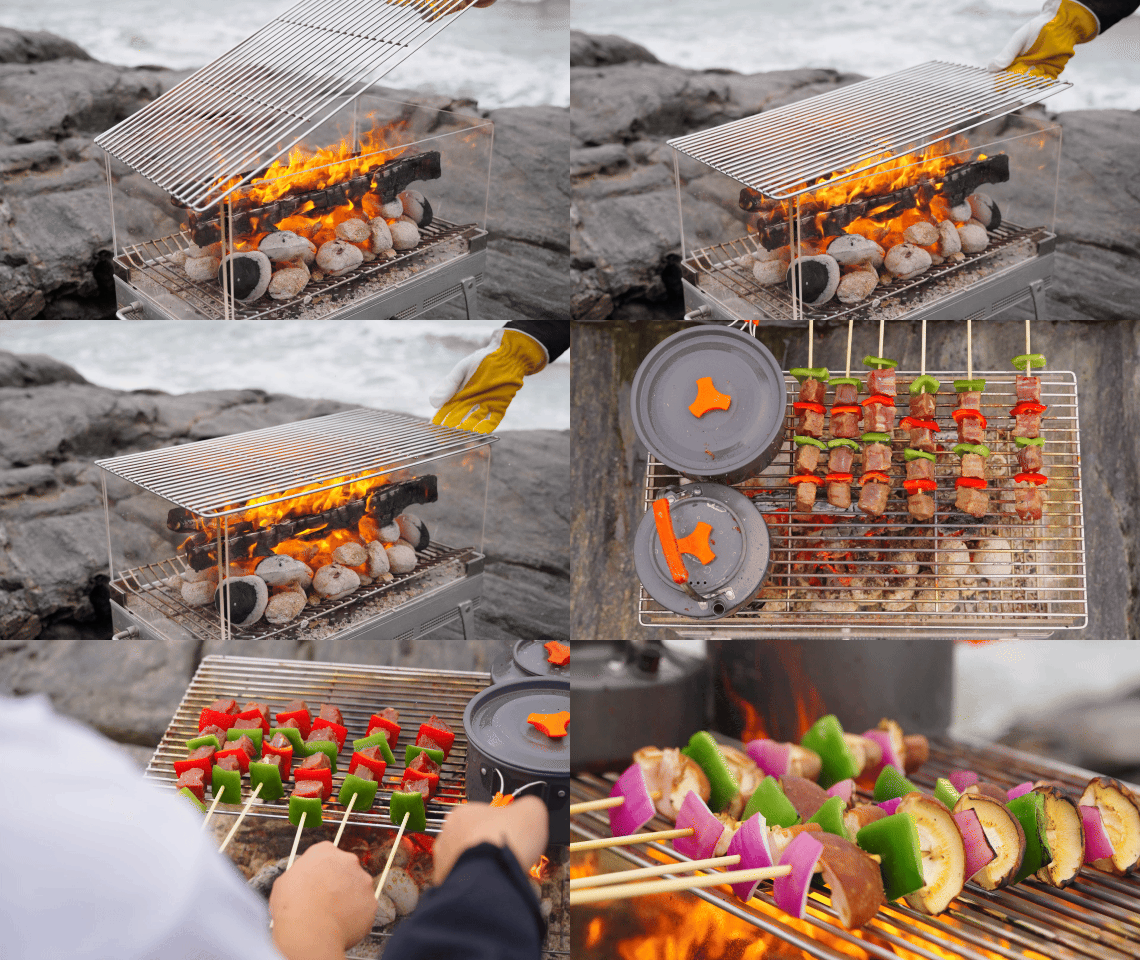
The equipment has been developed in two versions.
The standard version measures 30 centimeters in length, has glass panels that are 13 centimeters high, and weighs about 4 kilograms, suitable for two to three people.
The larger version reaches 45 centimeters in length and is designed for groups of four to five people.
Power can be supplied by its own power bank with a Type C cable for DC or by an optional 30000 mAh battery. There is also the possibility of using a foldable 30-watt solar panel.
This combination reinforces a clear trend: even fire is entering the era of portable electrification.
From Millennia-Old Tradition to Globally Funded Technological Equipment
The grill is being funded through an international crowdfunding campaign.
Over 600 supporters have already participated, and deliveries are expected for June 2026, with shipping costs estimated between 25 and 30 dollars.
The case draws attention because it demonstrates how the outdoor equipment industry is incorporating principles of energy efficiency, electronic control, and advanced structural design into traditional objects.
The transformation of fire into a system controlled by electric ventilation shows that innovation is not only in large plants or factories but also in compact and portable solutions.
What do you think of this application of engineering to something as old as a campfire? Is this technological evolution or excess electrification in daily life? Share your opinion in the comments.