






 Portuguese
  Spanish


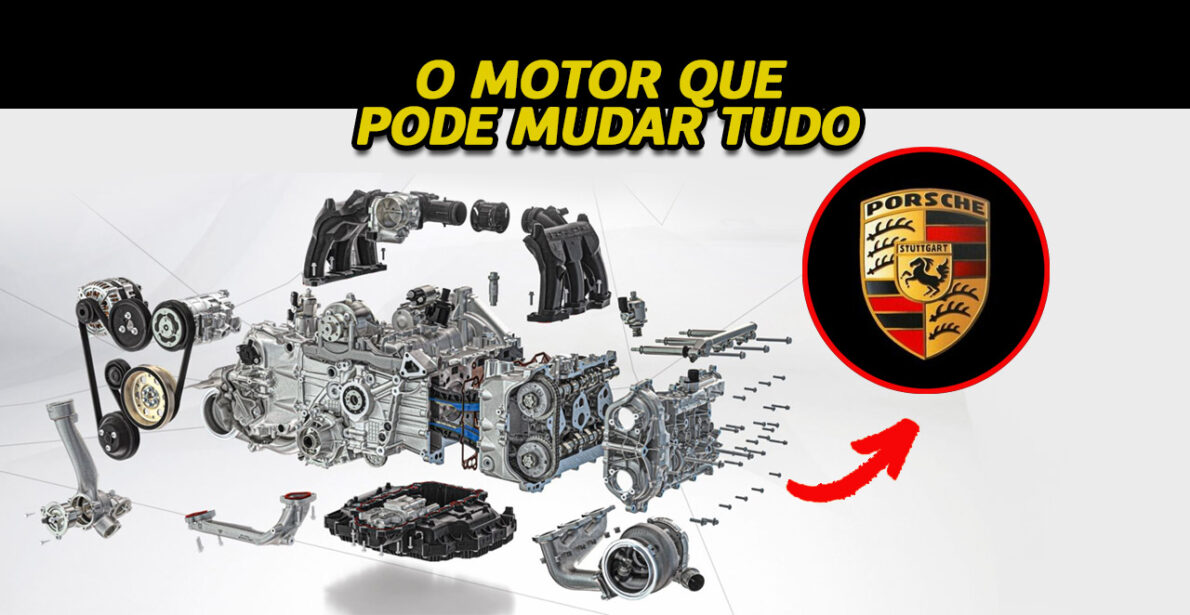
Porsche Challenges The Advancement Of Electric Motors With Surprising Technology. The Manufacturer Patented A Six-Stroke Engine Promising Greater Efficiency And Power. Will This Innovation Save Combustion Engines Or Are We Just Delaying The Inevitable?
While the global automotive market prepares for an inevitable transition to electric motors, Porsche challenges this trend.
In an unexpected twist, the luxury car manufacturer seems not ready to abandon combustion engines.
What’s behind this bold decision?
-
Toyota Launches First 100% Electric Car in Brazil: bZ4X with 343 HP, All-Wheel Drive, 361 km Range, Priced at $419,990 BRL, Limited to 99 Units

-
Chinese SUV Achieves 24.4 km/l, Outperforms Toyota Yaris Cross in Real-World Tests with 224 hp Hybrid System, Offers 51-Liter Tank for Greater Range, and Costs Up to R$ 5,000 Less.

-
Uber Black Revamps Fleet, Drops Ten Car Models and Sets Deadline for Electric BYD Dolphin
-
Chinese Giant Uses Metal Structures and Cranes to Deliver Over 700 Electric Cars to Brazil


A new patent reveals technology capable of giving a significant lifeline to traditional engines, challenging the seemingly certain fate of their extinction.
According to documents filed with the U.S. Patent Office, Porsche has developed a six-stroke engine — something that could be a brilliant move to extend the lifespan of combustion engines.
But how does this new technology work and what could it mean for the future of fuel-powered engines?
According to Porsche, most internal combustion engines used in cars today are four-stroke, following the cycles of intake, compression, combustion, and exhaust.
These engines are the most common and widely used worldwide.
However, Porsche’s innovation introduces an additional compression-work cycle, raising the number of strokes to six.
The Engineering Behind The Six-Stroke Technology
The revolutionary idea presented by Porsche engineers suggests that by adding this extra cycle, the efficiency and power of the engine can be significantly enhanced.
The concept is simple yet ingenious: instead of one combustion cycle for every four strokes, as happens in a conventional engine, this system uses a combustion cycle every three strokes.
The patent describes the engine as consisting of “six individual strokes, divided into two sequences of three strokes.”
This configuration would allow the engine to go through intake, compression, and combustion in the first sequence, followed by a second phase with compression, combustion, and exhaust.
This engine also features a 720º crankshaft rotating within a ring with two concentric circles.
This alters the piston movement, slightly reducing the stroke in the additional cycles.
The result of this alteration is a more complete combustion and, consequently, greater efficiency in power production.
The Race For Greater Efficiency
With this new configuration, Porsche aims to improve the energy efficiency of combustion engines.
In conventional engines, only one of the four strokes directly generates power, while the other three merely serve to complete the cycle.
With this new six-stroke technology, the ratio changes to a productive cycle every three strokes.
This, in theory, means that the power generated could be greater, and the air-fuel mixture will be burned more completely.
On the other hand, the complexity of this engine is considerable.
A system with two top dead centers and two bottom dead centers not only increases manufacturing complexity but also raises production and maintenance costs.
Still, Porsche believes that the efficiency and performance gains may justify this innovation, even if its mass production remains uncertain.
The Future Of Combustion Engines: Hope Or Nostalgia?
Despite Porsche’s efforts to keep combustion engines in the spotlight, the market is quickly moving towards electrification.
Several countries have already announced plans to ban the sale of fossil fuel-powered vehicles over the coming decades.
However, the introduction of synthetic fuels and innovative technologies, such as the six-stroke engine, may change this scenario and open a window of opportunity for combustion engines to remain relevant longer.
Porsche is not alone in this race.
Other globally renowned automakers are also investing in hybrid and alternative technologies for combustion engines.
The pursuit of efficiency, emission reduction, and sustainable solutions remains high in the automotive sector, even in the face of advancing electric motors.
Despite all the complexity involved, this innovative technology is still a patent and may never be commercially applied.
Patents are sometimes registered as part of experiments and, in many cases, never reach the market.
However, the mere fact that Porsche is investing in innovations for combustion engines is indicative that the manufacturer believes this type of propulsion still has a future ahead, even if it shares space with electric motors.
Will this new technology be sufficient to keep combustion engines relevant in the next decade? Or are we just delaying the inevitable dominance of electric motors in the global automotive market?





Be the first to react!