






 Portuguese
  Spanish


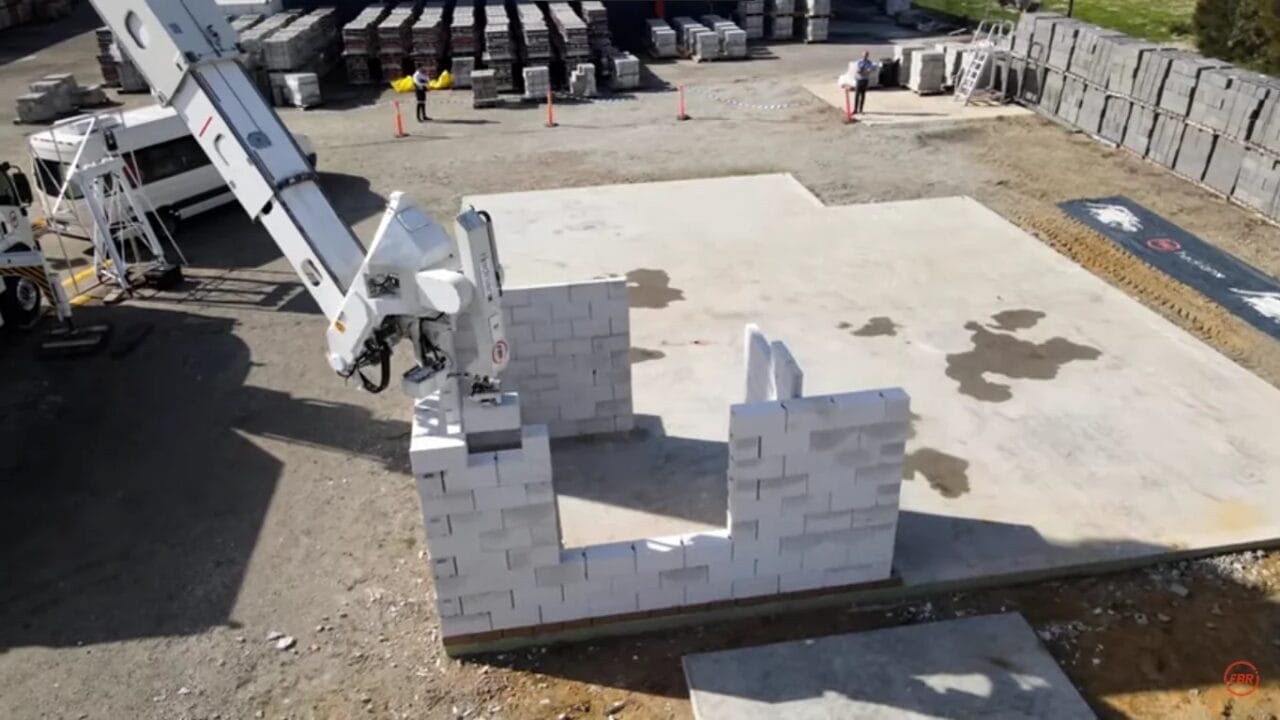

Construction Robot Revolutionizes the Industry: Hadrian X Lays Up to 500 Bricks Per Hour and Signals the Future of Civil Construction.
The Australian company FBR is transforming the construction industry, a sector that has remained virtually unchanged for millennia. With the development of an advanced construction robot, FBR aims to enhance efficiency in the sector: the robot can lay 500 blocks per hour, enabling the construction of the exterior and interior walls of a house in just one day, a remarkable milestone in construction automation.
Construction Robot Is 32 Meters Tall


The Australian company’s great asset is Hadrian X, a construction robot developed to lay blocks outdoors at lightning speed. FBR claims that its technology for civil construction is groundbreaking and has spent years working on it to achieve the current design. The robot is a truck with a large 32-meter telescopic arm, which, according to those responsible, allows it to lift walls three stories high by the roadside.
The company claims to have developed the construction robot to be able to lay up to 500 blocks per hour, which is equivalent to about 120 m², and complete the exterior and interior walls of a standard double brick house in a single day.
-
Pennsylvania Mine Creates Ice in Summer Heat and Melts in Winter, Turning a Mountain Crevice into a Reverse Natural Refrigerator

-
China Accelerates Global Expansion of Robotics: From Smart Vacuums to Industrial and Humanoid Machines, Millions Exported to Over 150 Markets
-
Two-Bedroom Home Built in a 40-Foot Shipping Container Delivered and Ready for Same-Day Living in São Paulo Countryside

-
Polar Air Mass to Hit Brazil: Temperatures to Plummet in Nine States, Near Freezing in the South with Frost Risk Until Monday




According to the Australian company, based in Perth, it was developed to lay commercially available blocks, as well as others that are not yet being sold on the market, including large bricks of up to 600mm x 400mm x 300mm and weighing up to 45 kg.
Its modular design allows various cuts in height, and during its operation, it uses a special adhesive that replaces mortar, a change that reportedly gives the walls even more strength, the company assures.
Hadrian X Uses a 3D CAD Model
In May, the company announced the completion of a house made up of around 4,300 concrete masonry units, in September it reported a project with 16 semi-detached houses, and just a few weeks ago it stated that it had completed a structure with large format blocks at a rate of more than 240 pieces per hour.
The portal The Sentiment goes further and details that this would be the average speed and that it actually achieved a much higher rate, 326 blocks per hour. The company claims to change the way the civil construction sector lays bricks, which has remained more or less unchanged over the last millennia.
For its work, Hadrian X uses a 3D CAD model and a process that, according to the company, generates less waste than conventional methods. To make the process more efficient, the company uses optimization software that translates sketches into practice.
This minimizes handling and waste of block products to improve residential construction efficiency. The robot incorporates Dynamic Stabilization Technology (DST). With this presentation sheet, it is already focusing on the North American market.
Robots Are Being Integrated into Human Jobs and Becoming Increasingly Popular
In addition to this initiative for the construction industry, Amazon revealed a new addition to its automation arsenal: Digit, a Humanoid Robot developed to optimize the package sorting process in the company’s distribution centers.
The model can move with agility, grasp objects, and handle various items, Digit represents a significant step in Amazon’s efforts to enhance the efficiency of its logistics operations.
This innovation is part of a broader strategy by the tech giant to invest heavily in robotics and artificial intelligence, focusing on transforming and accelerating its supply chains. Instead of wheels for movement, Digit has two legs, capable of going up and down stairs and accessing locations across multiple floors.






Bom dia como podemos trazer um robô deste para o Brasil, e quanto custa .