Portuguese
  Spanish


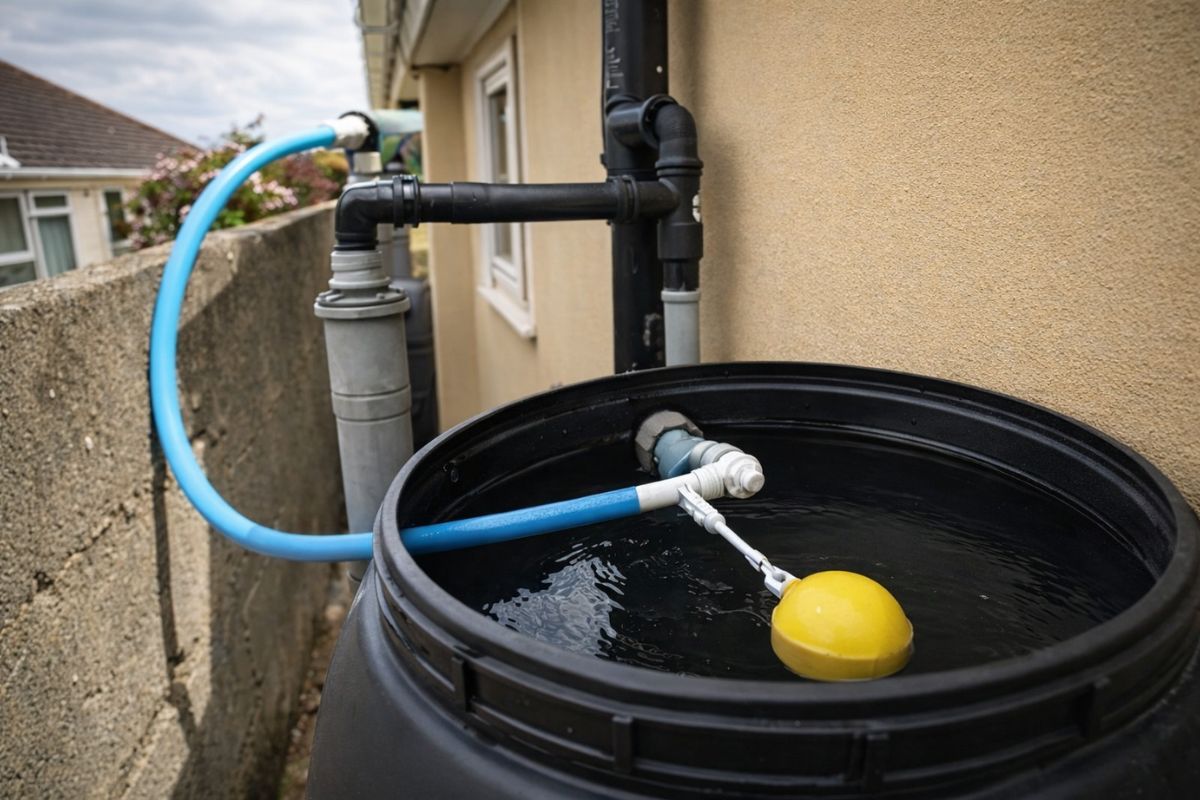


Instead of Buying a Professional Kit, the Project Uses Gutters, Collection Barrels, Socks Filter, and a First Flush Diverter with Cheap Plastic Tube and Internal Float, Directing Rainwater to Connected Reservoirs Pressurized by Pump, with Final Filtration at the Domestic Point of Use.
The idea behind this rainwater system is simple and, at the same time, full of technical choices that change everything: harvesting from the roof, discarding the first water, storing in barrels, and delivering “network-like” pressure at the tap. Instead of relying on an expensive pre-made set, the proposal relies on common parts, focusing on cost and maintenance.
The report describes a solution designed to supply the entire house while also allowing for switching when the reservoir runs dry. This involves pumps with defined power (320 W and 400 W are referenced), flow controller, valves, pressure gauge, layered filters, and, most importantly, a low-cost “first flush” to reduce the initial dirt that comes from the roof and gutters.
The Logic of the System: Harvest, Discard, Store, and Pressurize

The overall design follows a sequence that helps to understand why so many people are interested in rainwater without spending on a professional kit: first, the harvesting occurs through the gutters; then, part of the flow is diverted to the first flush; only then does the water go to the collection barrels, and finally, a pump and a control set try to transform irregular gravity into constant flow.
-
Pre-mixed stabilized mortar set to revolutionize construction in 2026: extends usability to 36 or 72 hours, boosts productivity, and minimizes waste in building projects.

-
Mexico Sinks Giant Fabric Tubes Filled with Sand off Yucatán Coast to Create Invisible Barrier and Restore Hurricane-Damaged Beaches

-
Modern Liquid Porcelain Flooring Offers Seamless, High-Gloss Finish for Home Renovations Without Demolition
-
Brazilian Couple Builds Entire Cabin from Cement and Shade Cloth in Just 7 Days to Escape Renting, Using Affordable Farm Supplies Instead of Steel Mesh




The described system aims for something very specific: to open the tap and feel a pressure similar to that of the public supply. For this, a 320 W stainless steel pump with a flow controller (with demand valve) is needed, in addition to items that usually appear in pressurized installations: check valve, purge valve, pressure gauge, and dry run protection. The harvested water does not go “straight for drinking”; it goes through stages, and the final quality depends on what happens at each one.
First Flush with Tube and Float: Why the First Water Counts in the Result
The first rainwater usually carries what has accumulated since the last precipitation: dust, particles from the roof, debris from the gutters, and organic material. The popular tutorial solves this with a first flush diverter made from cheap plastic tubes (referred to as gray), where the initial water is “separated” before going to the barrels.
The central detail is the internal float: in the report, a sphere rises during the rain and closes the first flush pathway when it fills, causing the remaining flow to be directed to the collection reservoirs. The logic is to reduce the worst “first impact” and save subsequent filtering stages, which can mean less clogging and less filter element replacement over time.
Layered Filtration: From Simple Pre-Filter to Point of Use
At the entrance of the barrels, the system uses a pre-filter that stands out for its simplicity: filtering socks (described as “milk sock”), with a cited cost of about £8 for one hundred units, placed before the water enters the reservoir. The assembly is described with T and 90-degree curve connections, in an arrangement designed to facilitate quick replacement when the material saturates.
Then, at the transfer and delivery stage, a 25 cm sediment filter (referenced at 5 microns) appears. And, at the point of use, the tutorial mentions ceramic candle filters (Doulton) installed at the bathroom tap and the kitchen’s drinking water tap, described as 99.9% effective against bacteria, viruses, and cysts. Here lies an important distinction: pre-filtration and fine filtration can improve appearance and reduce particles, but the actual performance depends on the element, installation, and maintenance, especially when the intent is human consumption.
Network Pressure and Control: Why Pump, Valves, and Protection Matter
Anyone trying to use rainwater indoors quickly hits a point: without control, the pressure varies, the flow oscillates, and the system can cavitate or run “dry”. That’s why the tutorial emphasizes an integrated set with flow controller, demand valve, and dry run shutdown, in addition to check valve and pressure gauge. The goal is stability, not just “having water stored”.
Besides the mentioned pressurizing pump (320 W), a second GRUNDFOS 400 W pump with float switch appears, used to transfer water from the barrels to a main reservoir through the sediment filter.
The report also compares durability: it describes a previous pump that corroded and failed early and mentions another that also rusted and broke prematurely, reinforcing the idea that, in the total cost, the reliability of the pump weighs as much as the purchase price.
Reservoirs, Interconnection, and Autonomy: Liters, Costs, and Where to Find the Parts
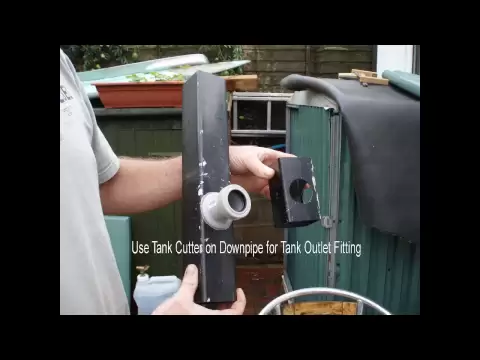

The described system works with two barrels (one on each side of the house) interconnected by a 32 mm plastic tube at the bottom, which helps to equalize level and take advantage of combined volume.
In terms of autonomy, the report brings a concrete reference: the person wanted a 3,500-liter reservoir but bought a 2,700-liter one for £155. This type of number usually defines “how long it lasts” in dry periods, as consumption varies greatly from household to household.
Regarding “where to find”, the tutorial mentions typical solutions for those assembling with individual parts: construction material stores for 32 mm tubes and connectors, in addition to marketplaces for hunting used pumps and components.
References for purchasing gutters and accessories also appear, with the note that part of the cost can drop if existing gutters are reused.
In the final balance, the total reported expense was £620, including gutter items and sealants that totaled about £250, with highlights for approximate values: pressure pump around £60, flow controller around £85, gutters and fittings around £180, and used Grundfos pump for £45 (with shipping).
Potable or Not: Limits, Maintenance, and Alternation with Network Water
Even with layered filtration, the difference between using rainwater for non-potable purposes and for drinking is a dividing line.
The project itself points this out by concentrating the finer filtration at the point of use and suggesting, as reinforcement, the possibility of adding a UV sterilizer (mentioned as used in ponds) to reduce the risk of pathogens.
Still, when the intent is human consumption, the maintenance discipline becomes a rule: replacement of pre-filters, care with sediment saturation, checking connections, and attention to odors, color, and taste.
To deal with periods without rain, the system includes a practical and very realistic solution: a dual tap to alternate between rainwater and public water when the reservoir empties. This type of redundancy is what prevents the house from “stopping” and also serves as a safeguard when the quality of the stored water is not within expectations.
In any scenario, it’s worth treating assembly and adjustments as something that requires supervision and, when possible, technical support, because pressurization, improperly sized valves and connections can lead to leaks, unwanted backflow, or pump failures.
In your home, would you use rainwater only for flushing and cleaning, or would you try to take it to specific taps with point-of-use filtration?
What weighs more in your decision: initial cost, maintenance of filters, space for reservoirs, or trust in water quality over time? And, if you’ve seen a first flush with an internal float working, did it seem simple or “too simple” for what it promises?