Portuguese
  Spanish


System uses artificial intelligence, high-definition cameras, and infrared sensors to identify infractions on São Paulo highways, while highway police officers validate each occurrence before issuing fines.
The use of artificial intelligence in traffic has just entered a new phase in the state of São Paulo. After a period of testing and technology calibration, the new smart radars have officially begun to assist the supervision of the Military Highway Police (PMRv). Now, images captured by the equipment can support citations of drivers caught using their cell phones while driving or not wearing seat belts.
The information was released by Motor1.com, based on official data from the concessionaire SPMAR, responsible for the South and East sections of the Rodoanel Mário Covas. According to the survey, during the testing period conducted between May 12 and June 9, 2026, the smart cameras recorded 4,879 infractions, equivalent to an average of 168.2 incidents per day. Since July 1, 2026, these images have been officially used to support the supervision carried out by the Military Highway Police.
Testing period revealed thousands of traffic infractions
The first results caught the attention of the authorities responsible for monitoring São Paulo highways.
-
Free Upgrade to Professional Driver’s License Categories in Over 130 Locations in Brazil, Including Exams and Courses

-
Bus Drivers in Sorocaba, Brazil, Avoid Strike and Secure 10.53% Pay Raise, Setting Wage Benchmark for Other Regions

-
Latin America’s Largest Port Invests $400 Million in Rail System with Trains Up to 2.4 Kilometers Long
-
New Smart Radar Begins Issuing Fines to Solo Drivers in Carpool Lanes, Uses Cameras to Count Occupants, Changing Traffic Enforcement Rules on Busy European Roads



During almost a month of operation in the calibration phase, the equipment identified thousands of drivers and passengers disregarding basic safety rules.
According to the numbers released by SPMAR:
- 2,420 drivers were caught not wearing seat belts, representing 49.6% of all registered infractions.
- 1,440 passengers traveled without the mandatory restraint equipment, corresponding to 29.5% of the occurrences.
- 1,019 drivers were using cell phones while driving, totaling 20.9% of the records.
In total, 4,879 infractions were recorded during the project’s initial phase.
However, during this period, no driver received a fine.
This is because the technology was still undergoing a calibration process. Thus, the monitoring had an exclusively educational and technical nature.
Furthermore, the concessionaire used this period to validate the accuracy of the algorithms before the official start of the fines.
How AI-powered radars work
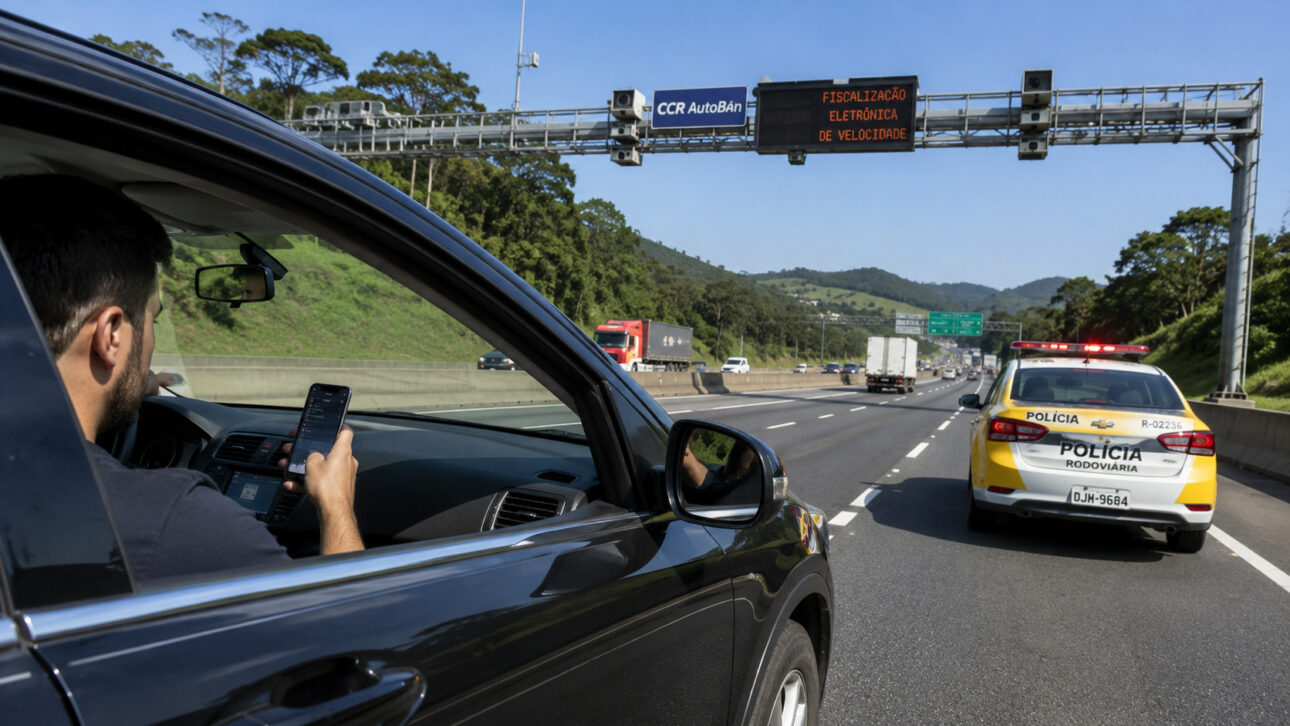
Unlike traditional radars, which only monitor speeding, the new equipment uses a set of advanced technologies.
The structures feature high-definition cameras, infrared sensors, and artificial intelligence systems capable of continuously analyzing driver behavior.
Additionally, monitoring occurs 24 hours a day, regardless of lighting conditions.
Whenever the algorithm identifies a possible driver using a cell phone or occupants without seat belts, the system automatically records the occurrence.
However, the issuance of a fine does not happen automatically.
As with other electronic enforcement systems, all images go through a human validation stage.
In this process, officers from the Highway Military Police analyze each record individually.
Only after this verification can the infraction result in a fine, provided all the requirements set forth in traffic legislation are met.
According to the concessionaire SPMAR, the technology does not replace the work of agents. On the contrary, it enhances the enforcement capacity and allows for the identification of infractions that would hardly be caught by field teams alone.
Where intelligent radars are already in operation
The first large-scale project began operating on the South and East sections of the Rodoanel Mário Covas, managed by SPMAR. Monitoring started in May 2026. Subsequently, on July 1, 2026, the technology officially began supporting the Road Military Police’s enforcement.
Additionally, the system is already operating on another important highway in São Paulo.
Since the beginning of 2026, radars equipped with artificial intelligence have also been operational on the Anchieta-Imigrantes System, the main connection between São Paulo’s capital and the Baixada Santista.
In this highway corridor, the equipment identifies various irregularities, such as:
- using a cell phone while driving;
- absence of seat belt;
- speeding.
However, all images continue to be analyzed by police officers before confirming the infraction.
According to the concessionaires, the installation of this equipment occurs primarily in locations with higher vehicle flow and a high history of accidents.
Technology also identifies accidents and risk situations
During the testing period, the intelligent radars demonstrated another important function.
Besides recording traffic violations, the cameras captured accidents and dangerous situations caused by driver distraction.
Among the recorded cases is a truck that left the road and stopped in the central reservation.
Additionally, another cargo vehicle invaded the adjacent lane, causing a rollover.
These images help operational teams respond more quickly to incidents and reinforce the preventive role of technology.
According to Andrew Aquino, Operations Manager at SPMAR, the proposal is to use electronic enforcement as a tool to reduce accidents and raise driver awareness.
According to Aquino, the goal is to encourage drivers to prioritize their own safety before using their cell phones while driving.
Cell phone use remains among the main causes of distraction
The data obtained during the tests confirm a long-standing concern of road safety experts.
According to the Brazilian Association of Traffic Medicine (Abramet), approximately 90% of traffic incidents involve some factor related to driver distraction.
Among these factors are precisely the use of mobile phones and the non-compliance with basic traffic rules.
According to the Military Highway Police, the expansion of electronic surveillance reduces the feeling of impunity and significantly increases the ability to identify infractions that might go unnoticed during conventional patrols.
Moreover, permanent monitoring allows for tracking driver behavior throughout the day, contributing to preventive actions and quicker responses in case of accidents.
Thus, the use of artificial intelligence in traffic represents a new stage in the monitoring of São Paulo’s highways. While the Rodoanel Mário Covas officially inaugurates this monitoring model, the Anchieta-Imigrantes System already shows that the trend is to expand the use of this technology on other state highways in the coming years.
Do you believe that the use of artificial intelligence in surveillance can reduce accidents and make highways safer for everyone? Share your opinion in the comments.