Portuguese
  Spanish


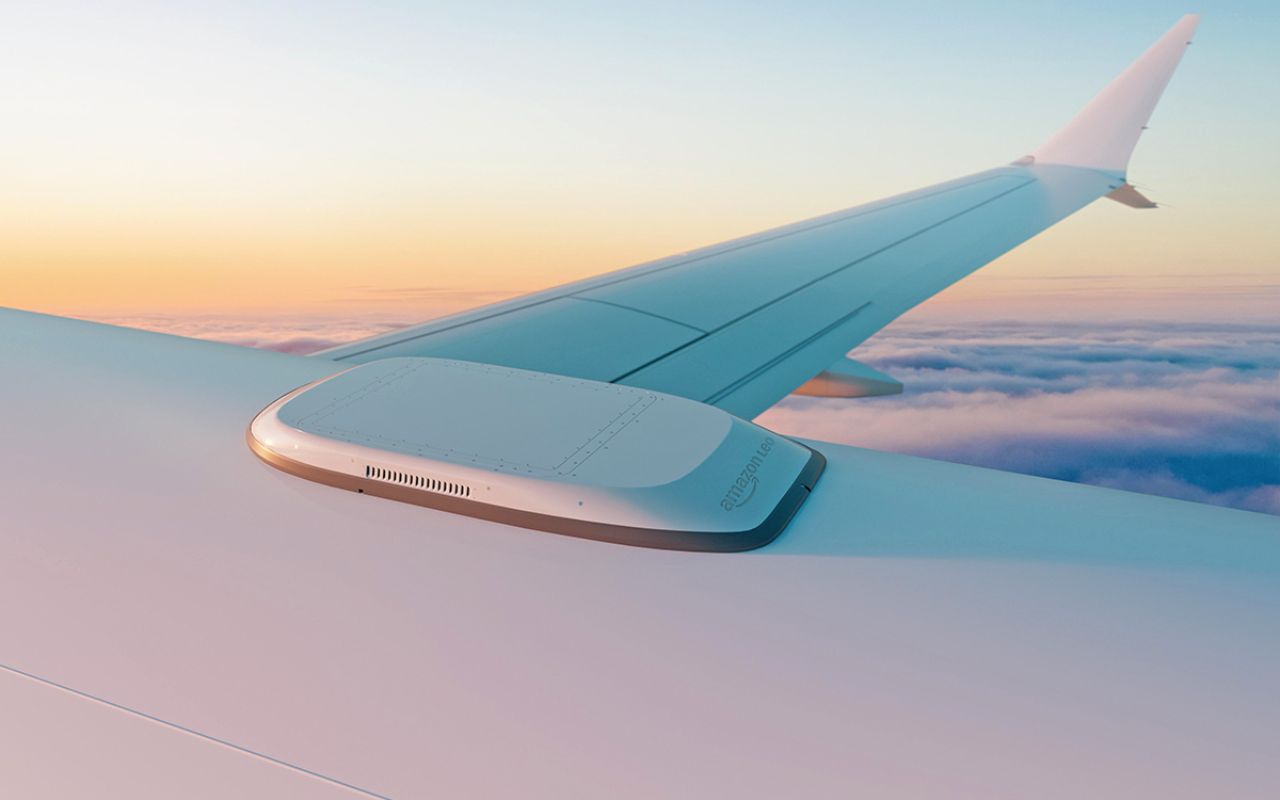

Amazon announces new antenna, Leo, for internet on airplanes with speeds of up to 1 Gbps, expanding global connectivity via satellite.
Amazon recently announced a significant advancement in its satellite connectivity project, revealing a new antenna aimed at commercial aviation. The innovation is part of the Amazon Leo system and promises to provide high-speed internet for passengers and crews during all phases of flight. The technology was presented as a solution to expand access to connectivity in aircraft, with a global implementation forecast in the coming years.
According to the company, the equipment was designed to work on different types of aircraft, from large planes to regional models. Thus, the proposal is to democratize access to internet on commercial flights, meeting a growing demand for constant connectivity, even on longer and more remote routes.
New Amazon antenna promises continuous internet in the air
Named Amazon Leo Aviation Antenna, the new antenna was developed to provide uninterrupted connection from boarding to disembarkation. Additionally, the technology uses a full-duplex phased array system, which allows simultaneous data transmission with high efficiency.
-
Brazilian Engineer Who Grew Up Without Electricity Develops Software, Expands AltoQi to 67,000 Clients, Aiming for $21 Million by Digitizing Brazil’s Construction Industry

-
Spain Launches World’s Largest Floating Dry Dock: 56-Meter Giant Produces Massive Concrete Structures in A Coruña Using Technology Proven in Brazil

-
AI-powered toys that talk, recognize faces, and collect data face scrutiny from Brazilian government over children’s privacy concerns

-
4,000-Year-Old Child’s Skull Unveils Ancient Burial in 7,500-Year-Old Norwegian Rock Shelter, Impressing Archaeologists





In practice, this means that passengers will be able to access internet with speeds of up to 1 Gbps for downloads and 400 Mbps for uploads. As a result, activities such as streaming, video conferencing, and using cloud applications should become more stable during the flight.
Another highlight is that a single unit can serve all seats in the aircraft. Meanwhile, the crew also benefits from access to data almost in real-time, which can improve flight operations and safety.
Antenna technology reduces maintenance and improves efficiency
The antenna developed by Amazon has no moving parts, which significantly reduces the need for maintenance. Moreover, this type of construction increases the reliability of the system, especially in extreme temperature and weather conditions.
The equipment will be installed on the exterior of the aircraft fuselage. With compact dimensions—about 58 inches long, 30 inches wide, and only 2.6 inches high—the aerodynamic design was intended to minimize the impact on fuel consumption.
Another relevant point is the ease of installation. According to Amazon, the system can be implemented in just one day, which facilitates adoption by airlines around the world.
Global infrastructure ensures internet even in remote areas
During the flight, the antenna connects to low Earth orbit satellites that move quickly around the Earth. These satellites automatically transfer the signal, ensuring continuous connection even with the aircraft’s movement.

Additionally, Amazon plans to install over 300 ground stations interconnected by fiber optics. This structure will be integrated with services like Amazon Web Services, expanding access to private networks and cloud solutions.
In more isolated regions, such as oceans and polar areas, the internet will be maintained through laser links between the satellites. Thus, the company aims to avoid connection failures and ensure greater stability even in traditionally coverage-lacking locations.
Main highlights of the technology:
- Connection of up to 1 Gbps during the flight
- Antenna with no moving parts (less maintenance)
- Quick installation in up to 1 day
- Global coverage, including remote areas
With this advancement, Amazon reinforces its strategy to expand internet via satellite and compete in an increasingly competitive market.
With information from AEROIN