






 Portuguese
  Spanish
  4 min of reading
  0 comments


An 1,800-Year-Old Amulet Found by Archaeologists May Shed New Light on the Arrival and Spread of Christianity in Europe
It was last read 1,800 years ago, when Christianity was still an emerging cult. Now, scientists have finally deciphered the famous “Frankfurt Silver Inscription” – an 18-line engraving on a thin sheet of silver, preserved in a protective amulet.
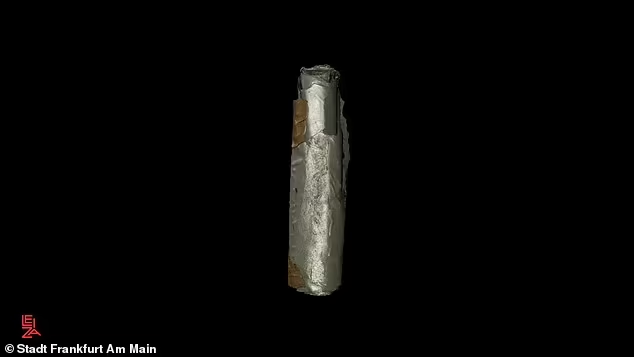
The object, measuring 3.5 cm in length, was found in an ancient cemetery on the outskirts of Frankfurt, Germany.
The skeleton of a man was discovered alongside the amulet, prompting researchers to use computed tomography to “digi-roll” the fragile surface of the piece.
-
Survivor of 1966 SS Daniel J. Morrell Shipwreck in Lake Huron Recounts 38-Hour Ordeal in Extreme Cold

-
The Greatest Hoax in World Cup History? The Film That Denied Brazil’s 1958 Victory and Exposed How Fake Evidence Can Seem Convincing on TV
-
Fake South Korean Online Stores Offer Shopping Thrill Without Spending Money or Receiving Products
-
The War of Jenkins’ Ear: How a Severed Ear Sparked One of the 18th Century’s Most Unusual Conflicts


The result is impressive: the text represents the oldest evidence of pure Christianity north of the Alps, dating from 230 to 270 A.D.
At that time, Christianity was just beginning to spread throughout Europe. Originating from Judea in the Middle East, it was considered a cult subject to persecutions. The discovery of the amulet is a historic milestone.
What the Inscription Says
Described as “purely Christian”, the text is written in Latin and references Lord Jesus Christ, Son of God, and Saint Titus, one of the first Christian missionaries and church leaders. This is a notable difference:
“Such inscriptions on amulets were generally made in Greek or Hebrew,” explained Professor Markus Scholz, an archaeologist at Goethe University in Frankfurt.
Another peculiarity is the lack of pagan or Jewish references, which are common in this type of artifact until the 5th century. Demons, archangels, or biblical characters such as Isaac or Jacob are absent.
Context of the Discovery
The amulet was found in 2018, in the ancient Roman city of Nida, which was the precursor of modern Frankfurt. It was positioned under the chin of the buried man, suggesting it was likely worn around the neck for protection in the afterlife.
Next to the body, there was also a bowl for incense and a clay jar, possible personal belongings of the deceased.
The tomb has been dated between 230 and 270 A.D., a time of risks for Christians. Paganism and Judaism dominated, and declaring oneself a follower of Christ could have serious consequences.
Ivan Calandra, an archaeologist at the Leibniz Center for Archaeology (LEIZA), led the deciphering process.
“The challenge was that the silver sheet was rolled up and, after 1,800 years, it was also very wrinkled and pressed”, he said.
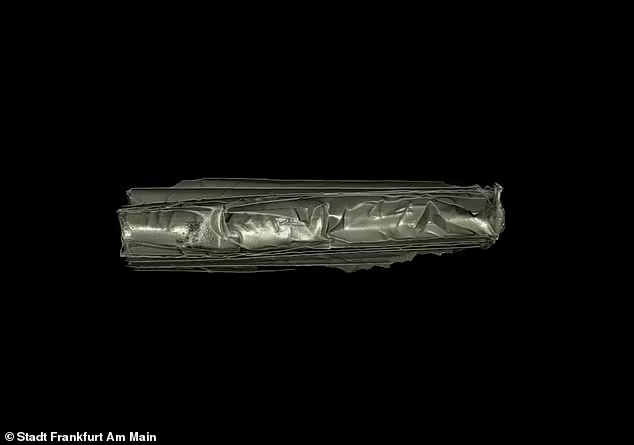
The solution came through high-resolution computed tomography, which allowed for the creation of a 3D model of the inscription.
The team virtually reconstructed each segment, fitting the pieces together like a puzzle.
“It was a painstaking job that involved experts in history of theology and linguistics,” Scholz said. The result was the deciphering of the message hidden for nearly two millennia.
Hidden Christianity
In the 3rd century, Christianity was still considered an underground religion. Persecutions were common, and there is little archaeological evidence of Christianity in Roman territory outside the Middle East.
This is why the discovery of the amulet in Frankfurt is so significant. It suggests that Christians not only lived north of the Alps much earlier than previously thought, but also had an independent expression of faith, represented by the purely Christian inscription.

The Impact of the Discovery
The mayor of Frankfurt, Mike Josef, called the finding “a scientific sensation”:
“This will force us to push back the history of Christianity in Frankfurt and well beyond by about 50 to 100 years.”
Dr. Ina Hartwig, head of culture and science in Frankfurt, highlighted the multidisciplinary importance of the discovery:
“It affects archaeology, religious studies, philology, and anthropology. A discovery this significant here is truly extraordinary.”
The finding also paves the way for new research. If a Christian was buried with such a distinctive amulet, it suggests the presence of an organized Christian community in the region.
The Inscription and History
Until now, evidence of Christianity in Roman territory has been centered in regions such as Rome, Antioch, and Alexandria. The existence of this amulet in Frankfurt challenges the geographical and temporal boundaries of this history. The man buried may be one of the first known Christians north of the Alps.
Researchers believe other archaeological sites may contain similar clues. This type of object is extremely rare, especially in such an ancient Roman context.
“We may have only scratched the surface of Christian evidence in ancient Europe,” the scientists concluded.
The ‘Frankfurt Silver Inscription’ Translated
(In the name of?) Saint Titus.
Holy, holy, holy!
In the name of Jesus Christ, Son of God!
The Lord of the world
resists with [forces?]
all attacks(?)/setbacks(?).
The God(?) grants
entry for well-being.
May this means of salvation(?) protect
the man who
surrenders to the will
of Lord Jesus Christ, Son of God,
before Jesus Christ
every knee will bow: those who are in heaven, those who are on earth
and those
beneath the earth, and every tongue
confesses (Jesus Christ).





Be the first to react!