Portuguese
  Spanish


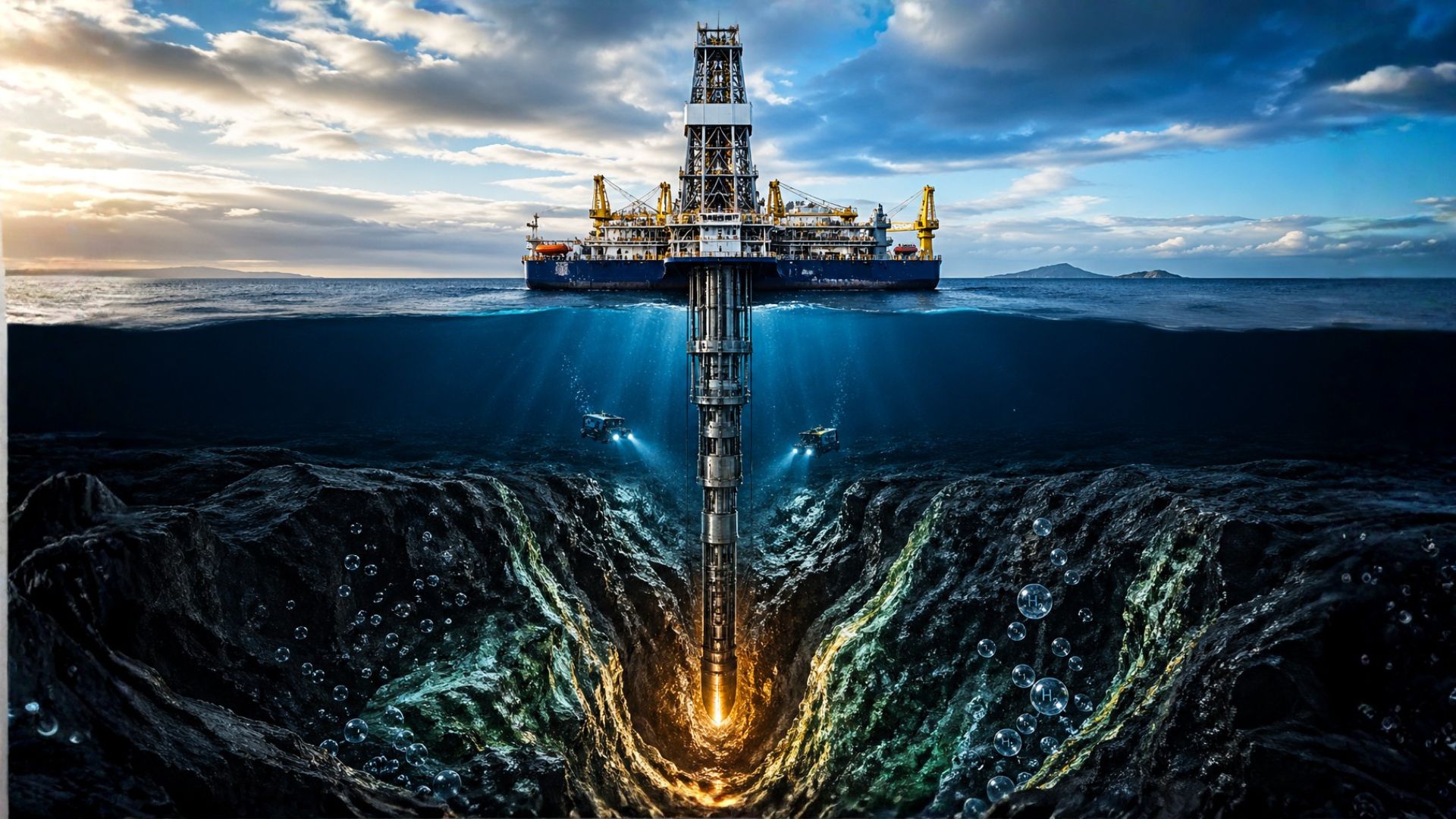


Unprecedented drilling in the Atlantic reveals deep rocks, rare chemical reactions, and clues about processes that may have preceded life on Earth, expanding scientific access to the mantle without crossing the entire oceanic crust and opening new possibilities for investigation.
Reaching 1,267.8 meters below the seabed, a scientific expedition in the Atlantic successfully drilled into the Atlantis Massif, an underwater mountain near the Mid-Atlantic Ridge, and recovered a record core of rocks directly linked to the Earth’s mantle.
Responsible for the operation, Expedition 399 of the International Ocean Discovery Program (IODP) gained access to materials rarely observed directly, usually hidden beneath kilometers of oceanic crust that hinder deep investigations.
With a 71% total recovery of the drilled material, well U1601C achieved a performance considered high for this type of geological environment, far surpassing the previous record in peridotite-dominated formations, which did not exceed 201 meters.
-
Chevrolet Offers Chance to Win a 2026 Sonic RS for Free via WhatsApp

-
Earthquake vs. Tsunami: Which Causes More Destruction and Why One Can Be Even More Dangerous
-
Hospital Cook Discovers 1,700-Year-Old Pot of 52,503 Roman Coins Using Metal Detector in Field

-
Salvador’s Acarajé Vendors Turn Used Frying Oil into Income by Selling it for Biodiesel Production



More than the depth reached, the continuity of the recovered samples is noteworthy, as long sections allow for a more precise reconstruction of the internal structure of the rocks, as well as monitoring deformations and chemical transformations over time.
Mantle rocks exposed in the Atlantic and unprecedented access to Earth’s interior

Located in a tectonically active area, the Atlantis Massif stands out because geological movements have brought mantle and lower crustal rocks to regions near the seabed, significantly reducing natural barriers to scientific access.
In other parts of the ocean, the crust typically reaches about 6 kilometers thick, which still prevents complete drilling to the mantle, something current technology has not been able to achieve even in the most favorable regions.
During the drilling of U1601C, ultramafic rocks predominated, accounting for 68% of the recovered material, while 32% corresponded to gabbroic rocks, a combination that helps to better understand the formation of the oceanic lithosphere.
According to the expedition report, the sequence includes mantle rocks intruded by gabbro, originating from the cooling of deep magma, forming a record that brings together tectonic, magmatic, and hydrothermal processes in the same environment.
Chemical reactions with hydrogen and possible links to the origin of life
Among the main scientific focuses, the interaction between seawater and olivine-rich minerals stands out, a process that triggers serpentinization, a reaction capable of generating serpentine and releasing hydrogen as a relevant chemical byproduct.
The presence of this hydrogen favors the formation of methane, short-chain hydrocarbons, and organic acids without direct participation of living organisms, which increases interest in abiotic environments similar to those of early Earth.
According to researchers, these compounds can act as fundamental chemical building blocks for life, not as direct evidence of its origin, but as a demonstration that natural processes can generate complex molecules under extreme conditions.
Furthermore, the Atlantis Massif hosts the Lost City hydrothermal field, known for releasing alkaline fluids rich in hydrogen and methane, reinforcing the region’s importance for studies connecting deep geology and pre-biological chemistry.
Second well deepens measurements and reveals high subsurface temperatures

In parallel, the expedition advanced in borehole U1309D, which reached 1,498 meters below the seabed, expanding the dataset on the lower oceanic crust, where gabbroic rocks predominate.
Near the base of the borehole, measurements indicated temperatures around 140°C, a value similar to that recorded in previous campaigns, which reinforces the consistency of thermal data obtained in the region.
Between 1,451 and 1,474 meters deep, researchers identified a zone of fracturing and alteration, important for understanding how heat, pressure, and fluid circulation transform these rocks over millions of years.
In addition to solid samples, the team collected fluids and recorded properties such as density, porosity, resistivity, seismic velocity, and fracture orientation, expanding the understanding of the physical behavior of these deep formations.
Another relevant objective involves investigating the limits of life in extreme environments, as the deepest parts of U1601C may exceed the known conditions for microorganism survival.
Area continues as a natural laboratory for studies of the Earth’s mantle
Kept open after drilling, the two boreholes will be able to receive new fluid collections, as well as the installation of subsurface observatories, which ensures continuity of research in the region.
This scenario transforms the Atlantis Massif into a permanent natural laboratory, focused on analyzing the Earth’s interior and the processes that shape the oceanic lithosphere over geological timescales.
Although it does not represent a complete traverse from the crust to the mantle, the drilling reaches mantle rocks exposed by tectonic processes, allowing an unprecedented approximation with normally inaccessible materials.
With extensive samples, evidence of reactions that produce hydrogen, and an environment marked by interactions between water, heat, and rock, the expedition reinforces the Atlantic’s role as a strategic area for investigating lithosphere formation and the chemistry preceding complex life.