Portuguese
  Spanish


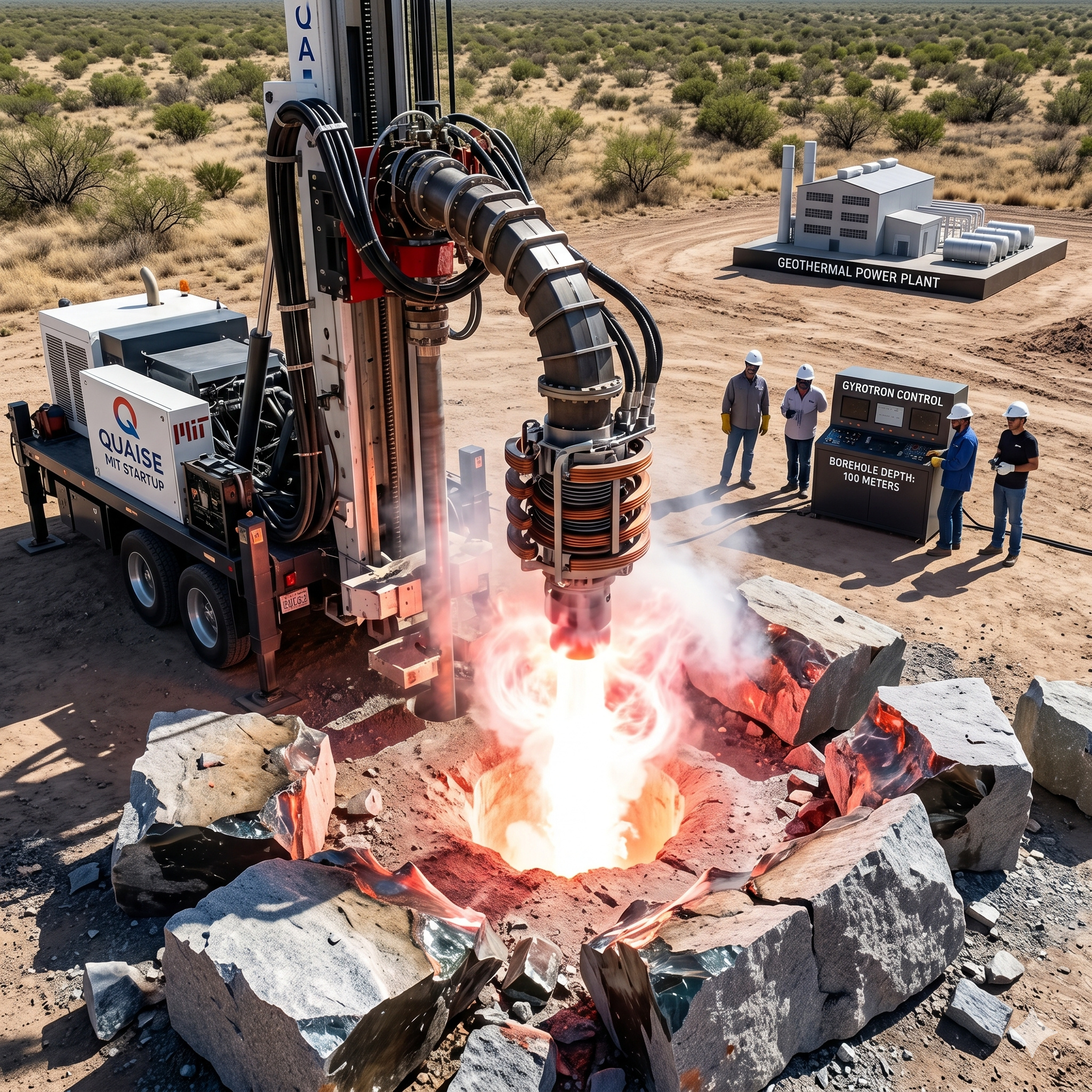

Nuclear fusion-inspired technology drills rock without a bit and could enable global geothermal energy with temperatures up to 500 °C in any region.
On July 22, 2025, Quaise Energy, a startup born from MIT research, announced it had drilled 100 meters into rock in central Texas using its proprietary millimeter-wave technology, a method that replaces the downhole drill bit with high-power electromagnetic energy. According to the company, the achievement marked a record for this type of drilling and brought a technology, which until then had primarily advanced in a laboratory setting, into the field.
The system uses gyrotrons, equipment known in nuclear fusion research, to generate waves capable of heating, melting, and vaporizing hard rocks like granite and basalt without direct mechanical contact at the drilling point. In an analysis published on November 3, 2025, the MIT Energy Initiative reported that Quaise drilled 118 meters in the field in July and then demonstrated advancement in granite at a rate of up to 5 meters per hour, reinforcing the company’s bet on superhot geothermal energy as a firm power source.
The result represents a radical shift in one of the most limited processes in the energy industry: deep drilling.
-
Pennsylvania Mine Creates Ice in Summer Heat and Melts in Winter, Turning a Mountain Crevice into a Reverse Natural Refrigerator

-
China Accelerates Global Expansion of Robotics: From Smart Vacuums to Industrial and Humanoid Machines, Millions Exported to Over 150 Markets
-
Polar Air Mass to Hit Brazil: Temperatures to Plummet in Nine States, Near Freezing in the South with Frost Risk Until Monday
-
Chinese “dark factories” produce electric cars 24/7 with minimal human intervention, as Zeekr assembles 800 units daily, raising concerns in Brazil.




Drill-less drilling eliminates one of the biggest bottlenecks in geothermal energy
Traditional geothermal energy relies on deep drilling to reach natural hot water reservoirs. However, current technology faces significant physical limitations.
Conventional drill bits experience extreme wear when penetrating hard rocks, in addition to presenting depth limitations and increasing costs as they advance underground.


Quaise’s approach eliminates this problem by replacing mechanical contact with thermal energy. The process works as follows:
- millimeter waves are directed at the rock
- the material is heated rapidly
- the rock turns into vapor and is removed from the well
This method prevents physical wear and allows reaching depths that were previously unfeasible with conventional technology.
Goal is to reach up to 20 kilometers deep in any region of the planet
The great differential of the technology is not just in the drilling itself, but in the depth it can reach.
The company’s goal is to reach 10 to 20 kilometers below the surface, where the Earth’s natural crust temperature can reach between 400 °C and 500 °C practically anywhere on the planet.
This level of heat is sufficient to generate high-pressure steam, which can be continuously converted into electricity.

Unlike traditional geothermal energy, which depends on specific geological conditions, this approach seeks to access globally available heat.
Geothermal’s geographical limitation can be overcome
Today, geothermal energy is highly dependent on regions with specific characteristics, such as volcanic activity or the presence of hydrothermal reservoirs.
Countries like Iceland, Kenya, and parts of the United States concentrate most of the world’s geothermal production precisely because they possess these natural conditions.
Quaise’s proposal changes this scenario by focusing on rock heat, rather than the presence of hot water. This means that, in theory, any country could explore deep geothermal energy, regardless of its surface geology.
First pilot plant planned for the United States
The company is already planning the construction of a pilot plant with a capacity of 20 megawatts in the state of Oregon, initially scheduled for 2028.
This project will be the first commercial-scale test of the technology, evaluating its economic and operational viability.
The idea is to integrate the system into existing power plants, using current energy infrastructure to accelerate implementation. The success of this stage will be crucial for validating the technology on a global scale.
Deep geothermal energy can operate 24 hours a day regardless of weather
One of the main advantages of geothermal energy over other sources renewable is its stability. Unlike solar and wind energy, which depend on weather conditions, geothermal energy can operate continuously.
This is because the Earth’s internal heat is constant and does not undergo significant short-term variations. The possibility of generating clean energy continuously positions geothermal as a strategic candidate to complement the global energy matrix.

If deep drilling becomes economically viable anywhere, geothermal energy could play a central role in the energy transition. Currently, much of global electricity still relies on fossil fuels, which have significant environmental impacts.
Deep geothermal offers an alternative with lower greenhouse gas emissions and constant operational capacity. This can help reduce reliance on polluting sources and increase energy security.
Technical and economic challenges still need to be overcome
Despite advancements, the technology still faces significant challenges. Among the main ones are:
- process efficiency at greater depths
- control of vaporized material
- operational cost at industrial scale
Furthermore, deep drilling requires robust thermal control and safety systems. Commercial success will depend on the ability to make the process economically competitive.
Adaptation of nuclear fusion technology expands industrial possibilities
The use of gyrotrons outside the context of nuclear fusion represents a significant innovation. These devices were originally developed to heat plasma in experimental reactors, such as those used in fusion research.
By applying this technology to geological drilling, Quaise creates a bridge between two distinct scientific areas. This technological convergence expands the potential for industrial applications of laboratory-developed equipment.
Brazil emerges as a possible beneficiary of the technology
One of the most interesting aspects of this approach is its applicability in countries that currently do not have significant geothermal exploration.
Brazil, for example, has low conventional geothermal activity but possesses sufficient internal heat at greater depths. With deep drilling technology, regions currently not considered viable could become energy sources.
This opens up the possibility of diversifying the energy matrix in countries that currently depend on other sources.
Contactless drilling could redefine limits of subterranean engineering
Beyond energy, the technology can impact other areas that rely on deep drilling.
Potential applications include:
- mineral exploration
- underground storage
- advanced geological studies
The ability to drill without physical contact reduces wear and expands possibilities for subsurface access. This could redefine the limits of engineering in underground environments.
Given this breakthrough, can geothermal energy cease to be limited to a few countries?
With the possibility of accessing deep heat in any region, the technology developed by Quaise Energy represents a paradigm shift in energy production.
What was once restricted to specific regions can become a global solution, capable of operating continuously and independently of climatic conditions.
The question that arises is direct: if the Earth’s heat is available across the entire planet, will the technology be able to make it accessible on a sufficient scale to transform the world’s energy system?