Portuguese
  Spanish


The largest stadium in the world is under construction in Morocco near Casablanca, with 115 thousand seats and a cost of US$ 500 million, as part of a plan for the 2030 World Cup that uses tourism, airports, hotels, and infrastructure as an African economic strategy for expansion and international projection.
The largest stadium in the world is being built in Morocco, on the outskirts of Casablanca, to accommodate up to 115 thousand fans and strengthen the country’s bid to host the final of the 2030 World Cup. The Grand Stade Hassan II is part of a cycle of works that includes tourism, logistics, airports, hotels, and urban modernization.
The information was published by Exame on July 10, 2026, with an update on the same day at 2:20 PM. According to the report, Morocco will invest around US$ 6 billion in preparation for the 2030 World Cup, while the stadium alone will receive 5 billion dirhams, about US$ 500 million.
115 thousand seat stadium aims for World Cup final
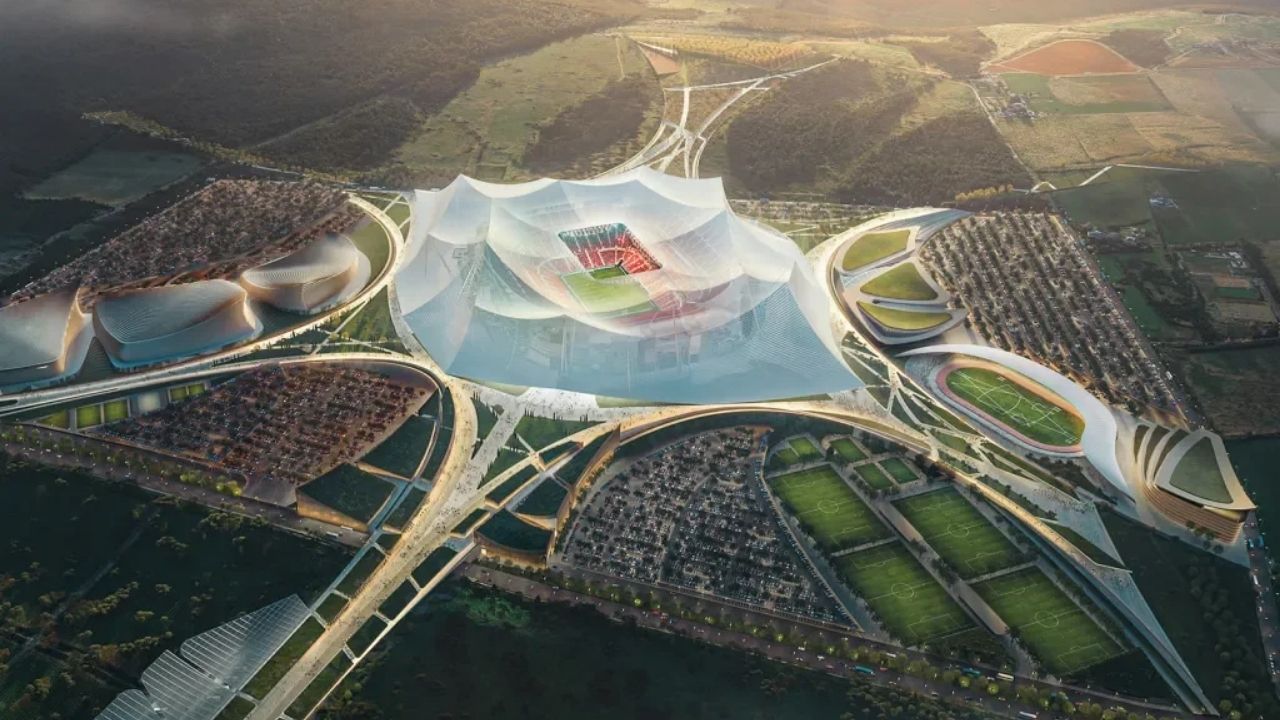
The Grand Stade Hassan II is considered Morocco’s great bet to host the final of the 2030 World Cup. There is still no confirmation from FIFA about the venue for the decision, but the project was designed to put the country in direct competition for one of the most watched moments in world sports.
-
While cities are still demolishing entire buildings to construct from scratch, Sydney preserved 95% of the core of an old tower, nearly doubled its area, and avoided an estimated 12,000 tons of emissions.

-
California wants to dig a 72 km long and 11 meters wide tunnel capable of swallowing more than 609 million liters per hour during “atmospheric rivers,” store the deluge for droughts, and protect the supply for 27 million people.

-
Builder reveals the real cost of roofing with sandwich panels and explains the difference between EPS, PUR, and PIR, showing why calculating only the price of the panel can blow the budget and cause leaks in the construction.

-
285 trucks work non-stop for 54 hours, pour over 24,000 m³ of concrete, and place a religious temple in the Golden Book of World Records with the largest foundation ever built for this type of construction.


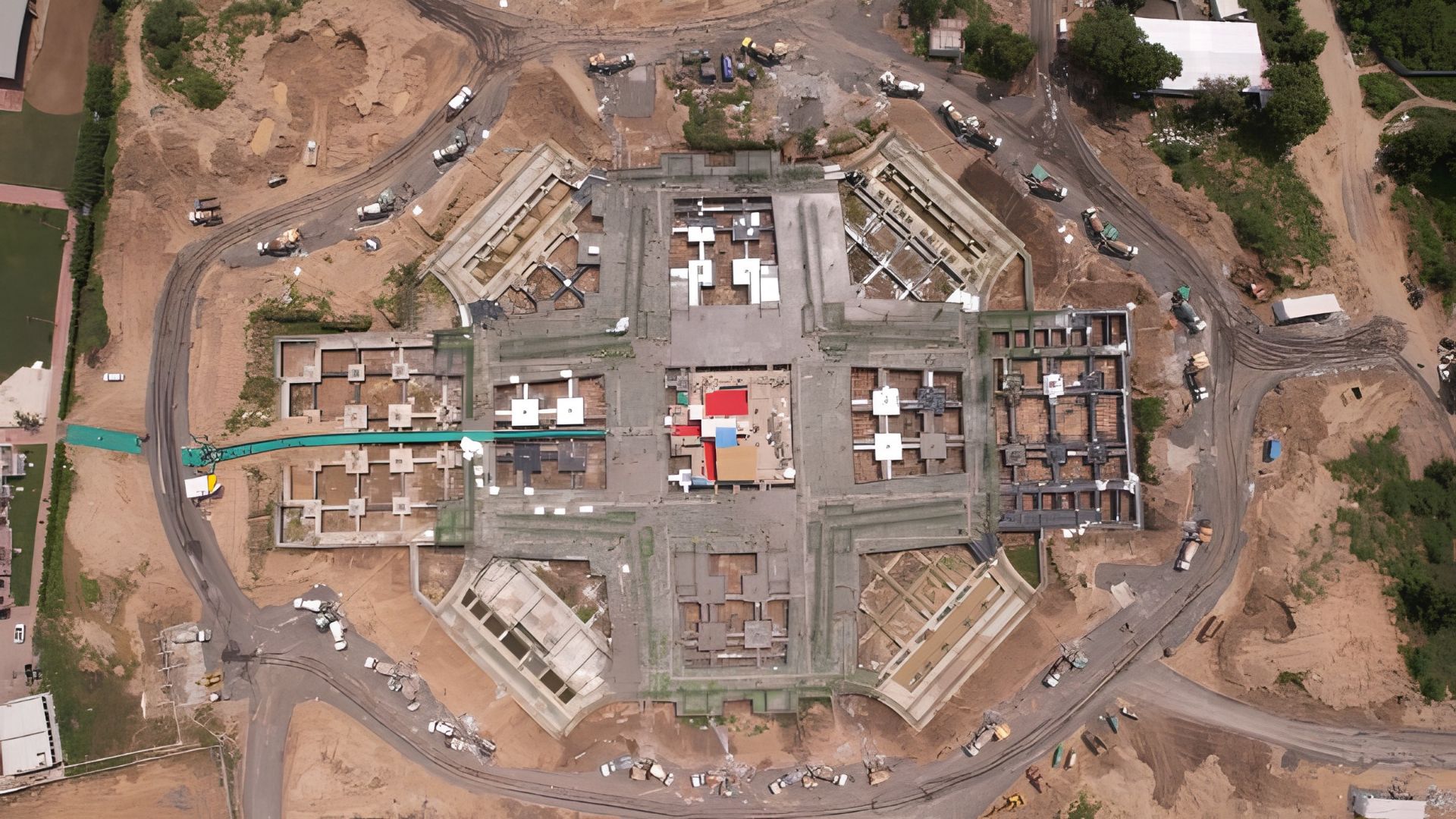
The arena is expected to have a capacity for 115 thousand people, a number that would make the project the largest stadium in the world. The scale of the work shows that Morocco does not just want to host games, but to transform the World Cup into an international showcase of infrastructure, tourism, and economic ambition.
Morocco will host alongside Spain and Portugal
The 2030 World Cup will be primarily organized by Morocco, Spain, and Portugal. Argentina, Paraguay, and Uruguay will also host commemorative matches linked to the tournament’s centenary, but the operational center of the World Cup will be in the axis formed by the three host countries.
For Morocco, the event has both sporting and strategic significance. The country seeks to consolidate its image as a gateway to Africa and as a transforming market. The construction of the largest stadium in the world appears in this context as a symbol of a bid that combines football, diplomacy, and development.
Total investment reaches US$ 6 billion
According to Alexandre Guido Lopes Parola, Brazil’s ambassador to Morocco, the African country will invest around US$ 6 billion in the 2030 World Cup. This amount is part of a broader package of US$ 20 billion involving the World Cup host countries.
The money will be directed to sectors such as tourism, hotels, logistics, transportation, and urban modernization. The World Cup is not being treated merely as a sporting tournament, but as an accelerator of works and economic repositioning, especially in a country that was already expanding its infrastructure.
Grand Stade Hassan II will cost US$ 500 million
Only the Grand Stade Hassan II will receive 5 billion dirhams, approximately US$ 500 million. Of this total, about US$ 320 million will be allocated just to the second phase of construction, according to data cited by Exame.
Completion is scheduled for 2028, two years before the 2030 World Cup. The deadline is relevant because it allows for testing, operational adjustments, and use of the stadium before the tournament. A project of this magnitude needs to be ready before the World Cup to prove safety, access, logistics, and operational capacity.
Airports and hotels included in the construction package
The Moroccan plan also includes investments of about US$ 4.2 billion in airports. The expansion of the air structure is considered essential to accommodate delegations, fans, tourists, press, and suppliers during the World Cup.
The hotel network is also expected to grow. The expectation is to increase capacity by 100,000 to 150,000 new beds and raise the annual flow to 26 million tourists by 2030. The largest stadium in the world is the most visible work, but it does not function alone without hotels, transportation, and airports.
African Cup helped test the country’s capacity
Before the World Cup, Morocco used the African Cup of Nations as a kind of rehearsal for major events. According to the report, the tournament generated more than € 1 billion, about US$ 1.17 billion, in economic impact for the country.
The competition also boosted the arrival of 19.8 million tourists in 2025, a historic record and a 14% increase over the previous year. Additionally, it would have created approximately 100,000 direct and indirect jobs. These numbers help explain why the country sees the World Cup as an economic engine.
Projects that would take ten years advanced in two
According to the Brazilian ambassador, projects that would normally take ten years were completed in approximately two years. He stated that about 80% of the infrastructure needed for 2030 is already underway.
This acceleration shows how major events can alter the pace of public and private works. At the same time, it increases the pressure for planning, supervision, and continuity after the tournament. The big question is whether the legacy will remain for the population or if part of the structures will lose utility after the World Cup.
Tourism and construction drive the transformation
Morocco has about 40 million inhabitants and a Gross Domestic Product of approximately US$ 194 billion. The economy is driven by sectors such as industry, tourism, construction, agriculture, mining, logistics, and renewable energies.
The 2030 World Cup is expected to reinforce this expansion cycle. According to Parola, the event could add between 1% and 1.5% to economic growth during its occurrence. The largest stadium in the world is part of a larger plan to attract tourists, investments, and international visibility.
Relationship with Brazil still has room to grow
The report also highlights that the Brazilian business presence in Morocco is still small. While France and Spain each have about 800 companies operating in the country, Brazil does not yet have a large company firmly established in the Moroccan market.
The main expectation mentioned involves Embraer, which already has a small structure in the country and is considering expanding its presence. The aerospace sector is considered strategic for Morocco, which hosts international operations and a growing chain of suppliers and component manufacturers.
Bilateral trade involves food and fertilizers
The trade relationship between Brazil and Morocco grew from the late 1990s and consolidated in the 2000s. Brazil expanded sales of agricultural products and food, such as sugar, corn, meats, and coffee, while Morocco became a strategic supplier of phosphate fertilizers.
Cooperation also advances in agricultural research. Brazilian universities and Embrapa develop projects with Moroccan institutions on topics such as agriculture in arid regions, food security, fertilizers, and efficient water use. The World Cup can expand this dialogue by exposing the country to new business opportunities.
Stadium becomes a symbol of a larger dispute
The Grand Stade Hassan II embodies the strongest image of Morocco’s preparation for 2030. A stadium with 115,000 seats, with an estimated cost of $500 million, has an immediate impact on the sports and tourism imagination.
But the project also carries a political and economic message. Morocco is trying to demonstrate its ability to execute large projects, attract visitors, modernize cities, and compete as an African platform for global companies. Therefore, the largest stadium in the world is also a piece of international positioning.
World Cup can leave a showcase or a challenge for later
By 2030, Morocco will try to transform the World Cup into a showcase for infrastructure, tourism, construction, industry, and international relations. The competition for the final at the Grand Stade Hassan II will be just one part of this strategy.
The challenge will be to ensure that the billion-dollar investment generates continuous use after the tournament. Do you think building the largest stadium in the world can consolidate Morocco as an African tourism powerhouse, or does this kind of project risk becoming an overly expensive symbol after the World Cup? Share your opinion.