





 Portuguese
  English
  Spanish
  6 min of reading
  0 comments


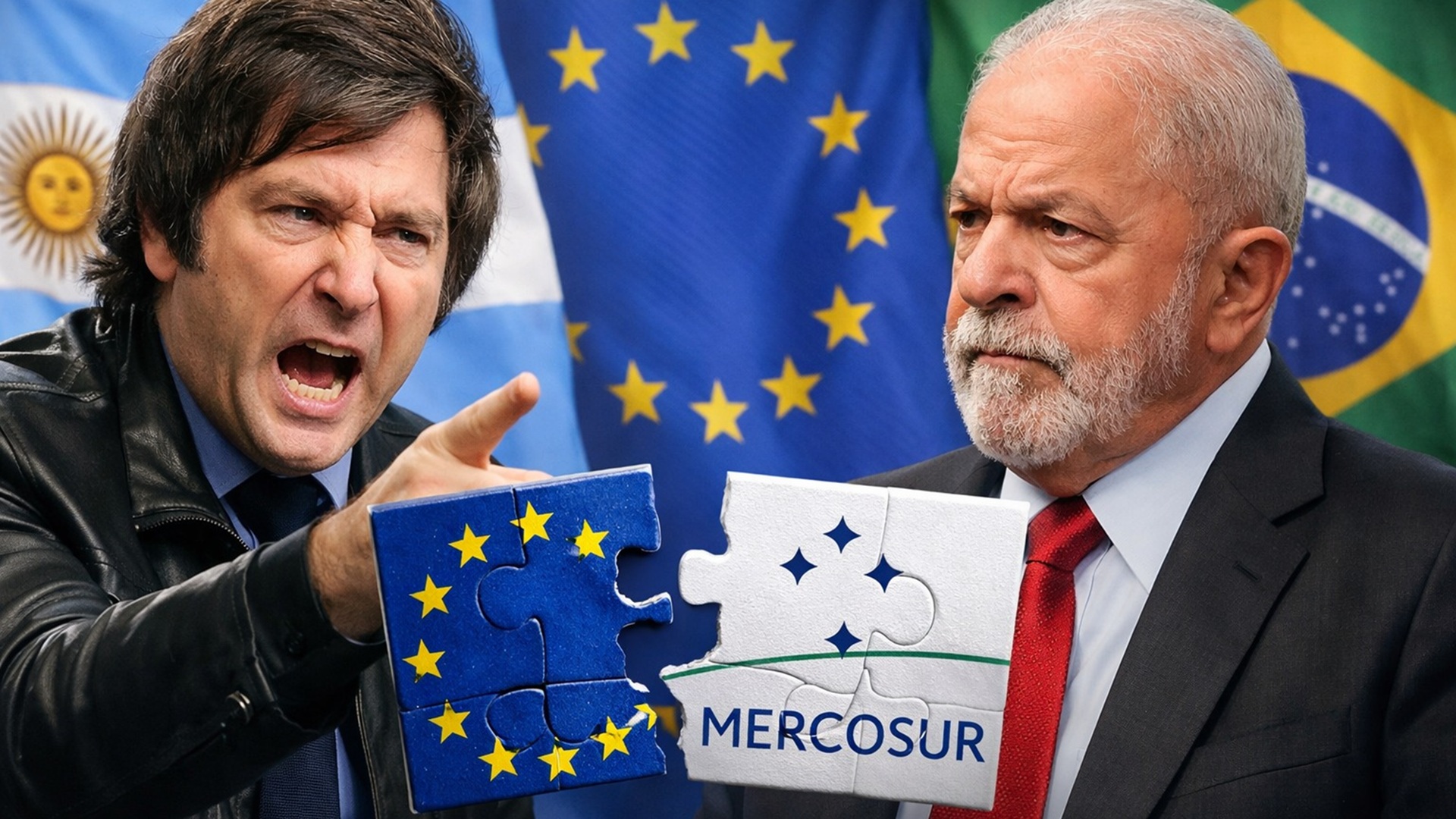
The Decision of the Brazilian President Not to Attend the Signing of the Mercosur-European Union Agreement in Asuncion Provoked a Strong Reaction from the Argentine Government, Which Accused Lula of Weakening the Regional Block, Extended the Diplomatic Wear, and Exposed Internal Political Divisions in Mercosur on the Eve of a Pact Considered Historic
President Luiz Inácio Lula da Silva will be the only leader from the Mercosur countries not to attend the signing of the free trade agreement with the European Union, scheduled for this Saturday (17), in Asuncion, Paraguay, with the presence of Argentina’s Milei.
Brazil will be represented by Foreign Minister Mauro Vieira, while the Brazilian government prioritizes political meetings in Rio de Janeiro with European leaders.
The ceremony will be attended by the President of the European Commission, Ursula von der Leyen, and the President of the European Council, António Costa, in addition to the Presidents of Argentina, Uruguay, Bolivia, and Paraguay, the country that holds the temporary presidency of the block and hosts the event.
-
Another market will take the place of Carrefour and the arrival of a new brand promises to stir up the retail scene with a model that combines wholesale, supermarket, and full services.

-
While the end of the 6×1 schedule becomes a national debate, Brazilians work almost 2,000 hours a year, have the 4th longest working hours in South America, and still live in one of the most unequal countries in the region, showing that working too much does not mean better income distribution.

-
A construction company from Paraná invested R$ 90 million in its own machinery and doubled in size with Sabesp: the company reaches R$ 560 million in revenue, takes on a R$ 1.4 billion project, and escapes the bottleneck that hinders infrastructure.

-
With deep ports and strategic railway, Espírito Santo advances to compete with Santos and attract foreign trade cargo.


Meeting in Rio Is Treated as a Priority by Brazilian Diplomacy
The day before the signing, Lula received Ursula von der Leyen in Rio de Janeiro, a meeting viewed by Brazilian diplomacy as strategically more relevant than the ceremony in Asuncion.
The internal assessment is that the meeting reinforces Brazil’s role as the main political articulator of the agreement between Mercosur and the European Union.
According to sources, European leaders sought a direct agenda with Lula to attribute prominence to the Brazilian president in the final phase of negotiations.
The goal would be to consolidate Brazil’s image as the political guarantor of the pact, even though the temporary presidency of Mercosur is under Paraguayan command.
For Itamaraty, the political weight of the meeting in Brazil outweighs the symbolism of the formal signing in Paraguay. The assessment is that the signing should occur at the ministerial level, justifying the presence of Foreign Minister Mauro Vieira, and not the Brazilian head of state.
Attempt to Elevate Ceremony to Presidential Summit Generates Divergence
Brazilian authorities claim that the Paraguayan government tried to elevate the level of the meeting in Asuncion at the last minute to a heads of state meeting. The initiative was not well received by Itamaraty, which maintained its position to treat the signing as a chancellors’ act.
Today, according to diplomatic sources, Lula sought a “victory photo” alongside the main authorities of the European Union. The understanding is that the symbolic construction of this meeting would have a greater political impact than the protocol presence at the formal signing of the agreement.
The Brazilian strategy also considers the context of bilateral relations within Mercosur, especially with Argentina, whose president will participate in the event in Asuncion.
Agreement Is Presented as a Historical Achievement by Leaders
During the meeting in Rio de Janeiro, Lula classified the delay in concluding the agreement as a result of “25 years of suffering and attempts at an agreement.” The president stated that the pact goes beyond the economic dimension by bringing together two blocs that share values related to democracy, the Rule of Law, and human rights.
In her speech, Ursula von der Leyen defined the agreement as an achievement of “an entire generation” and thanked Lula for leading the political negotiations that allowed the final advancement of the negotiations. The public acknowledgment reinforced the Brazilian strategy to centralize the political prominence of the agreement in Brasília.
The government’s view is that the bilateral meeting strengthens Brazil’s leadership narrative in the process, even without the president’s physical presence at the signing.
Absence Avoids Stage Divide with Javier Milei
Another factor considered in Lula’s decision was to avoid sharing the stage with Argentine President Javier Milei, with whom he maintains a protocol and distant relationship. The Brazilian leader’s absence at the ceremony generated discomfort in the Casa Rosada, which interpreted the gesture as disdain for the regional block.
A senior Argentine government official stated to MDZ that Lula’s decision would demonstrate contempt for Mercosur and its members. The criticism comes at a time of increasing tension between the two governments, marked by recent political and diplomatic divergences.
The relationship between Lula and Milei is described as one of the coldest since the beginning of the current Argentine government, with indirect exchanges of criticism and opposing positions on sensitive regional issues.
Economic Dimension of the Agreement and Global Reach
The trade agreement between Mercosur and the European Union aims to create the largest free trade market in the world. The pact encompasses over 700 million people, represents about 35% of global trade, and over 30% of the world’s GDP, according to the terms presented.
Among the main points are the elimination of most trade tariffs between the two blocs and preferential access for Mercosur products to the European market. The text provides specific quotas for exports of meat, corn, and ethanol, as well as rules for services and government purchases.
The agreement also regulates mutual access to public markets and establishes common parameters for strategic sectors. These provisions are highlighted as central for the long-term economic integration of the blocs.
Political Context Deepens Internal Divisions in Mercosur
Initially, the participation of presidents in the signing was not planned. The decision to attend occurred after Paraguayan President Santiago Peña opted to participate, followed by Yamandú Orsi and Javier Milei.
Sources in Brasília informed AFP that invitations to the heads of state were sent at the last minute, which made Lula’s attendance unfeasible. The official justification reinforces that the event was conceived as ministerial from the beginning.
Beyond the formal explanations, the Brazilian absence reflects deeper political divisions within Mercosur and the South American region. These tensions heightened after the intervention of American troops in Venezuela and the capture of Nicolás Maduro.
Regional Crisis and Impact on Brazil-Argentina Relations
While Brazil, Uruguay, Colombia, and Chile condemned the violation of international law, sectors of the regional center-right led by Milei celebrated the fall of the Venezuelan regime. The episode aggravated an already tense relationship between Brasília and Buenos Aires.
Posts from libertarian groups associating Lula with the Venezuelan regime and public statements from Milei in support of the Bolsonaro family increased diplomatic wear. The Brazilian government reacted by suspending administrative functions it had exercised at the Argentine Embassy in Venezuela since August 2024.
The decision was communicated to the Argentine Foreign Ministry, led by Pablo Quirno, and generated further controversy between the two countries. The gesture was interpreted as yet another sign of political distancing.
Visit of European Leaders Increases Argentine Discomfort
The announcement that António Costa and Ursula von der Leyen would be received by Lula in Rio de Janeiro, just before the summit in Asuncion, was not well received by the Argentine government. The official statement from the European Union highlighted Brazil as a key partner in trade, investment, climate, and democracy.
The text emphasized that Brazil’s recent presidency of Mercosur was crucial for the advancement of negotiations, paving the way for the signing of the agreement in Paraguay. The declaration intensified discontent within the Argentine libertarian government.
For Brazilian diplomats, the visit reinforces Brazil’s centrality in the process, even amid regional frictions and the president’s absence from the formal ceremony.
Ministerial Signing and Next Steps Until 2026
At the Asuncion ceremony, Brazil will be represented by Mauro Vieira, who will sign the agreement alongside his counterparts from Mercosur, including Pablo Quirno, Rubén Ramírez Lezcano, and Mario Lubetkin.
To come into effect, the agreement still needs to be ratified by the European Parliament and by the national congresses of the Mercosur countries. If there are no significant setbacks, the expectation is that the pact will come into force by the end of 2026.
The ratification process will be crucial to turning the agreement into a legal reality, ending a negotiation cycle that has lasted over two decades and defining trade relations between two of the largest economic blocs in the world.







-

-

-

6 people reacted to this.