Portuguese
  Spanish


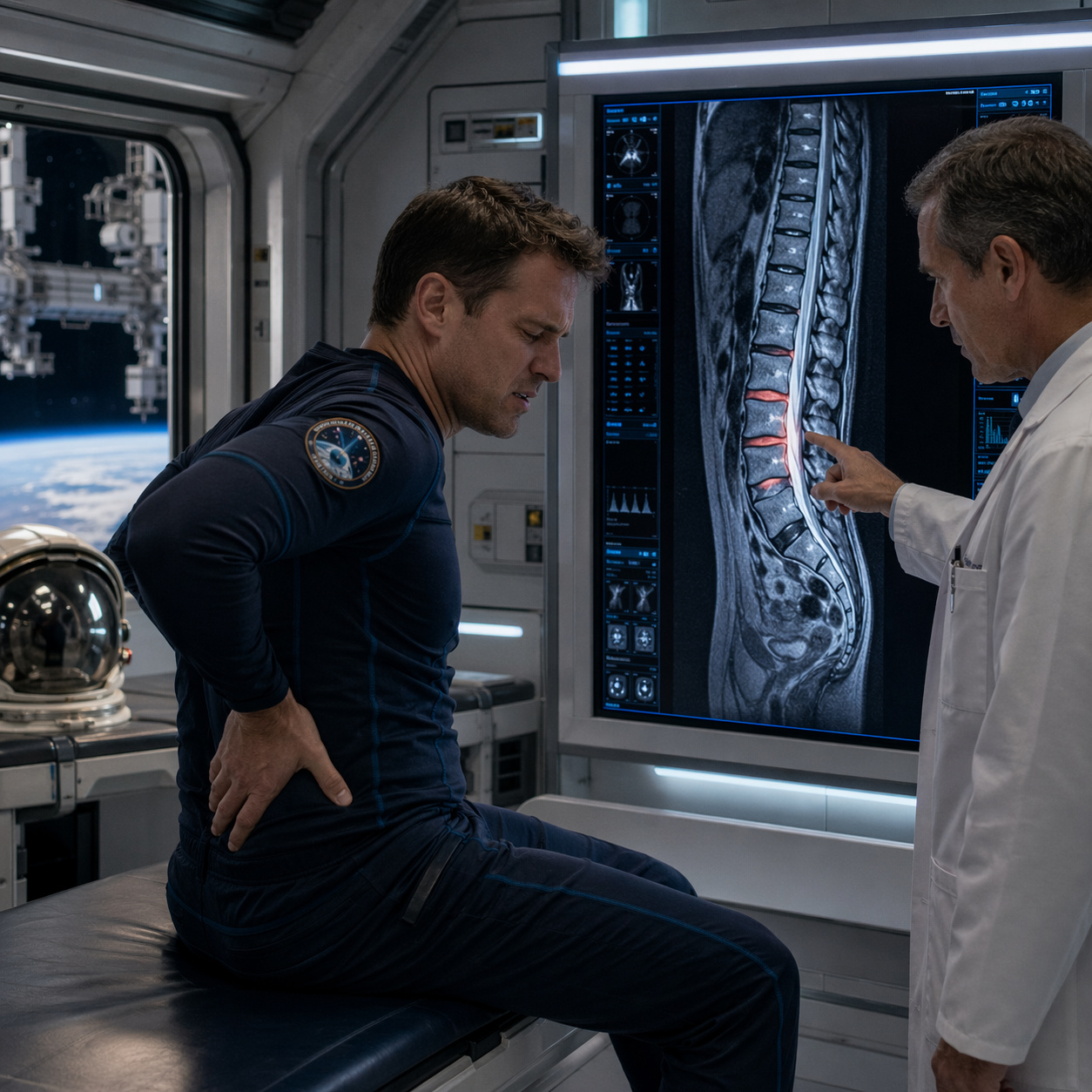

Astronauts can grow up to 3% in space, but the spine suffers, pain arises, and NASA warns of injury risk after returning to Earth.
In materials and technical reports published by NASA between April 2018 and March 2025, the agency recorded a phenomenon that, at first glance, seems positive but carries important medical implications: astronauts can increase their height by about 3% in the first few days in microgravity. This growth occurs mainly due to the stretching of the spine, as the absence of the constant axial load of Earth’s gravity alters the mechanics of the spine and directly influences height in flight.
However, the effect does not represent a healthy physiological gain. NASA itself highlights that the elongation of the spine and changes in the intervertebral discs are linked to more frequent reports of lower back pain during the mission and concerns about injuries after returning to gravity. In the technical report published in March 2025, the agency states that prolonged exposures to microgravity are associated with an increase in complaints of back pain and may be related to disc changes observed in the post-flight period.
This set of changes has come to be treated as one of the relevant medical risks in long-duration missions, especially in future scenarios involving prolonged stays outside Earth, such as trips to the Moon and Mars.
-
She spent 73 years breathing inside an iron lung, survived the aftereffects of polio, and became the last woman in the United States dependent on the equipment before dying at 78 years old.

-
Brazilian students created a $1 filter using pine bark, cotton, and 3D-printed parts to clean cassava wastewater, reduce the toxicity of a hazardous waste, and transform contaminated water into biofertilizer.

-
Astronaut from Artemis II steps down after mission to the Moon and decision surprises after a record of 406,771 km, a historic 10-day journey, and an unprecedented achievement for Canada.

-
A fossil kept for years in a small museum in Montreal concealed 450-million-year-old soft tissue, a discovery that has only happened once before in history.


Microgravity eliminates spinal compression and completely alters body biomechanics
On Earth, the spine is constantly subjected to the action of gravity. This weight compresses the intervertebral discs throughout the day, causing a person’s height to vary by a few millimeters between morning and night.
In space, this mechanism ceases to exist. Without gravitational force, the discs expand, increasing the space between the vertebrae.
This process leads to a temporary increase in height but also causes an important change in the biomechanics of the spine. The muscles that stabilize the lower back begin to work less, while the ligaments and discs take on a different load than usual. This combination creates a scenario where the spine is more elongated but less stable and more vulnerable to discomfort and internal tensions.
Back pain arises early in missions and affects a large part of astronauts
NASA itself acknowledges that lower back pain is a common symptom in space missions. In many cases, it appears within the first few days after adapting to microgravity.
Studies cited by the agency indicate that a significant portion of astronauts report some level of discomfort in their backs during flight. This symptom is directly linked to the stretching of the spine and changes in the distribution of forces on the tissues.

The pain can range from mild to moderate, but its impact goes beyond physical discomfort. In an environment where every movement needs to be precise and controlled, any alteration in body stability can influence the crew’s operational performance.
The most critical risk appears on return, when gravity returns to compress the spine
The most delicate moment does not necessarily occur during the mission, but upon returning to Earth. After weeks or months in microgravity, the spine is adapted to a state of elongation. When the astronaut is subjected to gravity again, a rapid and intense compression occurs on the intervertebral discs.
This process can increase the risk of injuries, especially in structures that were already under tension during the flight.
NASA has begun to monitor this risk more closely after identifying that astronauts may have a higher likelihood of developing intervertebral disc injuries after space missions.
This type of injury can affect mobility, cause persistent pain, and require prolonged recovery, which becomes critical in scenarios where the astronaut needs to be functional immediately after landing.
Studies indicate increased risk of herniated disc after space missions
Research conducted with astronauts returned from long-duration missions has shown a relevant fact: the incidence of herniated discs may be higher in this group compared to the general population.
This increased risk is associated with the cycle of expansion and compression experienced by the spine during and after flight.

During the mission, the discs absorb more fluid and expand. Upon return, this swollen structure is subjected again to gravitational load, which may favor fissures or displacements.
This mechanism transforms an apparently harmless effect, such as increased height, into a relevant biomechanical risk factor.
Muscle changes aggravate the problem by reducing spinal stability
Another factor contributing to the risk is the loss of muscle mass in microgravity. Even with intense exercise routines aboard the International Space Station, astronauts still experience some degree of muscle atrophy, especially in the muscles responsible for postural support.
With weaker muscles, the spine loses part of its natural support. This means that upon returning to Earth, the vertebral structure must cope with greater loads without the same level of muscular protection.
This combination of more vulnerable discs and weakened musculature increases the likelihood of injuries in the post-mission period.
Functional impact may compromise performance right after landing
The concern about spinal injuries is not only medical but also operational. In many scenarios, especially in more complex missions, astronauts need to be able to perform tasks immediately after landing, including capsule evacuation, movement in hostile environments, or supporting other crew members.
Changes in the spine, lower back pain, or limited movement can compromise this ability. This transforms a physiological problem into a direct risk to mission safety.
In light of these risks, NASA has been developing strategies to mitigate the effects of microgravity on the spine.
Among the approaches studied are:
- Specific exercise programs for strengthening the lumbar musculature
- Equipment that simulates axial load on the body
- Continuous monitoring of the spine through examinations before and after missions
- Development of post-flight reconditioning protocols
Despite these efforts, the agency acknowledges that there is still no complete solution to eliminate the effects of microgravity on the spine. The problem continues to be treated as an active risk in long-duration missions.
Moon and Mars missions increase concern about spinal health
The impact of this phenomenon takes on an even greater dimension when considering the future of space exploration. Moon missions may last weeks or months, while trips to Mars could extend for years.


In these scenarios, the accumulated effects on the spine may be more intense, and the return to gravity may occur under even more challenging conditions.
Furthermore, in long-distance missions, there is no possibility of quick evacuation or immediate specialized treatment.
This means that spinal problems may evolve without adequate intervention, increasing the risk of physical impairment of the crew.
Changes in the spine reveal a little-visible limit of human adaptation to space
The case of spinal expansion illustrates a central point of space medicine: not all risks are immediate or visible.
Unlike technical failures or external events, physiological changes can develop gradually and silently.
The increase in height may seem like a curious effect, but it is directly linked to structural changes that affect the integrity of the spine.
This type of adaptation reveals that the human body is still far from being fully compatible with prolonged microgravity environments.
In light of this scenario, to what extent can the human body endure long periods outside Earth’s gravity?
The expansion of the spine, lower back pain, and the risk of injuries upon return raise a fundamental question for the future of space exploration.
As missions become longer and more ambitious, the accumulated effects on the human body begin to represent a challenge as significant as any technological obstacle.
If something seemingly simple like the absence of gravity can already alter the structure of the spine and increase the risk of injury, to what extent will the human body be able to adapt to even longer journeys away from Earth?