Portuguese
  Spanish


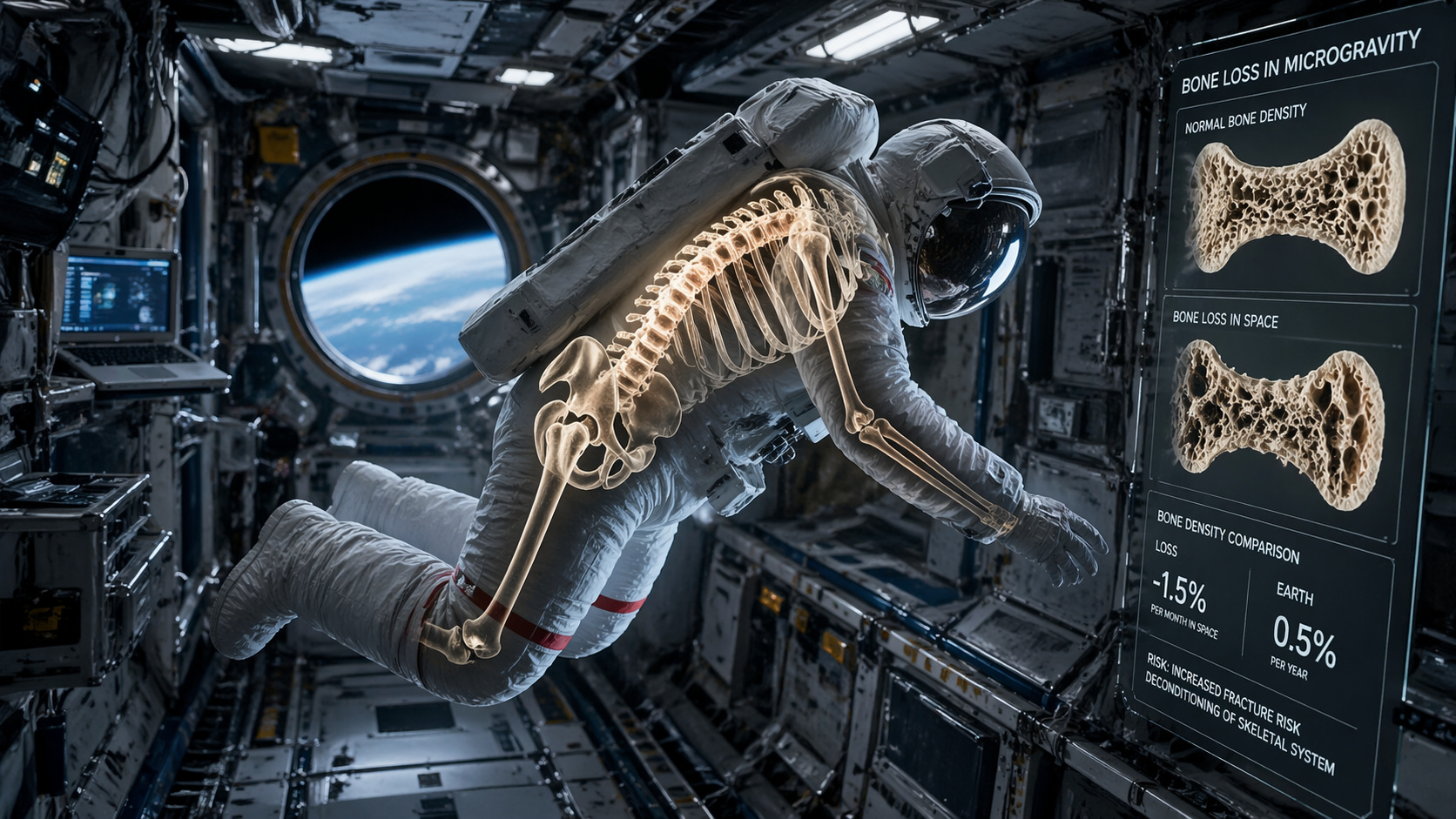

Research reveals extreme impact of absence of gravity on the human body and shows how the skeleton can undergo changes similar to accelerated aging in space
Life in space has always been surrounded by fascination and technological advancements. However, behind the stunning images of Earth seen from orbit lies an increasingly concerning biological reality. Astronauts who spend long periods in microgravity are facing an alarming phenomenon: accelerated bone loss, which in some cases can simulate a true “melting” of the bones.
This information was released by “NASA”, through recent updates on research conducted aboard the International Space Station (ISS), involving studies with bone stem cells and continuous monitoring of astronaut health. According to the data, the effects of absence of gravity on the human skeleton are more intense than previously thought.
Bones in space: a process comparable to extreme aging

Under normal conditions on Earth, bones are in constant renewal, balancing formation and resorption. However, in the microgravity environment, this balance is disrupted. As a result, astronauts begin to exhibit symptoms similar to those of the elderly, with significant loss of bone density.
-
Six Helicopters to Drop 550 Tons of Poison on Island Near Antarctica to Eradicate Mice Threatening Albatrosses and 19 Seabird Species.

-
Russia Unveils Poseidon: A 20-Meter Nuclear Torpedo-Drone with 10,000 km Range, 185 km/h Speed, and 100-Ton Capacity Threatening Coastal Cities with Radioactive Waves
-
Brazilian Innovator Converts Old Car into Electric Vehicle Using Laptop Batteries and Forklift Motor, Achieves Nearly 90 km/h in Urban Settings

-
Samsung Unveils Smart Oven with Built-In Camera, AI Food Recognition, and Real-Time Monitoring via Smartphone.




Furthermore, this process occurs at an accelerated rate. Within a few weeks, the body starts to reduce bone mass, primarily in areas such as the legs, hips, and spine — regions that, on Earth, support the body’s weight. Without this mechanical load, the body understands that it does not need to maintain the same structure, leading to the progressive degradation of bone tissue.
Meanwhile, scientists are deeply investigating the mechanisms behind this change. During the mission, NASA flight engineer Jonny Kim processed bone stem cell samples inside the Japanese Kibo module, using the Life Science Glovebox. The goal was to analyze, at the molecular level, how microgravity interferes with bone regeneration.
Consequently, the results of these analyses may not only help astronauts but also pave the way for treatments of bone diseases on Earth, such as osteoporosis and age-related degeneration.
Microgravity, brain, and adaptation: the whole body undergoes transformation
On the other hand, the effects of life in space are not limited to bones. The Roscosmos cosmonaut, Oleg Platonov, participated in brain-focused experiments, using virtual reality to understand how the body adapts to the absence of gravity.
This type of study is essential, as the balance and spatial orientation system undergoes profound changes outside of Earth. Thus, researchers can understand how the brain “relearns” to function in an environment where there is no reference for up or down.
At the same time, other experiments continue to monitor impacts on different parts of the body. NASA flight engineer, Zena Cardman, for example, participated in eye exams with the Ultrasound 2 equipment, allowing doctors on Earth to monitor changes in the cornea, lens, and optic nerve in real-time.
In addition, operational tasks are also part of the routine. Cardman conducted checks on space suits in the Quest module, including pressure tests and inspections of safety systems, such as propulsion backpacks that can save an astronaut’s life in case of an emergency.
The scientists’ warning: a silent risk for the future of space exploration
In light of this scenario, the warning from the scientific community becomes increasingly evident. Accelerated bone loss is not just a side effect — it can represent one of the greatest obstacles for long-duration missions, especially those involving trips to Mars.
This is because, upon returning to Earth, astronauts need time to regain strength and bone density. In longer missions, this impact can be even more severe, increasing the risk of fractures, physical limitations, and even compromising the mission.
Meanwhile, new missions continue to be planned. The next ISS resupply operation, involving SpaceX, Northrop Grumman, and NASA itself, aims to send more scientific equipment and supplies to the orbital laboratory, expanding research on human health in space.
Therefore, although space exploration continues to advance, biological challenges still represent a critical barrier. And, as the latest studies show, understanding how to prevent bones from “melting” may be the key to ensuring that humanity can indeed reach further into the universe.