Portuguese
  Spanish


With 25 apartments, eight social rental units, and collective spaces integrated into the building, New Ground Cohousing in London shows how architecture, social housing, and community management can create residential alternatives for an aging population.
In High Barnet, north of London, a residential development of 25 apartments was designed to address an increasingly common challenge in cities: how to create suitable housing types for older people without limiting the solution to long-term care institutions or conventional condominiums.
New Ground Cohousing combines independent apartments, collective areas, service spaces, and an occupancy model that mixes long-term units with eight apartments designated for social rental.
The case gained relevance in the housing debate because it is not limited to neighborly coexistence. The project involves residential architecture, urban design, construction efficiency, access to social housing, housing finance, and participation of future residents in the planning of the building.
-
After a court-ordered shutdown years ago, Onça Puma nickel mine in Brazil’s Pará region restarts, boosting production from 25,000 to 40,000 tons annually, becoming the largest ferronickel operation in Brazil while staying 13% under budget.

-
World’s Largest Playing Card Manufacturer is Belgian, Producing Everything from Market Decks to Pokémon, Magic, and Las Vegas Casino Cards
-
World’s Largest Cork Producer in Portugal Harvests Over 5 Billion Corks Annually from Trees Without Cutting Them Down
-
Most of the world’s wigs and hair extensions are made from Indian human hair and assembled in a single Chinese city, the global wig capital, where 300,000 people rely on this billion-dollar industry.


Housing project mixes long-term apartments and social rental units
The development has 25 apartments for 26 residents. Of these, 17 units operate under the leasehold model, a British long-term occupancy contract, while the other eight are designated for social rental.
This combination is one of the most relevant aspects of the project. Instead of creating a condominium restricted to people with purchasing power, the building incorporated housing for residents with lower income within the same residential structure.
The World Habitat case study highlights that the inclusion of the eight social units required coordination between the community, housing associations, and local authorities. The organization Housing for Women was responsible for the land ownership and management of the social rental units.
In practice, the model demonstrates that collaborative housing can be combined with affordable housing mechanisms, something uncommon in developments of this type in the United Kingdom.
Architecture of New Ground uses private apartments and collective structure to organize the building
New Ground was not designed as an institutional residence. Each unit has its own housing structure, while the shared spaces were incorporated as part of the building’s infrastructure.
The complex includes one, two, and three-bedroom apartments, as well as a communal kitchen, dining area, meeting room, laundry, drying space, guest room, inner courtyard, and community gardens.
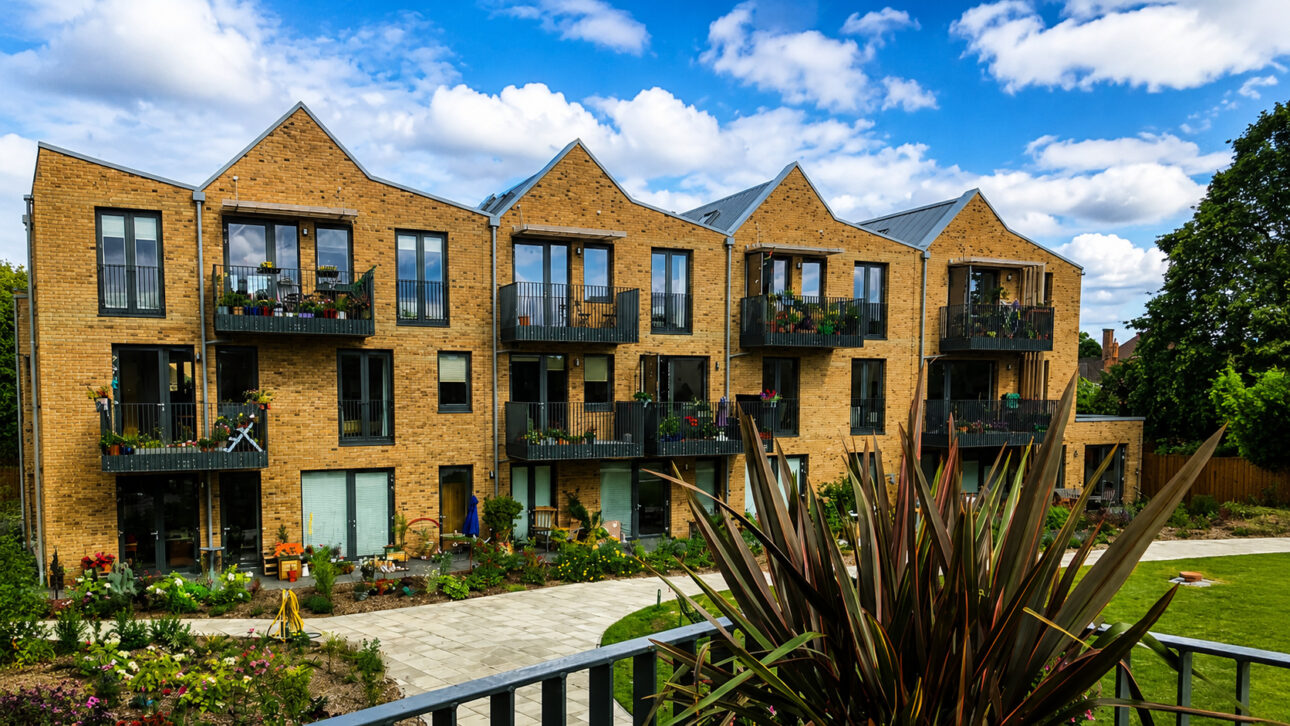
The architectural project adopted a “T” shaped configuration, concentrating shared areas, circulation, and gardens in locations that facilitate apartment access to common spaces.
According to Pollard Thomas Edwards, the architecture firm responsible, the layout aimed to ensure natural lighting and views for each apartment, while the communal spaces were positioned as the functional core of the development.
Project adopts thermal envelope strategy with orientation, insulation, and airtightness
In addition to the organization of apartments and communal areas, the project incorporated principles of construction efficiency. The architecture firm describes the strategy as fabric first, a concept that prioritizes the building envelope’s performance before the installation of additional equipment.
In practice, this means working on solar orientation, thermal insulation, sealing, air tightness, and material performance from the design phase. The idea is to reduce reliance on subsequent corrective solutions and improve the building’s thermal behavior.
The architectural brief of the development also aimed to meet level 4 of the former Code for Sustainable Homes, a British reference used to assess environmental efficiency and residential performance.
Shared management transforms residents into part of the operation of the development
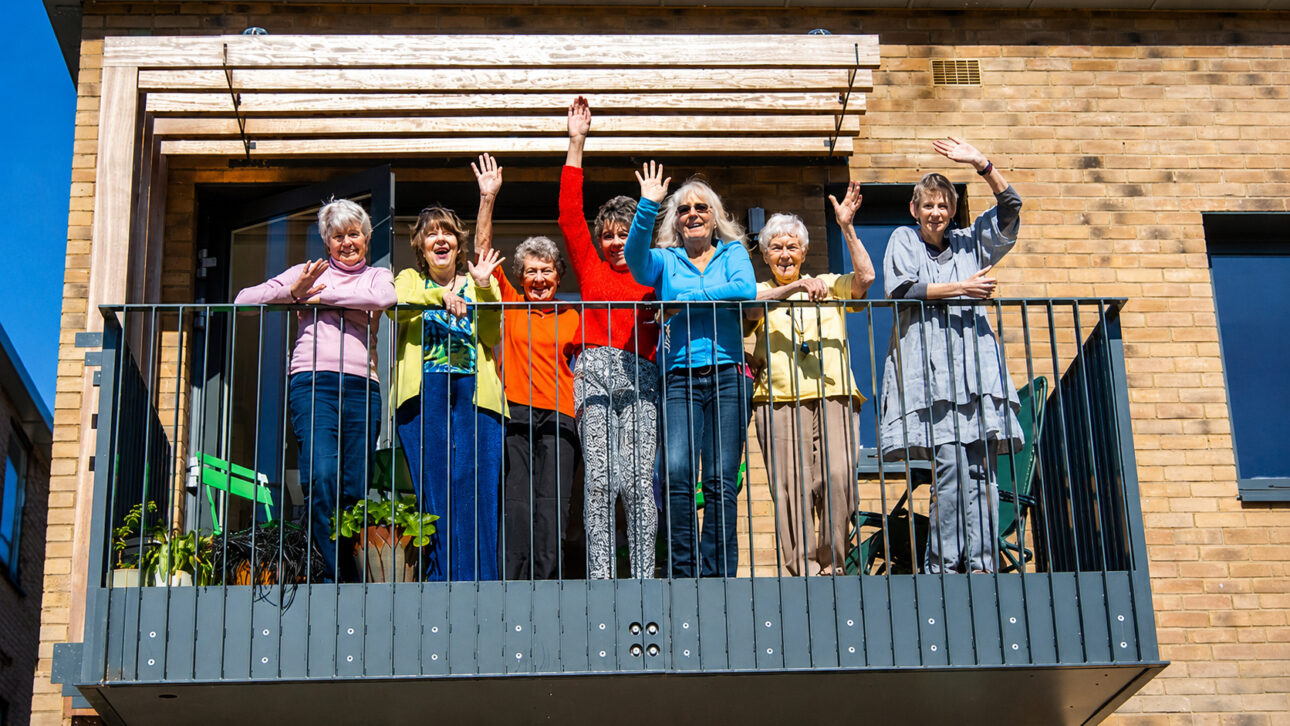
Another aspect that differentiates New Ground is the management approach. The community was structured as a non-profit mutual organization, where each resident has the right to participate in collective decisions.
The residents work in groups responsible for topics such as finance, building maintenance, gardens, communication, diversity, entry of new members, and organization of common areas.
This does not eliminate the need for suppliers, contracts, technical maintenance, or professional management. But it changes the role of the residents, who cease to be merely buyers or tenants and start participating in the choices that influence the building’s operation.
Investment of millions of pounds shows that the model depends on land, financing, and housing partnerships
The study published by World Habitat records a total investment of about £7.7 million to make the project feasible. The amount reveals that collaborative housing models require much more than goodwill among future residents.
The project needed to combine land, urban planning approval, partnership with a housing association, specialized architecture, financing, and a legal structure capable of accommodating private units and social rental apartments in the same building.
During the development phase, the Hanover Housing Association took on the role of project developer. The participation of future residents occurred during planning and construction, including defining features of the project.
The values presented in the study are historical references of the project’s development and do not represent current construction, purchase, or rental costs in London.
The case of London raises debate on social housing, architecture, and urban aging
New Ground should not be treated merely as a cohabitation experience. The project functions as an example of housing for aging that combines complete apartments, collective areas, social rental, participatory management, and architectural solutions designed for long-term residential use.
For Brazilian cities, the experience raises practical questions: how to expand the supply of adaptable properties? How to include social rental in new developments? How to use public or private land for projects aimed at different income levels? And to what extent could future residents participate in construction planning?
The model also makes it clear that collaborative housing does not replace health, social assistance, or popular housing policies. However, it can become a complementary tool when planned with legal security, income diversity, architectural quality, and adequate urban infrastructure.
By bringing together 25 apartments, eight social rental units, shared areas, and community management, the London building shows that the discussion about aging does not need to be restricted to assistance: it also involves construction, urban planning, financing, and access to housing.
For Brazilian cities, what would have more impact: building adaptable properties, expanding social rental, or allowing future residents to participate in the design of developments?