Portuguese
  Spanish



Understand How Bahia Leads Renewable Matrix in Brazil by Uniting Planning, Clean Sources, and Public Policies That Attract Billion-Dollar Investments and Strengthen Energy Transition
The Bahia Leads Renewable Matrix in Brazil and, at the same time, solidifies itself as one of the main hubs of clean energy in Latin America. Over the past few years, the state has not only taken advantage of favorable natural conditions, but also structured consistent public planning and, furthermore, built a secure institutional environment for national and international investors.
Thus, this set of factors explains why Bahia attracts new billions in energy investments and, consequently, maintains a continuous growth trajectory, with direct impacts on economic, social, and environmental development.
In addition to its natural potential, the state government has early on organized a stable regulatory framework. This has reduced uncertainties and, at the same time, has increased the confidence of companies and investment funds. In this context, this stability becomes even more relevant, especially because the energy sector relies on predictability to ensure financial return and technical viability over decades.
-
Robots Clean Solar Panels in Desert Power Plants Without Water, Preventing Energy Losses

-
Brazil’s Offshore Wind Energy Potential Worth $1 Trillion Stalled by Long-Delayed Agreement

-
World’s Largest Engie Solar Plant in Brazil Highlights Billion-Dollar Energy Waste Issue: Company Considers Batteries and Bitcoin Mining to Avoid Wasting Production

-
Air Products Cancels $2.9 Billion Clean Hydrogen Megaproject in Louisiana, Shuts Down Arizona Unit, Highlighting High Costs of U.S. Energy Transition


Historically, the Brazilian energy matrix has always shown a strong presence of renewable sources, especially hydropower. However, starting in the 2000s, the country began to diversify its sources and thus opened space for wind and solar energy.
In this scenario, Bahia has taken a prominent role because it recognized early on the potential of its constant winds and high solar incidence. As a result, it transformed these natural advantages into strategic assets of the energy transition.
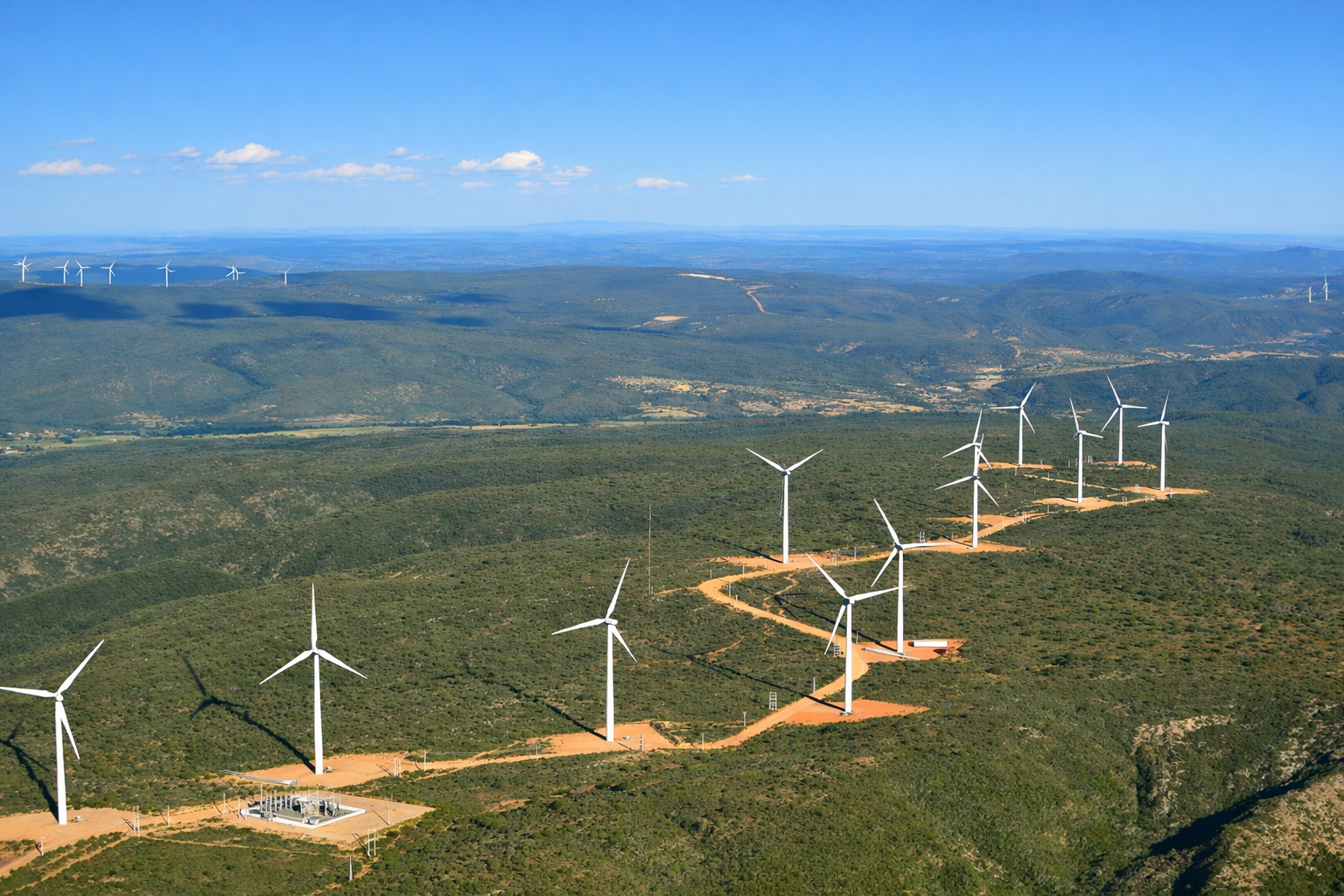
When observing the expansion of wind energy in Brazil, it becomes evident the leading role of Bahia. Regions in the semi-arid area, which previously faced economic limitations, began to receive large wind farms.
As a result, these projects generated jobs, increased local income, and boosted municipal revenues, promoting the interiorization of development and, consequently, reducing regional inequalities.
At the same time, solar energy found in Bahia a highly favorable territory for large-scale plants and, likewise, for distributed generation projects. In this way, this diversification widens access to clean energy, reduces costs throughout the production chain, and, furthermore, strengthens energy security, especially during periods of water scarcity.
Public Planning and Policies That Support Leadership
Bahia’s leadership in the renewable matrix does not happen by chance. On the contrary, it results from a long-term strategy, built with public policies, environmental planning, and constant dialogue with the private sector.
In this process, the Bahia State Secretary of Environment acts as a mediator of growth and, at the same time, ensures that the expansion of renewables respects socio-environmental and territorial criteria.
Additionally, structuring programs explain why Bahia consistently leads in renewable matrix. Initiatives such as Bahia + Verde and the State Program for Energy Transition of Bahia guide actions for emission reduction, rational use of natural resources, and also, encouragement of technological innovation.
Thus, these programs offer institutional predictability, a decisive factor for energy projects that require high investments and long return periods.
In parallel, the state has advanced in building an integrated climate agenda. The Bahia Climate Action Plan brings together policies for mitigation and adaptation to climate changes and thus enhances the coherence of government actions. Moreover, it connects the energy sector to strategic areas such as infrastructure, industry, agriculture, and urban planning.
As a result, this alignment between energy and climate strengthens the image of Bahia as a territory committed to long-term environmental goals. Currently, this commitment is being valued increasingly by international investors, who seek regulatory security and environmental responsibility.
New Frontiers of Energy Transition and Green Hydrogen
Another factor that reinforces Bahia’s leadership is its preparation for new frontiers of energy transition. In this sense, Bahia positions itself strategically in the Green Hydrogen economy, considered one of the most promising vectors for global decarbonization.
At the same time, the Camaçari Industrial Hub concentrates this advance by bringing together logistical infrastructure, a consolidated industrial base, and direct access to renewable sources.
Moreover, the State Plan for the Green Hydrogen Economy defines clear guidelines for the development of this production chain, from production to end use. Thus, by anticipating this movement, Bahia increases its international competitiveness and consequently connects to global markets seeking sustainable energy solutions.
As a consequence, this strategic positioning enhances the state’s ability to attract new billions in energy investments. Projects related to green hydrogen directly engage with sectors such as heavy industry, transportation, and export, creating long-term opportunities, technological innovation, and skilled jobs.
Environmental Licensing and Social Dialogue as a Differential
In addition to economic factors, Bahia also attracts investments through the way it conducts environmental licensing. In this model, the state reconciles agility, transparency, and socio-environmental responsibility. At the same time, the government promotes dialogue with local communities, strengthening the legitimacy of projects and reducing conflicts.
Initiatives such as “Diálogos Bahia” illustrate this approach well. Through active listening and negotiation between government, companies, and society, the state distributes the economic benefits of renewable energies more equitably, promoting social inclusion and regional development.
As a result, this model reduces legal and operational risks, a fundamental aspect for large-scale enterprises. Furthermore, by aligning economic growth and environmental responsibility, Bahia consolidates its image as a reference in energy sustainability.
Economic Impacts and Long-Term Legacy
From an economic standpoint, Bahia’s leadership in the renewable matrix generates broad and lasting effects. First, the influx of investments boosts local productive chains. Subsequently, it stimulates the formation of qualified labor and, moreover, strengthens sectors such as construction, logistics, and specialized services. In this scenario, small and medium enterprises also benefit from this favorable environment.
Additionally, the diversification of the energy matrix reduces exposure to climate risks and fluctuations in fossil fuel prices. Consequently, this greater energy resilience translates into economic stability and, at the same time, into better planning capacity for governments and companies.
Over time, Bahia has built a solid reputation in the clean energy sector. Thus, this positive image creates a cumulative effect, attracting new projects and expanding the scale of investments. As a result, companies already established in the state tend to expand operations, while new investors find a reliable environment with clear rules and a commitment to sustainability.
Finally, the timeless nature of this leadership lies in its adaptability and strategic vision. Bahia shows that leading the renewable matrix goes beyond the installation of power plants. On the contrary, the state integrates energy, environment, innovation, and social development. In a global scenario marked by climate urgency, this trajectory consolidates a continuous path of sustainable growth and positions Bahia as a permanent reference in the low-carbon economy.