






 Portuguese
  Spanish
  4 min of reading
  0 comments


Bamboo Begins To Replace Glass Fiber In Industrial Composites Due To Being Lighter, More Resistant And Having Production With Less Environmental Impact.
When someone thinks of bamboo, the first image that usually comes to mind is that of a flexible plant found in gardens, handmade furniture or temporary structures. What almost no one imagines is that the same material is entering the competition against glass fiber — one of the pillars of modern industry — to produce structural composites used in cars, wind turbine blades, sports boards, and even components of the construction industry.
The phenomenon is not utopian. It is already happening in countries that have technical mastery over bamboo as an industrial resource, especially China, Vietnam, and Indonesia, where universities, manufacturers, and research centers have expanded their capacity to process the plant into continuous fibers with interesting mechanical properties for engineering.
What Makes Bamboo Competitive Against Glass Fiber
Bamboo is not chosen just because it is “green.” It has specific physical characteristics that allow it to enter the composites market:
-
Humanoid Robot Climbs 6,263-Meter Volcano in Ecuador, Sets Sights on Everest Challenge

-
Physicist Harvests Water from Fog in the World’s Driest Desert, Turning Mountains into Water Traps

-
Wikipedia Blocks AI-Generated Edits, Citing Distrust in Automated Systems and Outlining Plans to Use Technology Without Losing Article Control
-
NASA Tests Rover with Lizard-Like Suspension and Independent Wheel Traction, Aiming for Speed Ten Times Faster than Perseverance on Mars





- It Is Lighter — plant fibers have densities between 1.3 and 1.5 g/cm³, compared to 2.5 g/cm³ for glass fiber. This means weight reduction, energy consumption, and logistical costs.
- Favorable Specific Strength — when comparing strength per weight, bamboo shows values that compete with glass fiber in various lightweight applications.
- Good Energy Absorption — ideal for parts subject to impact, such as automotive panels and boards.
- Simpler Thermal Processing — plant fibers can be molded at lower temperatures than synthetic composites, saving energy and reducing tool wear.
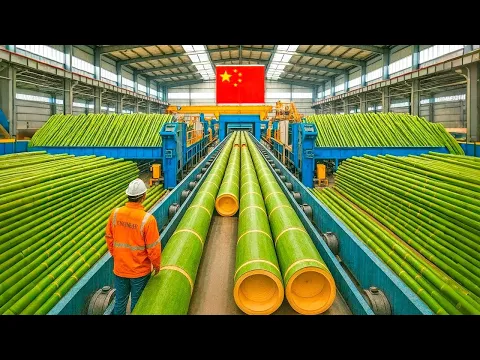

Where Bamboo Is Already Being Utilized In Industry
Although it may seem experimental, the market already has real commercial applications:
- Lightweight Automotive Industry — interior panels, coverings, door parts, supports, and non-metallic structural elements. Asian automakers are already using plant composites as a partial substitute for glass fiber.
- Sports Equipment — surfboards, skateboards, rackets, bicycles, and helmets use plant fibers to reduce weight and improve impact absorption.
- Experimental Wind Turbines — prototypes use blades reinforced with natural fibers to assess aerodynamic performance and durability with less environmental impact.
- Construction Industry — structural panels, reinforcements, laminates, and filling for lightweight systems.
The common vector among all these sectors is the same: reduction of mass, lower energy production costs, and environmental control of the supply chain.
Why Industry Is Interested In Plant Fibers
In addition to physical performance, there is an economic and regulatory component:
- CO₂ Emissions — the production of glass fiber involves temperatures above 1,400 ºC, with high energy consumption and associated emissions. Plant fibers can reduce emissions at the manufacturing stage.
- Renewable and Traceable Source — bamboo grows rapidly, does not require replanting after cutting, and captures carbon during its cycle.
- Growing Agricultural Scale — China has more than 6 million hectares cultivated with bamboo and is transforming part of it into industrial input.
- Environmental Regulations — sectors pressured by goals of circularity and sustainability seek alternative materials to meet market and government demands.
This is not just about being “green,” but about economic viability aligned with industrial policy.
The Bottlenecks That Still Prevent Mass Substitutions
We will not see entire cars made of plant composites in the short term, for three reasons:
- Insufficient Standardization of Fibers, which varies with species and processing
- Thermal Limitations, as plant composites do not withstand extreme temperatures
- Durability and Moisture Issues, requiring specific treatments and resins
In other words: bamboo will not “wipe out glass fiber,” but it is already occupying profitable industrial niches, especially where weight, impact, and sustainability are real advantages.
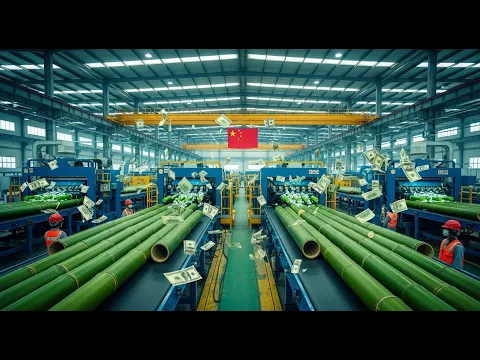
The Next Step In Materials Engineering
The most promising technical advancement is not just the use of pure plant fiber, but the creation of hybrid composites, combining:
- bamboo + technical resins
- bamboo + glass fiber
- bamboo + carbon fiber
This strategy allows for customizing mechanical properties and opens doors for more demanding applications, such as drones, lightweight vehicles, modular urban structures, and high-performance furniture. We are just at the beginning of the process.
Bamboo is moving from being a “natural alternative” material to gradually entering the category of strategic industrial input, with a clear space within composite engineering. Lighter than glass fiber, with competitive strength and good impact absorption, it offers an interesting route for markets wanting to reduce weight, energy costs, and environmental footprint without sacrificing performance.
What was once a flexible plant growing in backyards is now competing with synthetic materials that have dominated the industry since the 1950s — a narrative that contemporary engineering is just beginning to write.








-

-

-

-

-

10 people reacted to this.