






 Portuguese
  Spanish




Central Bank Prepares New Features for Pix. New Resources Include Installment Payments, Credit Guarantee, and Offline Payments by 2027
The Central Bank is preparing new features for Pix that are expected to change the way Brazilians and businesses use the instant transfer system. The idea is to expand the reach of the payment method, provide alternatives to credit cards, and enhance security against fraud.
According to data from the BC itself, in July 2025, Pix recorded 6.67 billion monthly transactions, moving R$ 3.05 trillion — nearly three times the country’s monthly GDP. Valor Econômico was the first to detail the schedule of the news.
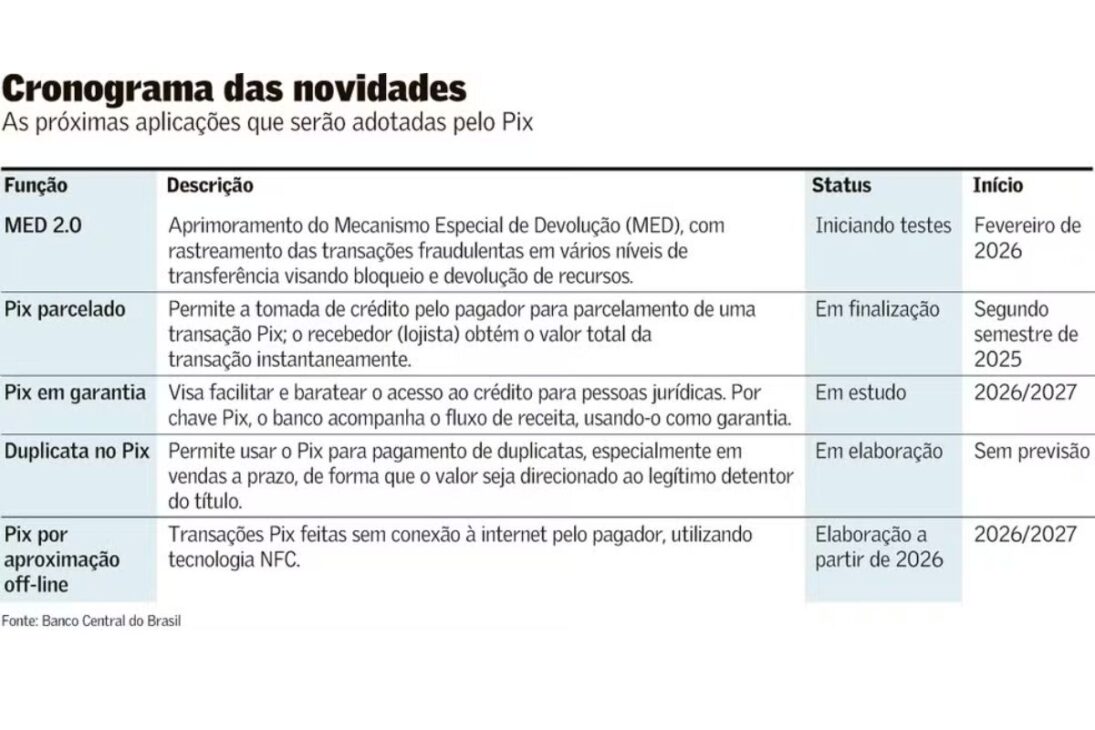
What Changes with the New Pix Features
Among the main features anticipated are:
-
Brazil’s 2026 Tax Refund: Record 9.58 Million Filers in Largest Payout Ever, But a Key Detail on Priority Recipients Draws Nationwide Attention

-
Itaú Alters Hybrid Work Model, Increasing Office Days from 2028, Prompting Employees to Adjust to New Routine
-
Facing Labor Shortage, Japan Plans to Invest $34 Million to Attract Foreign Workers in Construction, Healthcare, Industry, and Commerce

-
Brazilian City Makes Remarkable Leap, Becomes 4th Wealthiest in the Country with GDP of R$ 134.1 Billion




Installment Pix: will allow users to split a purchase in a standardized way with rules defined by the BC. The merchant receives the full amount immediately, while the customer pays in installments, similar to a credit card, but with differentiated fees. The launch is expected in the second half of 2025.
Guarantee Pix: will enable companies to use future receivables from Pix transactions as collateral for credit operations, making access to loans cheaper and safer. The measure is under study for 2026/2027.
Duplicate Invoice in Pix: will function as an alternative to payment slips, registering and settling duplicates in real-time. This should reduce costs and increase security. The measure is still in development, with no defined date.
Offline NFC Pix: will allow payments even without an internet connection, using NFC technology. Development will begin in 2026, with a launch expected between 2026 and 2027.
MED 2.0: an enhanced version of the Special Mechanism for Refund, which tracks diverted funds in frauds. It will be able to trace the money flow across multiple accounts until the resources are blocked and returned. Testing will start in February 2026.
Impact on Consumers and Businesses
For the average consumer, the Installment Pix is expected to be the most visible change, providing an alternative to credit cards. The difference is that, while in the card the merchant bears the costs of interest-free installments, in Pix the customer can assume fees, but with direct discounts on the purchase price, since the merchant will receive the amount upfront.
For businesses, especially small enterprises, the Guarantee Pix should facilitate access to credit with lower rates, as future receivables will serve as collateral. This model can reduce dependence on more expensive credit lines and increase competitiveness.
Security Against Fraud
Another central point is the MED 2.0, which strengthens protection against scams. Currently, the mechanism can only track money to the first destination account. The new version will allow tracking the flow even after several transfers, increasing the chance of recovering diverted funds.
This change is considered essential because Pix has already replaced cash in many transactions, and complex frauds have become more common.
The Central Bank is preparing new features for Pix that are expected to further transform the Brazilian payment system by 2027. Focusing on installments, credit, security, and digital inclusion, Pix is consolidating as a key element in the daily life of millions of people and businesses.
And you, what do you think of these changes? Will Installment Pix really replace credit cards? Can Offline Pix make your life easier on a daily basis? Leave your opinion in the comments — we want to hear from those who live this in practice.








