Portuguese
  Spanish




Mobile Infrastructure Built in the 20th Century Shows How Engineering, Climate Adaptation, and Environmental Preservation Can Coexist in One of the Most Robust Coastal Defense Systems in the World
A major engineering project with significant territorial and symbolic impact was completed in the second half of the 20th century in the Netherlands, attracting international attention.
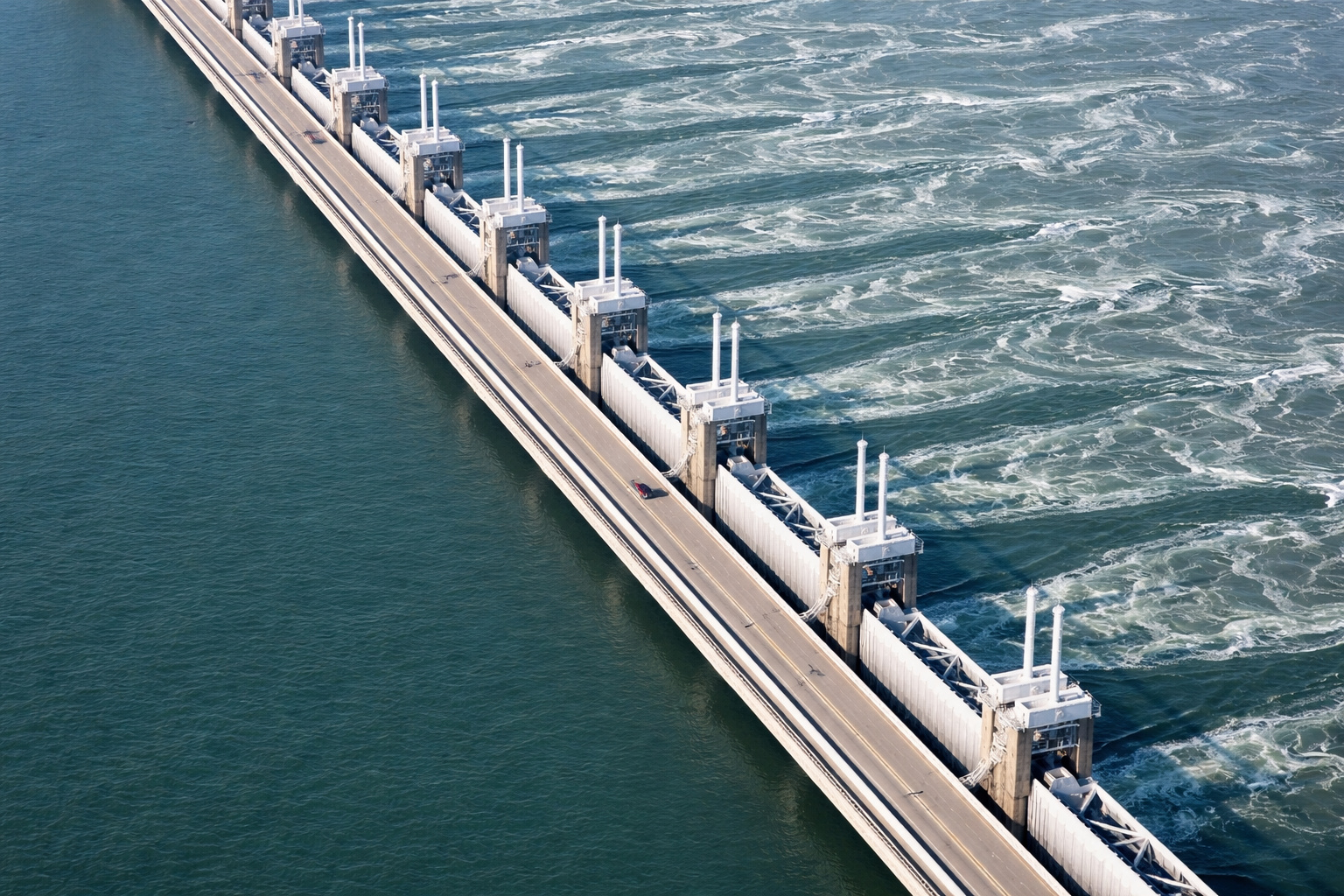
The Oosterscheldekering, known as the storm surge barrier, was completed in 1986 and is part of the national Delta Works system, conceived after the disaster of 1953, when storm surges caused thousands of deaths and historic damages, according to records from the Dutch government.
Since then, the structure has come to symbolize the country’s ability to live with the ocean, and not just combat it, in a scenario of persistent risk associated with sea level rise.
Moreover, the physical dimension of the work draws attention.
With a length of approximately 9 kilometers, the barrier connects the islands of Schouwen-Duiveland and Noord-Beveland, in the southwest of the country.
Its total weight is equivalent to about 700 times that of the Eiffel Tower, reinforcing its status as one of the largest coastal infrastructures ever built on the planet.
Mobile Structure Redefines the Concept of Maritime Barrier
First of all, the Oosterscheldekering does not function like a traditional fixed dike.
On the contrary, it operates through moveable sluices. Under normal conditions, these sluices remain open. Thus, saltwater circulates freely through the estuary.
Consequently, fishing, navigation, and coastal habitat conservation remain active, a decisive factor during the environmental and economic debates that preceded the project.
-
Alert in Santa Catarina: the Anita Garibaldi Bridge on BR-101 is completely closed in both directions due to “structural risk,” and drivers are diverted to a 20 km/h detour that promises kilometer-long queues until July 20.

-
More than 6,000 trucks poured nearly 70,000 cubic meters of concrete without interruption for 72 hours to create the largest continuous concrete pour in history and erect a megaproject in Saudi Arabia.
-
28-meter, 156-ton titans traveled 20,000 km from China to the port of Santa Catarina: Portonave received 7 fully electric megacranes, part of a R$ 210 million package, to double container handling.
-
They exchanged the idea of a large house for a 35 m² warehouse, spent US$ 12,000 on the structure, and created a tiny house in Colorado with space to live and work.




However, when severe storms or extreme tides approach, the system changes its operation.
At that moment, technical teams commence the coordinated closure of the sluices. As a result, the structure temporarily forms a wall that blocks the ocean’s entry and protects the internal areas of the country.
Technical Operation Based on Continuous Monitoring
To operate accurately, the barrier relies on constant monitoring.
Specialized services continuously track data on wind, tide, and storm intensity. When risk thresholds are reached, teams authorize the gradual closure of the sluices, reducing the impact of waves.
From a construction standpoint, the work combines dozens of concrete pillars, positioned directly on the seabed. It also features more than 60 moveable steel panels, designed to withstand intense currents and extreme forces.
According to reports from the Ministry of Infrastructure of the Netherlands, the use of precast elements and floating platforms was essential to enable construction in open water during the 1980s.
Main Technical Features of the Oosterscheldekering
Among the most relevant attributes of the infrastructure, the following stand out:
– Approximate length of 9 km between two strategic islands;
– Concrete pillars with dozens of meters in height;
– More than 60 moveable steel sluices;
– Dual function, combining storm protection and estuary preservation;
– Complete integration into the Delta Works, national flood defense system.
Balance Between Maximum Security and Environmental Preservation
During the project’s development, engineers sought a solution that ensured security for millions of residents. At the same time, they avoided the permanent closure of the estuary.
Therefore, the mobile barrier keeps the coastal environment active most of the time. In this way, environmental impacts remain smaller than those in completely closed dikes.
Nonetheless, the structure provides one of the highest levels of coastal protection in the world, especially in light of the increase in extreme events associated with global warming.
Reference for the Future of Climate Adaptation
As the global debate on climate adaptation progresses, the Oosterscheldekering remains an international reference. Low-lying countries with large river deltas are observing this model with interest.
Experts indicate that, in the coming decades, it will be necessary to review safety standards, modernize monitoring systems, and evaluate structural reinforcements in light of rising sea levels.
In this scenario, the Dutch experience demonstrates that long-term planning, precision engineering, and flexible infrastructure allow for controlled coexistence with the ocean.
In light of the continuous rise of the sea, will other countries be prepared to adopt similar coastal protection strategies?