






 Portuguese
  Spanish
  3 min of reading
  0 comments


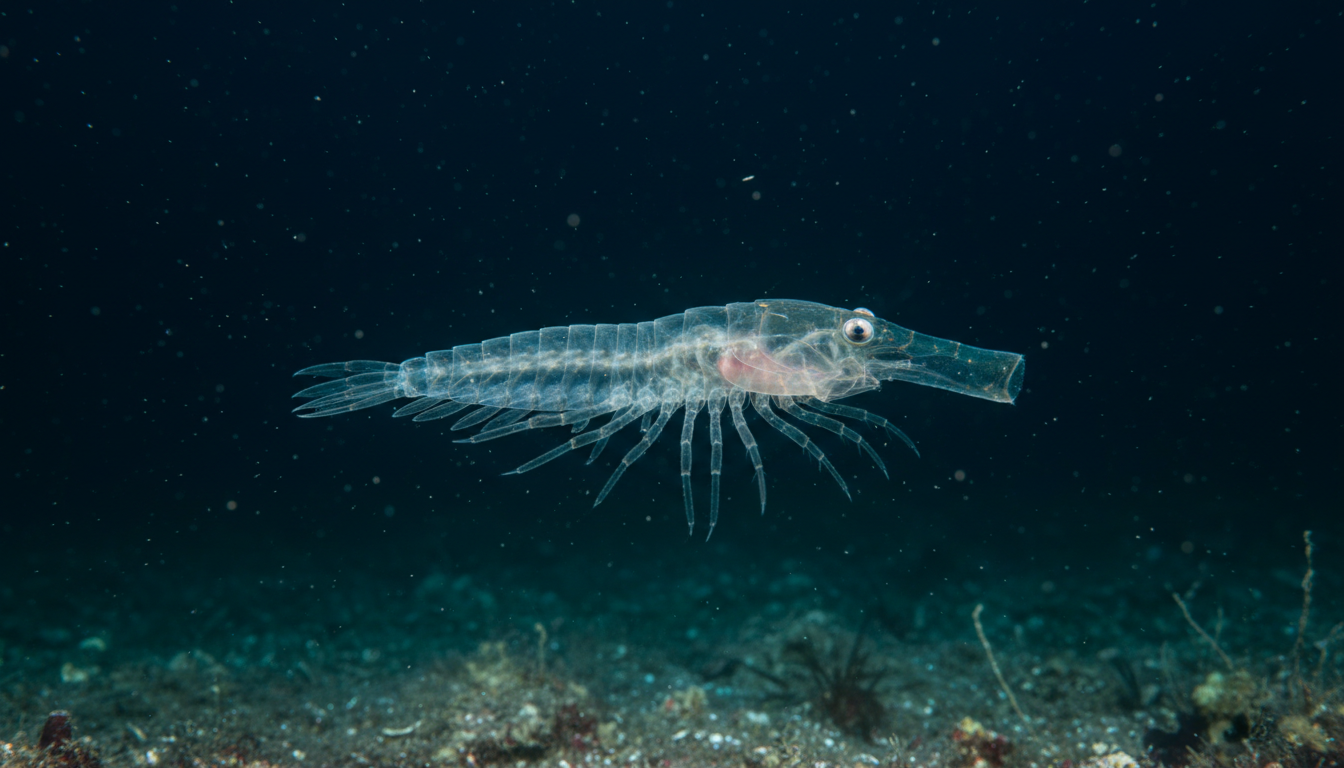
Publication in ZooKeys describes 24 amphipods, a new superfamily Mirabestioidea, a new family, and two new genera found at 4,000 meters between Hawaii and Mexico — in an area of 6 million km² marked for deep-sea mining
Scientists have just described 24 new species of amphipods — small shrimp-like crustaceans — on the bottom of the Pacific Ocean.
The creatures live at about 4,000 meters depth in the Clarion-Clipperton Zone (CCZ), a vast area between Hawaii and Mexico.
The CCZ spans 6 million square kilometers. It is larger than the entire India. And it is marked for deep-sea mining.
-
Helicopter Drops 180 Tons of Sand and Gravel on Swedish River to Revive Ecosystem Damaged by Decades of Exploitation

-
Brazilian Company Launches Retro Smartphone with 48 MP Camera, T9 Keyboard, and Privacy Features for Social Media-Free Use

-
Self-Taught Chinese Farmer Builds 5-Ton Submarine from Scrap, Launches It in Anhui River
-
Invisible Induction Technology Enables Wireless Power for Blenders, Coffee Makers, and Air Fryers, Reducing Countertop Cables




The discovery is even more significant because it occurred before any mining activity in the region.
The results were published in a special issue of the journal ZooKeys. It is the largest cataloging of deep-sea amphipods in history.

An entire superfamily that had never been seen
These are not just new species. Scientists described a new superfamily: Mirabestioidea.
They also identified a new family (Mirabestiidae) and two new genera. It is a rare taxonomic discovery.
The found amphipods have cone-shaped mouths adapted to the extreme environment. They are different from any known crustacean.
The diversity found suggests that the CCZ is a biodiversity hotspot on the ocean floor.
And all of this was cataloged before mining companies began to explore the region.
The numbers of the discovery
- New species: 24 amphipods
- New superfamily: Mirabestioidea (unprecedented)
- New family: Mirabestiidae
- New genera: 2
- Depth: ~4,000 meters
- Area of the CCZ: 6 million km²
- Location: between Hawaii and Mexico, Pacific
- Publication: ZooKeys (special edition)
The discovery raises an uncomfortable question: how many species will be destroyed before they are discovered?
Deep-sea mining seeks polymetallic nodules — rocks rich in manganese, cobalt, and nickel on the seabed.
The collection process disturbs the sediment and destroys habitats. Species that have lived there for millions of years may disappear.

Why this matters for the future of the oceans
Pre-mining cataloging serves as a scientific baseline. If mining begins, it will be possible to measure the impact.
Without this record, species would disappear without science even knowing of their existence.
The International Seabed Authority (ISA) has been debating the rules for mining in the CCZ for years.
Environmentalists argue that deep biodiversity is irreplaceable. Companies argue that the minerals are essential for batteries and clean energy.
Those following the environmental debate know that sustainability and mining are forces in constant tension.

Crucial discovery, but limitations exist
The 24 amphipods are just a fraction of the biodiversity of the CCZ. Thousands of species may exist without ever having been cataloged.
The collection was made at specific points. Vast areas remain unexplored by science.
The decision to start mining or not depends on international negotiations. There is no consensus among the 167 member countries of the ISA.
Information compiled from a study published in ZooKeys and a report from UAI Notícias. The data reflects recent scientific publications.





Be the first to react!