Portuguese
  Spanish


Futuristic Library in China Houses Up to 1.2 Million Books and Impresses with Its Monumental Design, Being Compared to the US Capitol in Scale and Impact.
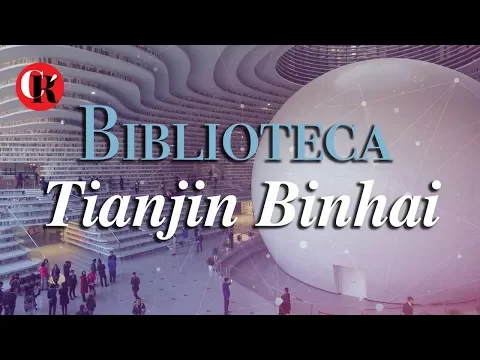
In the port city of Tianjin, in northern China, stands one of the most impressive buildings of the 21st century: the Tianjin Binhai Library. Inaugurated in 2017, the futuristic structure has been nicknamed “The Eye” — and not without reason. Its interior design evokes a gigantic three-dimensional iris, where bookshelves curve in fluid shapes and seem endless. With a capacity for 1.2 million volumes, the building is not just a library. It is an architectural, cultural, and political manifesto of a country that wants to show the world its bet on knowledge and the monumentality of its works.
A Masterpiece of Futuristic Architecture
Designed by the Dutch firm MVRDV, in partnership with the Tianjin Urban Planning Institute, the library was built in just three years — a pace that underscores the speed with which China erects megaprojects.
The glass, curvilinear façade gives way to a gigantic atrium spanning five floors, where wavy white shelves extend from floor to ceiling, creating the sensation that visitors are inside a living work of art.
-
15-Year-Old Entrepreneur Malu Lira Publishes 20 Children’s Books on Financial Education, Earns $500,000, and Expands Her Project to the Amazon Rainforest

-
Entrepreneur Turns Rio Cemetery Canteen into a Successful Snack Chain Generating $4.9 Million Annually and Expanding to Metro Stations

-
Rare fox feared “extinct” found alive on Caribbean island after over two decades without official sightings

-
21-Year-Old Brazilian Student Turns Homemade Popsicle Hobby into $100,000-a-Month Business





In the center, a giant spherical auditorium functions as the “eye” that observes the space, reinforcing the symbolic character of the construction.


Architects around the world have already pointed to the Tianjin Library as one of the most daring projects in contemporary public architecture, comparable in visual impact to landmarks such as the Guggenheim Museum in Bilbao and the Sydney Opera House.
Monumental Capacity and Advanced Technology
The building has 33,700 square meters of constructed area and is located in the Binhai cultural district, a region planned to concentrate centers of knowledge, innovation, and the arts.
In addition to its capacity for 1.2 million books, the library houses digital reading rooms, exhibition areas, media studios, children’s spaces, and even environments geared towards augmented reality and technological immersion.
The internal design was conceived to integrate the experience of physical books with the digital universe. Interactive screens and automated systems for searching and borrowing works are part of the users’ routine.
Comparisons with the US Capitol
The impact of the Tianjin Library is so great that many analysts compare it, in scale and grandeur, to the United States Capitol. Not for its political use, but for the grandeur of the internal space and the symbolic character of the building.
While the US Congress is a symbol of political power, the Tianjin Library is presented by China as a symbol of cultural power.
Both structures have become architectural landmarks, visited not only by their users but also by tourists and experts from around the world.
Criticisms and Controversies
Despite the initial fascination, the library also generated controversies. Shortly after its inauguration, it was revealed that some of the books visible on the curvilinear shelves were, in fact, false prints used to compose the futuristic design. Only the most accessible shelves contained real books.
The news generated international criticism, raising questions about the extent to which the library was functional or merely scenographic.
Over time, however, the space has been filled with real collections, while the controversy ended up reinforcing global curiosity about the project.
Symbol of the Chinese Strategy
More than a reading space, the Tianjin Library has become a symbol of the Chinese strategy to invest in cultural megaprojects to consolidate its global image.
In a country that is already building record bridges, colossal skyscrapers, and entire cities from scratch, the library represents a new frontier: that of cultural soft power. By showcasing a monumental structure dedicated to knowledge, China sends the world the message that it intends to lead in the realm of intellectual capital as well.
Touristic and Cultural Attraction
Today, the Tianjin Library receives thousands of visitors per week, including readers, tourists, and curious individuals who wish to experience the futuristic space. Many do not even enter to read — they go to photograph, film, and share on social media the visual impact of the construction.
The site has already appeared in international rankings as one of the most beautiful libraries in the world, reinforcing its fame as a global architectural icon.
The case of the Tianjin Library shows that, in China, the construction of megaprojects is not limited to transportation infrastructure or corporate skyscrapers. There is also room for impactful cultural works that combine aesthetics, innovation, and monumental capacity.
Just as the Capitol in Washington has become synonymous with political power, the Tianjin Library positions itself as a symbol of Chinese cultural and technological power, in a narrative that connects books, architecture, and national ambition.
The “Cathedral of Knowledge” in the Heart of China
With its monumental scale, capacity for 1.2 million books, and a design that seems straight out of the future, the Tianjin Library has already entered history as the largest and most daring cultural work of modern China.
From a “futuristic setting” to a global attraction, the space has transformed into a true cathedral of knowledge, consolidating the country not only as an economic powerhouse but also as a cultural protagonist of the 21st century.