






 Portuguese
  Spanish
  3 min of reading
  0 comments


BNDES and Asian Bank Announce Partnership That Will Inject Billions into Transport, Energy, Digital Connectivity, and Sanitation in Brazil
On Monday (16), during the G20 Leaders’ Summit, the National Bank for Economic and Social Development (BNDES) and the Asian Infrastructure Investment Bank (AIIB) signed a memorandum of understanding to enable investments in Brazil totaling R$ 16.7 billion. The agreement reflects a strategic partnership between the two institutions, focusing on infrastructure and sustainability projects.
The Asian Infrastructure Investment Bank, headquartered in Beijing, China, is a multilateral bank focused on Asian development, but it brings together members from various parts of the world, including Brazil. The signed memorandum aims primarily to complement the financing of strategic projects aligned with the Climate Fund and the New Growth Acceleration Program (PAC).
Strategic Investments for Brazil-Asia Integration
Among the projects covered by the agreement are initiatives that promote economic integration between Brazil and Asia in priority areas such as transportation infrastructure, energy and digital connectivity, water, and sanitation. These initiatives aim to stimulate cooperation between the two regions, promoting not only economic growth but also sustainable long-term development.
-
German sedan with rear-wheel drive flaunts a 1.6 turbo engine with 156 hp, automatic transmission, 480-liter trunk, premium status, and executive cabin in the range of fully equipped compact zero km: meet the Mercedes-Benz C180 Avantgarde 2015.

-
Suzuki launches “hybrid family van” with 8 seats, sliding rear door, Toyota Noah-like design, 1.8 electrified engine, and a price equivalent to about R$ 124,000 without taxes, below 7-seater SUVs sold in Brazil: meet the Landy in Japan.

-
Mitsubishi has a “Kombi 4×4 premium” diesel that is cheaper than the Tiggo 8 Pro when converted: the Delica D:5 costs around R$ 143,000 without Brazilian taxes, seats 7 or 8 people, and promises to handle snow, mud, and rough roads in Japan.
-
The part that can destroy your engine doesn’t warn when it’s going to break, ages even when idle, and has a different lifespan for each car.



Additionally, BNDES and AIIB committed to financing reconstruction projects in the state of Rio Grande do Sul, which has been heavily affected by recent natural disasters. Another highlight is the support for the urban and social infrastructure necessary for the 30th United Nations Climate Change Conference (COP-30), scheduled to take place in Belém, Pará, in 2025.
The partnership also aims to mobilize private capital for infrastructure projects, a crucial step to expand available resources and attract investors interested in sustainable and high-impact economic projects.
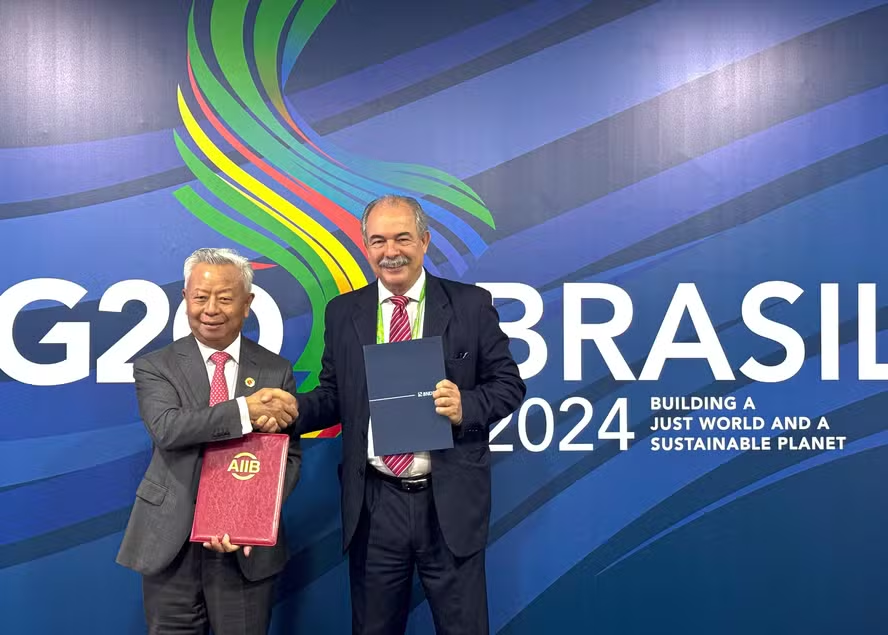
Signing with Notable Presence
The agreement was formalized in a ceremony held at Marina da Glória in Rio de Janeiro, a space reserved for official delegations during the G20 event. Among those present were the president of BNDES, Aloizio Mercadante, the president of AIIB, Jin Liqun, the vice president of AIIB, Konstantin Limitovskiy, and the director of Planning and Institutional Relations at BNDES, Nelson Barbosa.
Aloizio Mercadante emphasized the significance of the agreement:
“The memorandum signed with AIIB proves that BNDES has resumed its mission to promote the economic and social development of the country and that it has a broad capacity to diversify funding and seek important international partners for financing sustainable and infrastructure projects that benefit both Brazil and Asia,” he stated.
In turn, Konstantin Limitovskiy, vice president of AIIB, reinforced the importance of the expanded partnership:
“We are very pleased to sign this expanded MOU with BNDES, increasing the scope of our existing partnership for co-financing in Brazil. This collaboration will strengthen strategic infrastructure projects and sustainable initiatives that drive economic growth.”
Limitovskiy also highlighted that the agreement will directly contribute to the goals of COP-30, with a special focus on climate and adaptation projects in Brazil.
Challenges and Opportunities of the Partnership with BNDES
Although the memorandum represents a positive milestone, significant challenges remain, especially regarding the implementation of projects and the mobilization of private capital. Ensuring that investments actually reach the most affected communities will be a critical point for the success of the partnership.






Be the first to react!