Portuguese
  Spanish


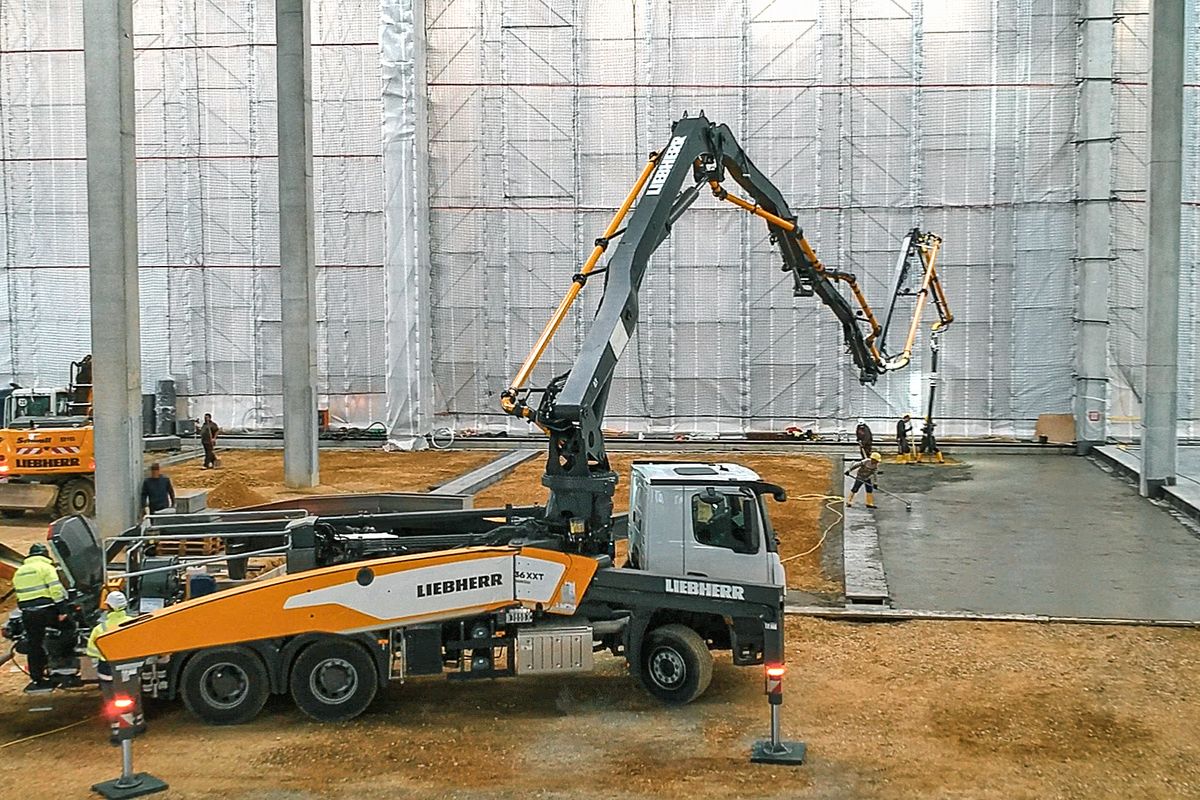

Understand How Concrete Pump Trucks Revolutionize Concrete Pouring in Construction, Optimizing Time, Costs, and Reaching Great Heights with Precision.
Concrete Pump Trucks are crucial equipment in today’s construction industry. Mounted on truck chassis, they combine mobility with the ability to transport and apply concrete with great precision in high or hard-to-reach locations.
This article explores the operation of these indispensable machines. We will discuss their main components, the technologies of benchmark models in the market, their various strategic applications, and the essential guidelines for safe operation and efficient maintenance.
Concrete Pump Trucks: How Do These Giants Work?
The effectiveness of Concrete Pump Trucks lies in the synergy of their components. The boom, or mast, is an articulated structure with three or more sections. It defines the vertical reach – which in Brazil typically varies between 28 and 43 meters, reaching up to 63 meters – and the horizontal range. Various folding designs, such as roll, Z, or RZ, optimize maneuverability.
-
Giant Robots Build Entire Neighborhood of 100 3D-Printed Homes in the U.S., Showcasing Technology’s Impact on Construction Industry

-
Helsinki Residents Receive Water That Travels 120 Kilometers Through a Hidden Rock Tunnel from a Lake Before Treatment

-
Brazil’s Sertão Region Nears Completion of Latin America’s Longest Artificial River, Transforming Water Access in Drought-Prone Ceará
-
Pre-mixed stabilized mortar set to revolutionize construction in 2026: extends usability to 36 or 72 hours, boosts productivity, and minimizes waste in building projects.



The heart of the machine is the pumping system. It typically uses two hydraulic pistons that operate alternately: while one pulls concrete, the other pushes it into the pipeline. A concrete valve, such as the ROCK from Schwing or the S-Valve from Putzmeister, directs the flow. Flow rates can vary from 90 to 200 m³/h. The vehicle unit (truck) provides mobility, and the stabilization system, with extendable outriggers, ensures safety during operation, especially with the boom extended.
Knowing the Main Models and Manufacturers

The Brazilian market for Concrete Pump Trucks features renowned manufacturers such as Schwing-Stetter, Putzmeister, Liebherr, SANY, and Zoomlion. Each seeks to innovate by offering more efficient and reliable equipment. Innovations include more efficient pumping systems, such as Putzmeister’s iLS (intelligent Low Stroke), which promises fuel savings, or Schwing’s long-stroke pumps that reduce wear.
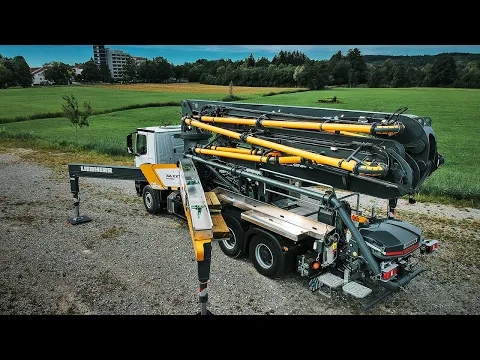
Concrete valves have also evolved, with designs that minimize friction and facilitate maintenance. In stabilization systems, technologies like Liebherr’s XXT (extendable front outriggers) or Putzmeister’s OSS/iSC (one-sided or variable support) increase flexibility in tight job sites. The constant pursuit is for greater reach, lower fuel consumption of the truck, and reduced total ownership cost.
Where Concrete Pump Trucks Make a Difference
Concrete Pump Trucks are vital for a wide range of projects. Their most common application is in pouring slabs, columns, and other superstructures in residential, commercial, and industrial buildings. They expedite the process and contribute to the quality of the poured concrete.
For high-rise projects, such as bridges, overpasses, tunnels, silos, and stadiums, or in hard-to-reach locations, these machines are indispensable solutions. The choice of the ideal pump depends on the required vertical reach and the concrete flow rate needed by the project. Large projects in Brazil, such as the pouring of foundation blocks for high-rise buildings, often use multiple pump trucks operating simultaneously, demonstrating their capability and strategic importance.
Safe and Efficient Operation
Safe and efficient operation of Concrete Pump Trucks requires planning. The construction site must have adequate access and stable, level areas. The logistics of concrete delivery need to be synchronized to avoid interruptions, ensuring that the pump’s high flow capacity is utilized.
Compliance with safety standards NR-12 (Safety in Machinery and Equipment) and NR-18 (Conditions and Environment of Work in the Construction Industry)1 is imperative. Special attention should be given to electrical hazards and proper stabilization of the machine. Thorough cleaning of the equipment after each use and a preventive maintenance program (daily, weekly, monthly) are crucial for durability. Additionally, the transport of these heavy vehicles must comply with DNIT and CONTRAN regulations, including the acquisition of Special Transit Authorization (ETA) where applicable.
The Future of Concrete Pump Trucks in Construction

The technology of Concrete Pump Trucks continues to evolve. The trend is towards greater automation, with smarter control systems that optimize pumping and enhance safety. Energy efficiency and reducing environmental impact are also significant focuses in the development of new models.
In Brazil and worldwide, these machines will play an increasingly indispensable role. They are essential for supporting urban verticalization and enabling the execution of large and complex infrastructure projects. The ability to adapt to different construction challenges ensures that concrete pump trucks remain key players in the progress of the construction industry.