






 Portuguese
  Spanish




National Project Aims to Replace Diesel Generators and Ensure Continuous Supply with Low Emission
Brazil is advancing in the development of nuclear microreactors with the goal of providing clean electricity to remote areas.
In 2024, nine public and private institutions, including universities, research institutes, and the Brazilian Navy, have joined forces to create compact and autonomous reactors.
These devices will be capable of operating for up to 10 years without recharging.
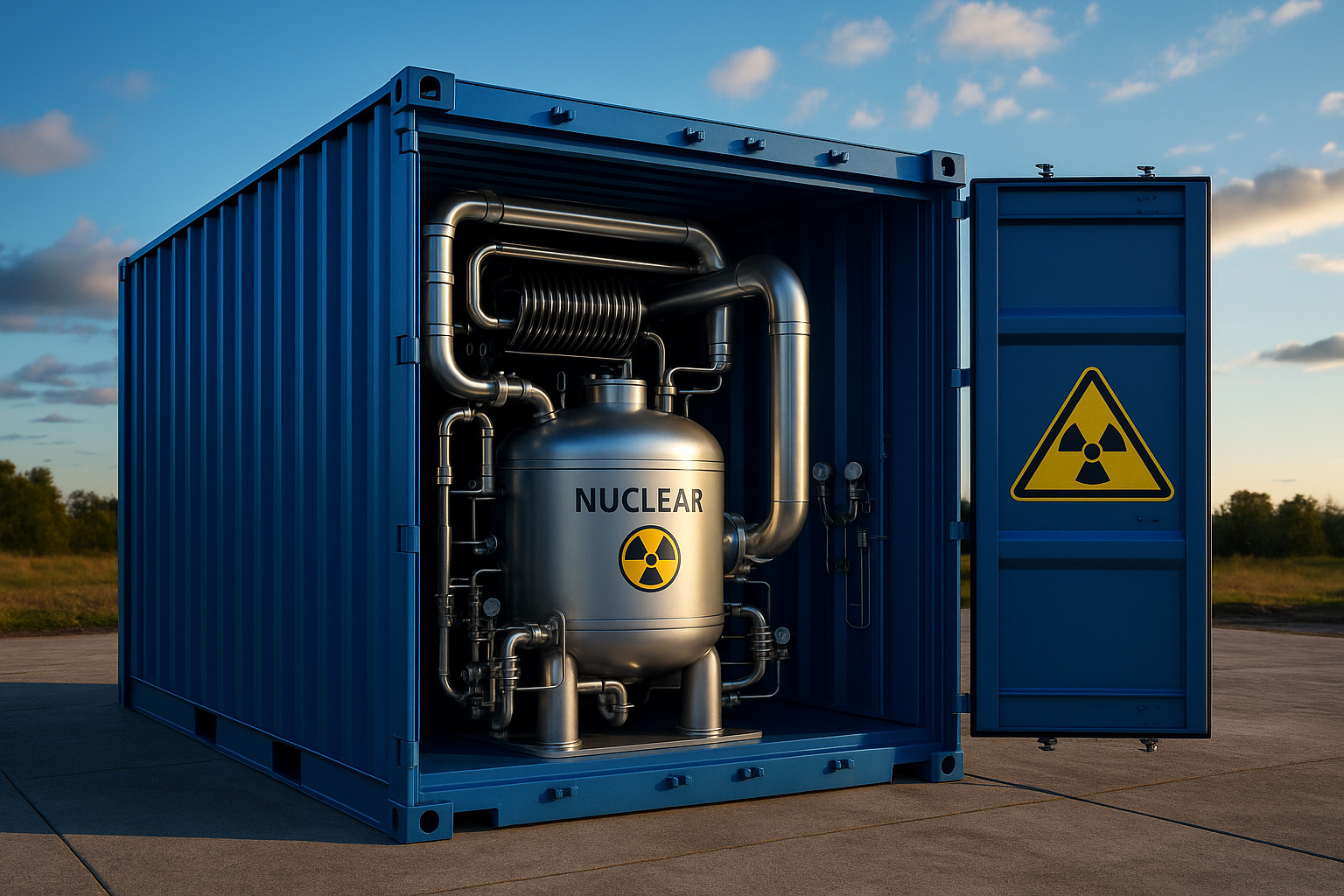
With dimensions similar to a 40-foot container, they will provide between 1 and 5 megawatts per unit.
This power is sufficient to supply 1,000 people, as explained by physicist João Manoel Losada Moreira from UFABC.
These reactors will utilize technology inspired by space systems.
They will operate with zero greenhouse gas emissions and with continuous and safe operation.
Compact Equipment Ensures Safety and Energy Stability
The technology is currently at level 3 on the TRL scale, still in the laboratory testing phase.
The goal is to reach level 6 by 2027, validating critical functions in a real environment.
The microreactors will use graphite or beryllium to slow down neutrons during nuclear fission.
This strategy replaces heated water used in traditional reactors.
The generated heat can reach 800 °C and will be transferred through heat pipes with pure sodium.
This method eliminates the need for pressurization, increasing the safety of the operation.
According to Jesualdo Luiz Rossi from IPEN, fission control will use boron carbide, a high-hardness ceramic material.
This technology is known abroad, but it is not yet produced in Brazil.

Microgrids and Remote Control Increase System Autonomy
To operate efficiently in remote locations, the microreactors will feature digital remote control developed by Inatel and IEN.
This system will allow for distance operation and integration with local energy microgrids.
The microgrids can combine solar, wind, and nuclear energy.
This combination ensures stability of supply, especially in areas with intermittent energy.
The project includes a steel containment structure, which will isolate the reactor in the event of failures.
According to Moreira, the low operational power and the absence of cooling liquids facilitate cooling during shutdowns.
This makes the microreactors safer than large traditional reactors.
-
Nvidia Secures Billion-Dollar Deal to Supply Up to 170,000 AI Accelerators to a 360 MW Data Center in Indonesia, Aiming to Transform Batam into an Advanced Computing Hub

-
NuScale proposes revised plan for six VOYGR SMR reactors in Poland after ending U.S. project

-
Holtec and EDF Submit Joint Proposal to Install Four SMR-300 Reactors in England with Combined Capacity of 1.3 GW
-
Brazil’s Angra 3 Nuclear Plant Reaches 66% Completion; Government Faces 2026 Deadline to Decide on $24 Billion Project’s Future


National Results Exceed International References
A study published in 2024 in the journal Nuclear Engineering and Design confirmed that the Brazilian reactor can operate for 8.7 years without refueling.
This performance surpasses international models, which reach five years.
The reactor will use uranium dioxide (UO₂) with enrichment of up to 20%, while Angra 1 and 2 operate with only 5%.
The Nuclear Industries of Brazil (INB) will provide the initial fuel.
In the future, it will be possible to recycle waste from the Angra plants, as is already done in Europe and Asia.
Physicist Claudio Schön from Poli-USP stated that the microreactors are extremely safe.
They operate with low uranium load and do not use cooling liquids, significantly reducing the risk of accidents.
Commercial Perspective Boosts Brazilian Technological Sovereignty
Although there are currently no active commercial models, companies like Westinghouse and Rolls-Royce are already developing similar technologies.
Additionally, the Brazilian microreactor costs about US$ 10 million, but this price is expected to decrease with production at scale.
On the other hand, the generation will cost R$ 990 per MWh, below diesel, which exceeds R$ 1,000, according to data from 2025.
In May, President Lula reaffirmed interest in partnerships with the Russian state-owned company Rosatom.
Thus, the plan includes integrating modular reactors (SMR) into the Brazilian energy matrix.
Petrobras and Coppe-UFRJ are also studying the use of SMR in offshore platforms.
Thus, according to physicist Giovanni Stefani, Brazil could become a global supplier of the technology.


