






 Portuguese
  Spanish
  3 min of reading
  3 comments


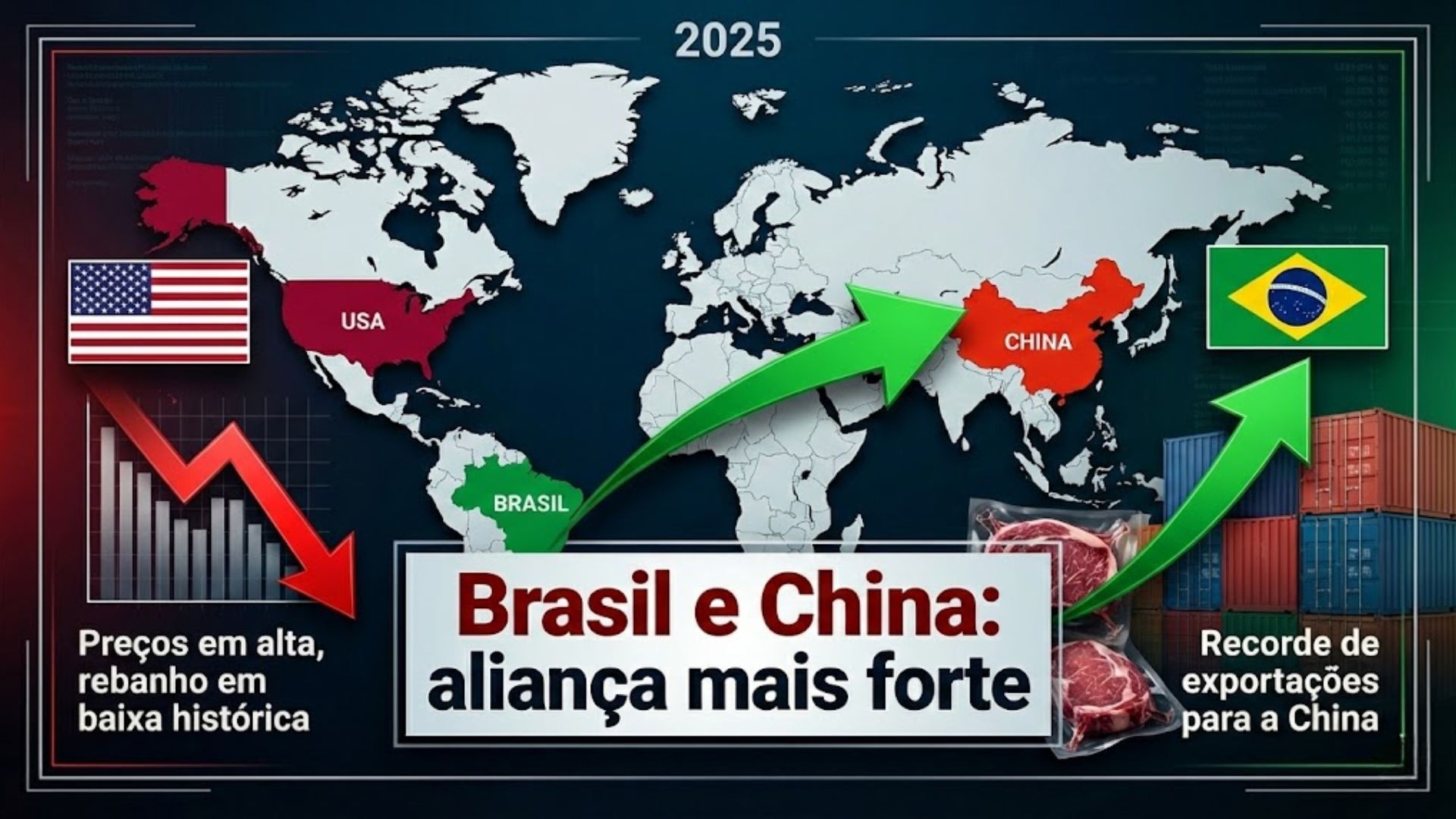


Global Meat Market Experiences Unprecedented Contrast Between Crisis In The USA And Brazilian Advance Toward China, While National Exports Reach Historic Levels And US Consumers Face Record Prices.
Beef prices in the United States have reached historical levels amid a significant decline in the national herd, while Brazil expands its presence in the Chinese market and consolidates nearly US$ 93 billion in exports to Beijing for the year 2025.
The combination of these movements accentuates the contrast between the American supply crisis and the growing Chinese demand for Brazilian products.
Beef Prices In The USA And Inflation Impact
According to a report published by Plantão Times Brasil from CNBC on Tuesday (09), the US consumer price index shows that the beef and veal category has risen 14.7% in 12 months, a pace significantly above the 3.1% registered for food in general.
-
The urgent need to implement a severe cut in public spending and a massive increase in taxes, in addition to drastically compromising the quality of basic services and the purchasing power of the population, could result in social unrest in the country, with the population leading protests, strikes, and frequent disturbances.

-
FIRJAN’s mega plan of R$ 526.3 billion for Rio de Janeiro aims to revive Brazil’s largest industry, with two-thirds of the investments going to oil and gas.

-
China signals an increase in beef imports, Brazil has already consumed 70% of the 1.106 million ton quota and seeks to renegotiate the tariff that jumps from 12% to 55%, while demand from the US also skyrockets.
-
Food inflation rose 302% in 20 years in Brazil, but the supermarket changed: purchasing power yielded 87% more mortadella and 31% less fruit, and ultra-processed foods took over the cart.




The significant increase reflects a market pressured by reduced supply and rising costs along the production chain.
The same report details that the country is operating in early 2025 with the lowest number of cattle since 1951.
The prolonged drought of recent years remains one of the main factors for the herd reduction, as it has hindered the maintenance of pastures, increased animal feed costs, and discouraged the retention of breeding stock.
In various regions, ranchers have chosen to accelerate slaughter in light of the unfeasibility of maintaining large herds.
According to the newspaper’s investigation, tariffs affecting certain suppliers and incidents involving cattle diseases have also contributed to tightening the supply picture.
Although US imports are more relevant for ground beef, the impacts are felt throughout the supply chain, and consumers report noticeable increases in various cuts, including steaks, roasts, and processed products.
Livestock Cycle And US Consumer Reaction
The North American livestock cycle, which alternates between expansion and contraction over about a decade, reinforces the slowness in supply recovery.
With the rising cost of animals for slaughter, slaughterhouses pass part of the cost onto retail and, inevitably, to the consumer.
Supermarket chains are adjusting strategies, reviewing portion sizes, and promoting substitutions for alternative proteins, although the demand for beef remains solid even in the face of record prices.
Advance Of Brazilian Exports To China
Meanwhile, Brazilian trade is moving in the opposite direction.
Exports to China grew 41% in November, driven mainly by commodities such as soybeans, meats, and oil.

For the year, the exported value approaches US$ 93 billion, reinforcing China’s position as the main driver of the Brazilian trade surplus.
This advance occurs in a context of greater Chinese appetite for raw materials and energy, expanding the Asian market’s dependence on Brazilian sales.
In an interview with the newspaper Plantão Times Brasil, analysts highlighted that China has increased purchases in practically all key sectors of the Brazilian agenda.
The strong demand for grains and animal proteins, combined with the competitiveness of the national agribusiness, supports the growth of shipments.
Soybeans and corn remain among the main products shipped, while beef, pork, and chicken exhibit favorable performance even amid fluctuations in competing markets.
The newspaper also pointed out that this behavior reinforces a trend observed since 2024, when Beijing had already comfortably led the Brazilian trade balance.
Change In Commercial Weight Between Brazil, China And The USA
This movement also highlights the temporary loss of space for the United States as a relevant destination for Brazilian exports.
Recent reports indicate a significant decline in shipments to the American market, while imports from the USA have increased, bringing the country closer to a deficit in the bilateral balance.
The combination of prolonged drought, tariffs, and diseases penalizing American production contrasts with the expansion of Brazilian agribusiness, which benefits from favorable supply, exchange rates, and demand conditions.
China, in turn, seeks to diversify suppliers but maintains Brazil as an essential partner to ensure food and energy security.
The growing disconnect between the US domestic market and Brazilian foreign trade illustrates how climatic, sanitary, and economic shocks quickly transform the global dynamics of animal proteins.





Nunca se consumiu tanta proteína **** no Brasil.
Aqui a carne ainda é mais cara do que nos EUA.😏
O grande problema aqui é que a gente tmbm está sofrendo com os preços da carne! E já faz tempo!