






 Portuguese
  Spanish
  6 min of reading
  0 comments


The pink floss-silk tree impresses with its “pot-bellied” trunk, its ability to withstand dry periods, and its pink bloom that changes the landscape, but its large size requires careful planning before its beauty becomes a problem in the backyard
The pink floss-silk tree has become one of those trees that catch the eye at first glance, with a wide trunk, distinctive thorns when young, a broad canopy, and pink flowers that appear just when many plants lose strength during the driest time of the year.
Also known as bottle tree, the species has the scientific name Ceiba speciosa and is native to South America. It stands out in landscaping for combining ornamental beauty, drought resistance, and the ability to create shade in open areas.
But the visual charm hides a decisive point: this is not a tree for just any backyard. Due to its large size, the pink floss-silk tree requires a spacious area, full sun, and a safe distance from buildings, walls, narrow sidewalks, and power lines.
-
Brazilian Man Transforms Degraded Area in São Paulo into Urban Forest with 40,000 Trees

-
11-Year-Old Brazilian Prodigy Develops New Math Formula, Seeks Publication in Leading Scientific Journal
-
They promised wealth with Sigma Lithium’s lithium mining, but the Jequitinhonha Valley got cracked houses, skyrocketing rent, and R$ 0 in royalties in 2025.
-
Brazilian creates ingenious hack with bus air conditioner water and transforms invisible dripping into savings of millions of liters; Capixaba system reuses condensation on the windshield, supplies the toilet on long trips, and has become a practice in Águia Branca’s fleet.




The species is known precisely for its swollen trunk, its adaptation to drought, and its pink bloom that can transform large gardens during the cold and dry months.
The pot-bellied trunk is not an ornament and reveals how the tree withstands drought
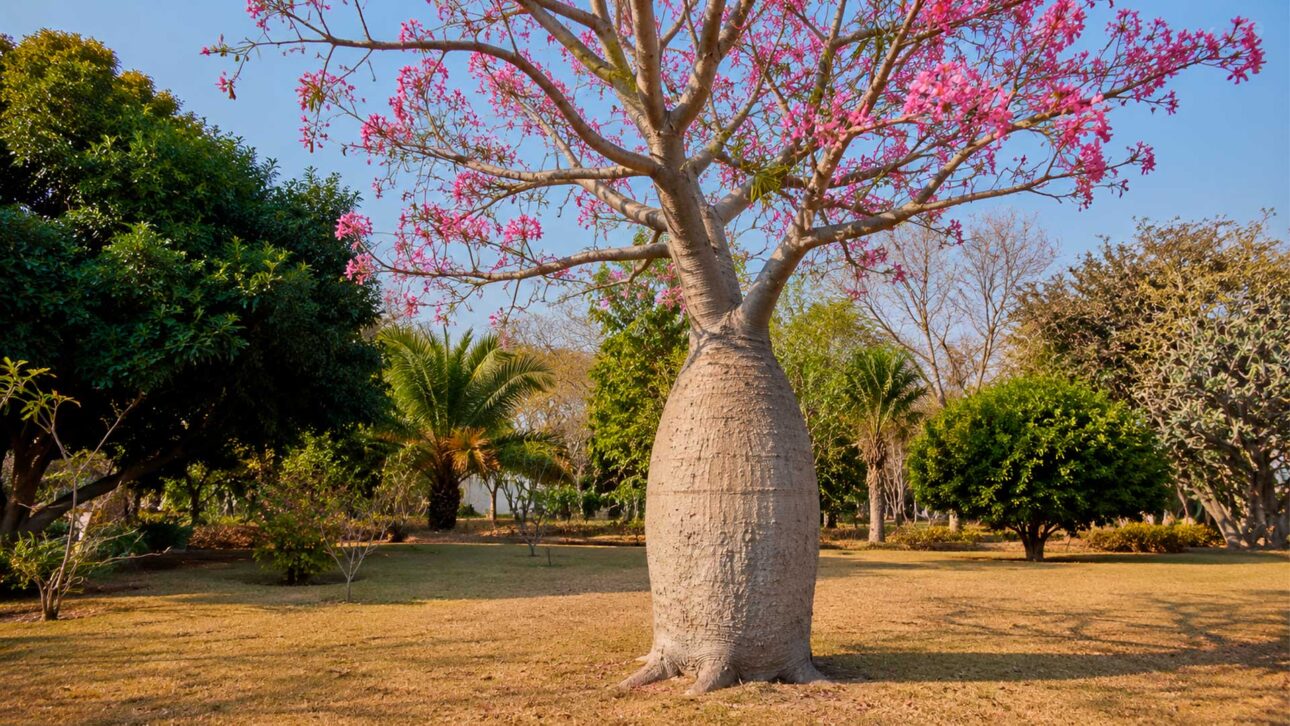
The most curious shape of the pink floss-silk tree is in its trunk. The wider base functions as a natural adaptation for periods of lower water availability, which helps to explain its reputation as a hardy tree in regions with a well-defined dry season.
This “pot-bellied” appearance should not be mistaken for disease or deformation. In practice, the voluminous trunk is part of the plant’s own survival strategy and becomes even more evident in adult specimens.
When young, the tree may also present spines, structures similar to thorns on the stem. They help protect the plant during its growth phase and are often one of the most distinctive features for identifying the species.
According to information from Embrapa, the silk floss tree is a deciduous species, meaning it can lose its leaves at certain times of the year, and it blooms between March and July. This loss of leaves helps to highlight the flowers even more when they appear.
The pink bloom emerges when the canopy becomes clearer and changes the garden landscape
The blooming of the pink silk floss tree is usually the most anticipated moment for those who cultivate or observe the species in open areas. The large flowers, with shades of pink and sometimes lilac variations, appear during a period when the canopy may be less laden with leaves.
This detail increases the visual impact. Without so much foliage competing for attention, the flowers stand out and create the impression that the entire tree has been taken over by pink patches.
In landscaping, this effect is valued because it combines beauty with seasonality. The tree does not deliver the same visual throughout the year but changes appearance with the seasons, alternating moments of shade, leaf loss, blooming, and fruiting.
After flowering, fruits appear that open and release seeds wrapped in a light and silky fiber, known as paina. It is precisely this fiber that helps explain popular names like silk floss tree, paina tree, and wool tree.
The detail that many people forget is that a beautiful tree can also become too large
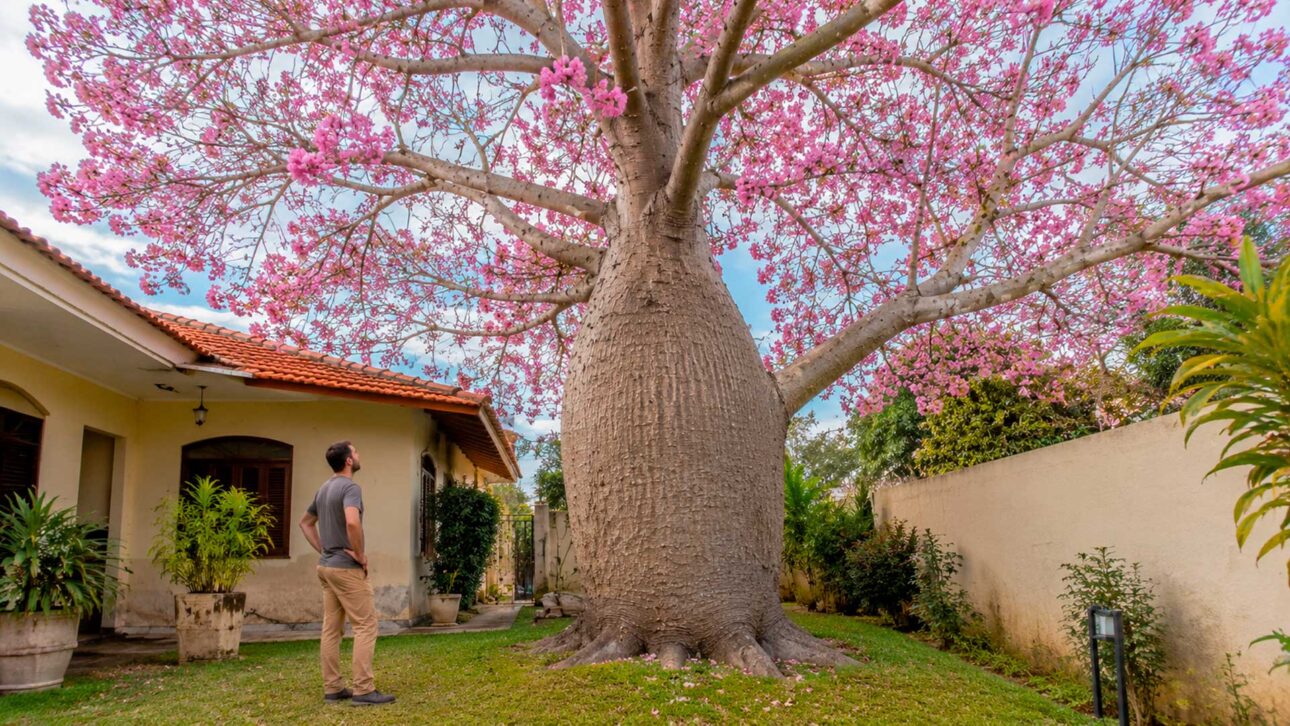
The pink silk floss tree can be an excellent choice for farms, ranches, parks, squares, large gardens, and areas where the tree has the freedom to grow. The problem begins when it is planted in a small location just for the beauty of its bloom.
In the UENF Trees survey, the species appears as native to Brazilian forests and Bolivia, with recorded occurrences in different regions of Brazil, including Bahia, Minas Gerais, São Paulo, Rio de Janeiro, Paraná, Santa Catarina, and Rio Grande do Sul.
This geographical reach shows the plant’s adaptation but does not eliminate the need for planning. In urban areas, large trees can conflict with wiring, roofs, sidewalks, garages, and pipelines when planting is done without space assessment.
Therefore, the central point is not just to ask if the pink floss-silk tree is beautiful. The more important question is: is there enough space for a tree that can form a wide canopy and occupy a prominent position for decades?
Well-drained soil, direct sunlight, and free space make a difference from the seedling stage
The pink floss-silk tree is not considered an extremely demanding tree in terms of soil, but this does not mean it can be planted just any way. The soil needs to have good drainage because water accumulation at the roots can hinder the seedling’s development.
The choice of location should prioritize areas with plenty of light. As a full-sun tree, it develops better where it receives several hours of direct light per day, away from the constant shade of buildings or larger trees.
In the first years, watering helps the seedling establish itself. Once mature and well-rooted, the species tends to behave more robustly, better enduring periods of little rain.
It is also important to avoid drastic pruning to try to “control” a tree planted in the wrong place. The best management starts before planting, choosing a spot where the canopy and trunk can grow without competing with surrounding structures.
Beyond beauty, the pink floss-silk tree helps attract life to open areas
The IlhaViva project, linked to UFRJ, describes the Ceiba speciosa as a tree of humid and semi-deciduous forests, with pink flowers and seeds wrapped in floss. These characteristics help explain its ornamental and ecological value.
In large gardens, the tree can serve as a point of shade and shelter for birds. The flowering also attracts the attention of pollinators and reinforces the species’ role in creating more vibrant green areas.
The mature canopy helps reduce the feeling of heat in open spaces, especially in places where the soil is exposed to the sun for many hours. In times of hotter cities, large trees gain importance, provided they are planted in the right place.
In the end, the pink floss-silk tree is a tree of impact. It does not suit improvisation, but it can completely transform a landscape when given space, sun, and planning.
Before planting, the secret is to think about the size it will have in the future
The main lesson about the pink floss-silk tree is simple: it should be chosen for the whole package, not just the flower. Sculptural trunk, pink flowers, wide shade, and drought resistance are real advantages, but all depend on adequate space.
For those with large land, the species can be a striking alternative in Brazilian landscaping. For those living in small areas, narrow sidewalks, or places with nearby power lines, other smaller trees tend to be safer options.
The pink floss silk tree shows that nature can unite beauty and adaptation in an impressive way. But it also reminds us that planting a tree is a long-term decision, capable of changing the environment for many years.
Would you have a pink floss silk tree at home, or do you think a tree of this size is more suitable for parks, farms, and squares? Leave your opinion in the comments and tell us if you’ve ever seen one of these trees in bloom up close.





Be the first to react!