Portuguese
  Spanish


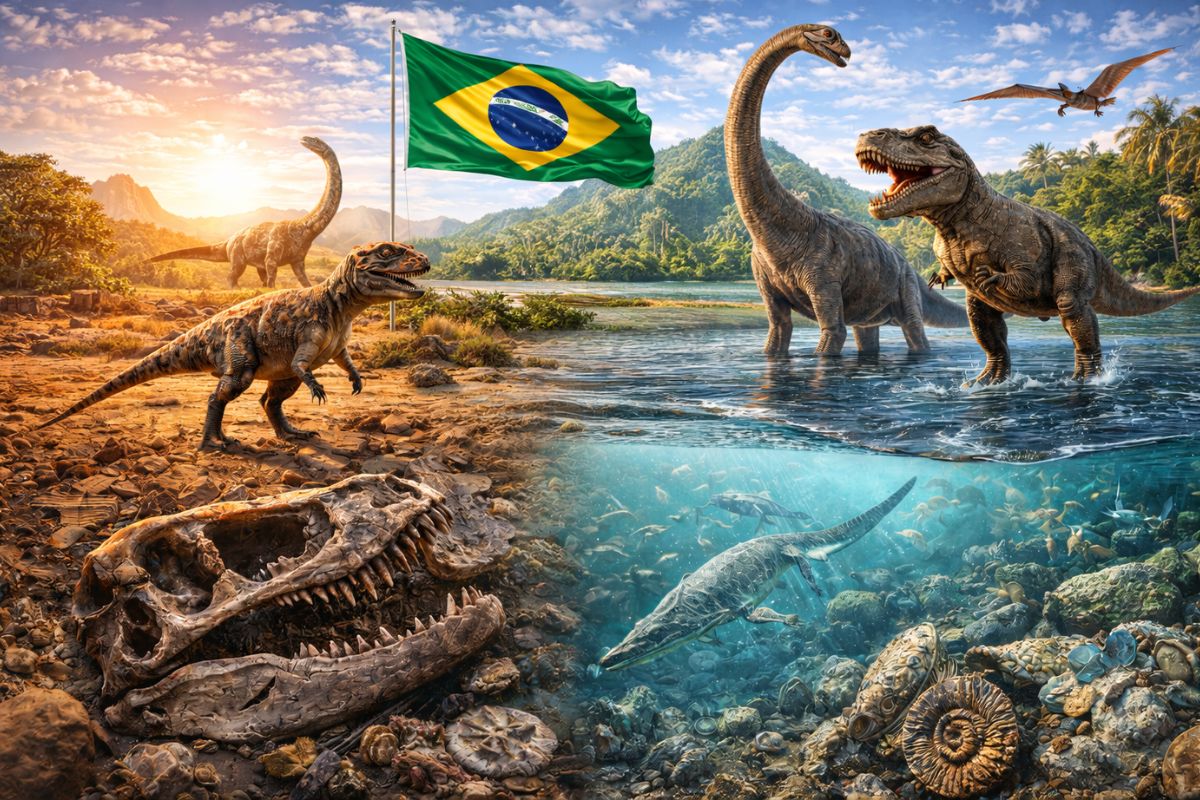


Brazilian fossils reveal that the first dinosaurs of the planet appeared in the south of the country, lived with gigantic glaciers, extreme deserts, shallow seas full of life, and gave rise to one of the richest prehistoric stories of the Earth already reconstructed by science
The Brazil you know today, with tropical forests, cerrado, caatinga, pampas, and pantanal, is just the most recent chapter of a saga that began hundreds of millions of years ago. Long before the cities, roads, and farms, the Brazilian territory was already the stage of glaciers nearly 1 kilometer thick, immense deserts, and glacial lakes, while the first dinosaurs of the planet took their steps in what would one day become the interior of Rio Grande do Sul.
Modern paleontology shows that Brazil was not just a supporting actor in the age of dinosaurs. It was a protagonist. Here appeared some of the oldest known dinosaurs, long-necked pioneers, strange carnivores, ancestral birds with teeth, and spectacular pterosaurs. Understanding this history also helps us understand how our territory was formed, why we have seas of hills, mountain ranges, and plateaus, and why today we are the country with the greatest diversity of birds on the planet.
From Megadiverse Brazil to Dinosaur Brazil
It is often said that Brazil is the country with the greatest biodiversity on the planet. But what almost no one realizes is that today’s wealth is the inheritor of a much older geological and biological story, which begins even before the age of dinosaurs.
-
Brazilian Researcher Develops Protein Supplement from Tilapia Waste, Combining Innovation and Sustainability with Economic Potential

-
Women in São Paulo Unknowingly Tracked by Coin-Sized Tags Hidden in Cars and Belongings, Raising Stalking Concerns
-
Near a $750 million AI data center in Brazil, a resident’s well runs dry, leaving her unable to afford the $25,000 needed for repairs.

-
16-Year-Old from Brazil’s Sertão Wins Young Scientist Award for AI Predicting Rainfall with 94.5% Accuracy to Aid Farmers


At the end of the Carboniferous and the beginning of the Permian, what we now call Brazil was part of the supercontinent Gondwana, alongside Africa, Antarctica, Australia, and India.
There was no Brazilian coastline, there was no Atlantic Ocean, and the areas that are now along the seashore were the dry heart of a vast continent.
During the Karoo glaciation, much of the south and central Brazil was covered by a gigantic glacier.
In the interior of São Paulo, for example, there are the so-called seas of stones, with rounded blocks that were pushed and reworked by the ice.
The very rock scratched by the glacier’s passage, like the moutonnée rock in Salto and the layers of varvito in Itu, is a fossil of ice.
Meanwhile, four-legged animals learned to live away from water thanks to amniotic eggs. From this group would emerge the synapsids, ancestors of mammals, and the sauropsids, ancestors of reptiles and birds.
The synapsids dominated the terrestrial ecosystems, while the sauropsids were still supporting characters. The age of dinosaurs had not yet begun.
The Great Death That Cleared the Way for Dinosaurs

At the end of the Permian, the situation changes dramatically. Colossal eruptions in the region that is now Siberia poisoned the atmosphere and the oceans, triggering the largest mass extinction in history. Almost 90 percent of all life forms disappeared.
This event, known as the Permo-Triassic extinction, toppled the dominant groups and reset the evolutionary game. In the next era, the Mesozoic, which spans from 252 to 66 million years ago, the sauropsids seized the opportunity.
Among them, one group would become iconic: the archosaurs, which include crocodiles, pterosaurs, and later, dinosaurs.
By the beginning of the Triassic, Pangea was already assembled, gathering all the landmasses into a single C-shaped block, surrounded by the Panthalassa Ocean and the Tethys Sea.
The interior of this Pangea, where Brazil was located, remained arid and challenging. For millions of years, dinosaurs had not yet existed.
Only about 20 million years after the start of the Triassic did the lineage of dinosaurs separate from other archosaurs.
The first members were small, bipedal, generalists, likely feeding on insects and small vertebrates. The dominance of the planet was still a promise.
The turning point comes with the so-called Carnian pluvial event. A period of warming and intense rainfall, driven by volcanic activity, profoundly alters ecosystems.
Many dominant archosaurs disappear and dinosaurs take on the role of main megafauna for the first time, capable of regulating body temperature and having efficient respiratory systems.
First Dinosaurs of the Planet: The Nursery in the South of Brazil
It is here that Brazil enters history definitively. Some of the oldest dinosaur fossils in the world were found in the Santa Maria Formation, in Rio Grande do Sul, in rocks around 233 million years old.
Among these fossils is Staurikosaurus, a small bipedal carnivore weighing around 12 kilos.
It was excavated in 1938 and described in 1970, and is considered one of the first dinosaurs on the planet in terms of age.
Another important representative is Gnathovorax, a herrerasaurid about 3 meters long, with an almost complete skeleton.
These animals are part of a basal group of sauropodomorph dinosaurs, prior to the clear separation between the large carnivorous theropods and the long-necked sauropods.
In practice, this means that the south of Brazil functions as a cradle of the dinosaur family tree, at a moment when the main lineages were still being defined.
In the same region, other pioneering dinosaurs helped rewrite history. Sauropodomorphs like Pampadromaeus, Saturnalia, Buriolestes, Bagualosaurus, and Macrocollum show the step-by-step transformation from small generalist bipeds to giant long-necked herbivores.
Some still ate meat and plants, while others had teeth and necks adapted for an almost entirely herbivorous diet.
It is from these forms that the idea consolidates that the region that today encompasses the south of Brazil and the north of Argentina was the likely center of origin of the first dinosaurs on the planet, from where they spread throughout Pangea.
The Invisible Jurassic and the Birth of Brazilian Mountains
After the Triassic and the consolidation of dinosaurs as the dominant megafauna, the Jurassic begins. Worldwide, this is the classic period of large long-necked dinosaurs and the first “birds” like Archaeopteryx. However, in Brazil, the Jurassic is almost a book torn from the shelf.
The reason is geological. During the Jurassic, internal forces of the Earth compressed Gondwana and raised a large mountain range between South America and Africa, precisely in the region that now corresponds to southeastern Brazil. Instead of accumulating sediments, this range became intensely eroded.
As a result: Jurassic rocks are rare in Brazil and fossils from this period are almost nonexistent. A petrified forest in Ceará, a marine crocodile in Maranhão, footprints in Pernambuco, and little more. The 46 million years of Brazilian Jurassic history remain a great mystery.
On the other hand, what happened with this mountain range shaped the current relief. The seas of hills, the mountain ranges, and the brutal step between the plateau and the coastline, like the escarpment near São Paulo, are legacies of this lost Jurassic, which also paved the way for the breakup of Gondwana and the formation of the Atlantic.
Cretaceous: Red Rivers, Immense Deserts, and the Fossilized Northeast

With the opening of the Atlantic and the progressive breakup of Gondwana, the Cretaceous begins, a long and dynamic period.
Flowering and fruiting plants diversify, social insects explode in variety, and entire ecosystems are reorganized.
In Brazil, the Cretaceous is divided into two large scenarios. In the north, the humidity brought by warm seas feeds lakes, rivers, and lagoons filled with fish, turtles, crocodiles, pterosaurs, and dinosaurs. In the south and interior, the climate is drier, with deserts and semi-arid fields.
In the Paraná Basin, on thick layers of volcanic rocks, the sands of the paleodesert of Botucatu form. There, dinosaurs, primitive mammals, lizards, and arthropods left millions of footprints, including even a rare record of fossilized urine from an ornithischian dinosaur.
In Paraíba, a herbivorous dinosaur about 12 meters long left a trail of 32 footprints in the Valley of the Dinosaurs.
In the Northeast, the star is the Araripe Basin, which crosses Ceará, Pernambuco, and Paraíba. There, the Santana Group, with the formations of Crato, Ipubi, and Romualdo, has exceptionally preserved plants, insects, fish, amphibians, turtles, crocodiles, pterosaurs, and theropod dinosaurs in finely detailed forms, including skin and feathers.
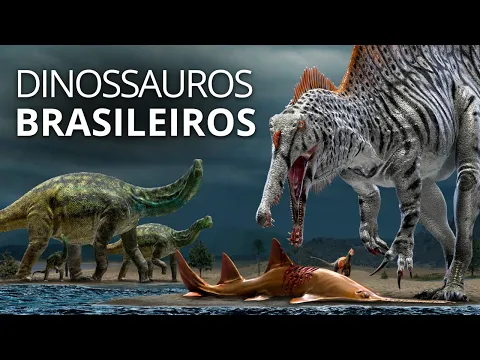
Among the dinosaurs of Araripe are spinosaurs like Irritator and Angaturama, carnivores specialized in fish, related to the famous African Spinosaurus.
Primitive birds like Cratoavis also appear, still with teeth and claws on their wings, and extremely curious forms like Ubirajara, possibly the first dinosaur with display feathers described in Brazil.
The quality of these fossils places Araripe among the ten most important paleontological sites on the planet, functioning as an open window to an ancient system of Cretaceous lakes that existed about 115 to 120 million years ago.
Giants, Dwarfs, and Predators at the End of the Cretaceous
As the Cretaceous advances, the climate in the interior of South America becomes drier, and the Bauru Basin, covering parts of Paraná, São Paulo, Mato Grosso, Mato Grosso do Sul, Goiás, and Minas Gerais, records a vast desert and semi-arid environment between 95 and 65 million years ago.
There, herbivores and carnivores had to adapt to the scarcity of water and lush vegetation. This is seen both in the giants and the dwarfs.
Among the carnivores, abelisaurids like Pycnonemosaurus, in Mato Grosso, reached about 9 meters in length, with a short snout and extremely reduced arms, resembling the famous Argentine Carnotaurus.
Another Brazilian abelisaurid, known from a cervical vertebra and named Thanos, would have been around 5 meters long.
Among the medium and strange forms appears Berthasaura, a theropod just over 1 meter long, with a horny beak and no teeth. It was likely omnivorous, with a significant herbivorous component, in a scenario where dietary flexibility was a matter of survival.
Among the long-necked titanosaurs, Brazil is home to both giants and “dwarfs.” Uberabatitan, from Uberaba, and Austroposeidon, from the interior of São Paulo, vie for the title of the largest Brazilian dinosaur, with estimates around 26 meters in length.
In contrast, Ibirania and Brasilotitan, at 6 to 8 meters, are considered small by sauropod standards. In arid environments, reducing body size may be an advantage, as it decreases the daily food requirement in landscapes with sparse and dispersed vegetation.
It is possible that titanosaurs as large as the Argentine giants also walked on Brazilian lands, but their remains have not yet been found or have not been preserved.
The End of the Dinosaurs and the Brazil of Living Dinosaurs
The age of dinosaurs does not end in Brazil; it ends in the world. About 66 million years ago, an asteroid about 10 kilometers in diameter struck the region that is now the Gulf of Mexico and set off a chain of planetary disasters: earthquakes, tsunamis, global fires, prolonged darkness, and abrupt climate changes.
At the end of this process, all non-avian dinosaurs, all large flying reptiles, and a vast portion of terrestrial life were extinct.
Among the dinosaurs, only a specific group of toothless theropods with beaks survived: modern birds.
Today, Brazil is the country with the largest number of bird species on the planet. This means that the Brazilian territory continues to be one of the great refuges for living dinosaurs, now feathered, flying, or terrestrial, occupying all biomes, from restingas to mountain forests.
At the same time, deforestation, fires, habitat fragmentation, and invasive species put many of these birds at real risk of extinction.
The past shows us how many times life has been nearly wiped off the Earth. The present reminds us that this time, the risk agent is us.
Why the Story of the First Dinosaurs of the Planet Matters for Today’s Brazil
The saga of the first dinosaurs on the planet, beginning in the interior of Rio Grande do Sul and unfolding throughout the country, is not just a paleontological curiosity.
It reveals that Brazil has a central role in the history of life on Earth, both in deep history and now.
We are the country where some of the first dinosaurs walked, where giant long-necked dinosaurs crossed deserts, where pterosaurs soared over tropical lagoons, and where ancestral birds began testing flight that today fills the sky with macaws, toucans, and hummingbirds.
We are also the country that loses forests, fields, and rivers at a dangerous speed, that still sees fossils being trafficked abroad, and that struggles to value science, museums, and education amidst misinformation and denialism.
Caring for our biomes and our fossil heritage is not a luxury; it is a historic responsibility. The same land that preserved the footprints of the first dinosaurs on the planet for millions of years now holds the future of the species that still walk, swim, and fly here.
And you, if you could visit any moment in Brazil during the age of dinosaurs, would you choose to see the first dinosaurs of the planet in the south, the lakes filled with pterosaurs in the northeast, or the giant titanosaurs walking through the ancient deserts of the interior?