Portuguese
  Spanish


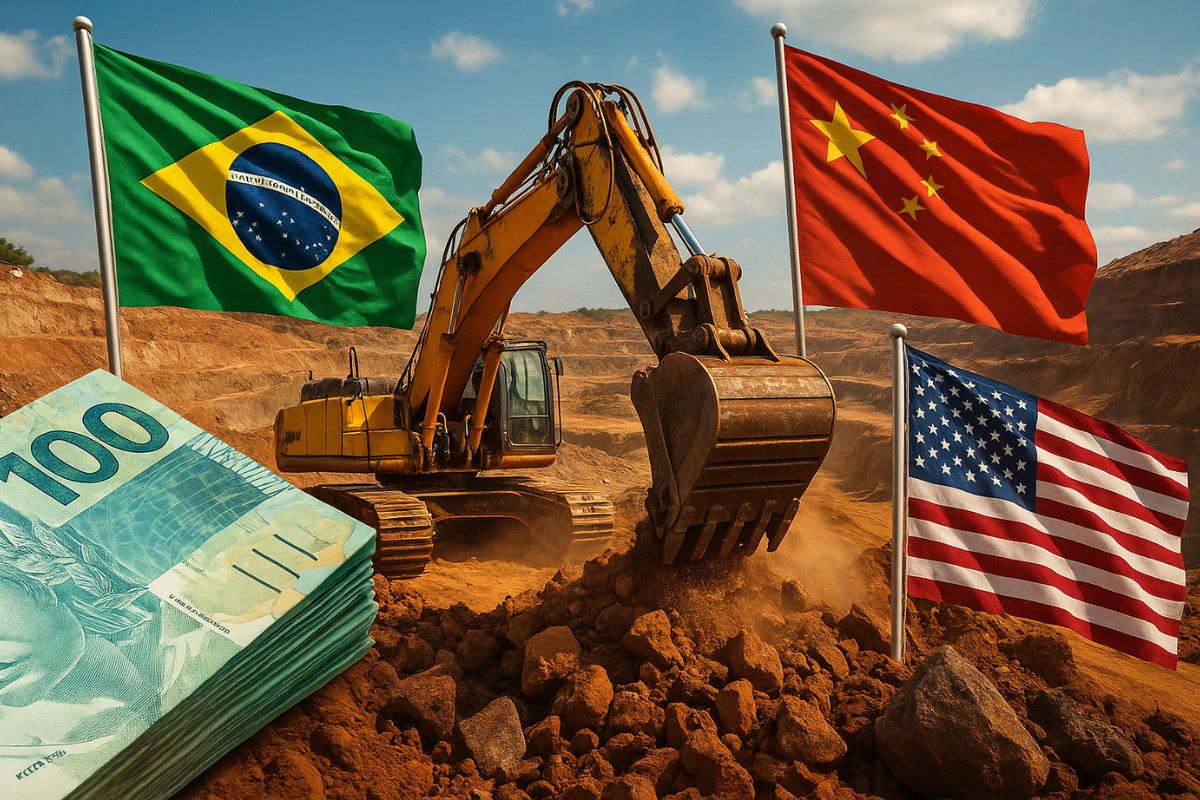


Even With One of the Largest Reserves of Critical Minerals on the Planet, Brazil Faces Delays in Production, Failures in Public Policies, and Risk of Falling Behind in the Global Race for Energy Transition, While China and the US Advance on an Industrial Scale.
Brazil has about 10% of the world’s critical mineral reserves, essential inputs for electric car batteries, wind turbines, and high-tech systems. Despite this potential, national production represents less than 0.1% of global supply, revealing a huge gap between available resources and economic utilization.
According to data released by O Globo, this discrepancy could cost trillions of reais in lost opportunities, as China and the United States move quickly to secure dominance over the production chains of these strategic minerals.
Why Critical Minerals Are Strategic
The energy transition is expected to multiply global demand for minerals such as lithium, nickel, graphite, and rare earths by up to six times by 2040.
-
Giant 142 kg Emerald from Brazil’s Bahia Region Auctioned with Starting Bid of Nearly $16 Million

-
Study Reveals 97% of Pregnant Munduruku Women in the Brazilian Amazon Have Mercury Levels Above Safe Limits, 90% of Newborns Contaminated by Gold Mining
-
China could reduce iron ore imports from 80% to 50% of consumption by 2030, while its share in global steel production falls from 52% to 46%, in a shift that could reshape the global market, says CMRG.
-
Brazil is sitting on one of the largest lithium reserves in the world, in the Jequitinhonha Valley, but national mining has almost become an appendage of China: 97% of the metal’s export goes to a single country, which also dominates refining.


These inputs are indispensable not only for the clean energy sector but also for the defense industry, fertilizers, and cutting-edge equipment.
Brazil could be a key player in this scenario, but has yet to establish effective policies that transform its reserves into competitive production.
Meanwhile, countries like China already dominate the rare earth chain, supplying practically the entire world.
Where Brazil Is Falling Behind
According to the Brazilian Institute of Mining (Ibram), Brazilian extraction of critical minerals is minimal compared to global leaders.
In 2024, for example, the country produced only 20 tons of rare earths, compared to 270,000 tons from China.
In the case of lithium, the difference is also striking: 10,000 tons extracted in Brazil compared to 88,000 tons in Australia.
This delay is explained by factors such as delays in environmental licenses, regulatory bureaucracy, and lack of infrastructure for processing and value addition.
Furthermore, geological mapping covers only 27% of the national territory, which prevents the full identification of the existing potential.
The Role of National Policy for Critical Minerals
The government is preparing the National Policy for Critical and Strategic Minerals (PNMCE), which will have two central axes: environmentally sustainable mining and value aggregation in Brazil.
The goal is to ensure that exploration is not limited to raw material export but advances to high value-added industries, such as battery factories and energy systems.
According to the Ministry of Mines and Energy, the new legal framework will include commitments in innovation, job creation, and sustainability for companies operating in the sector.
The idea is to transform the country into a supplier of complete solutions, not just mineral commodities.
Investments and Obstacles on the Horizon
Between 2025 and 2029, Ibram estimates investments of US$ 18.45 billion in exploration.
However, each project may take up to ten years to come to fruition, increasing the risk of Brazil losing ground to more agile competitors.
There are also environmental and social concerns. Experts warn that the expansion of mining cannot encroach on protected areas, indigenous lands, and quilombola territories, risking new conflicts and international tensions.
The challenge will be to balance competitiveness and environmental preservation, without repeating historical mistakes in the mineral sector.
The Dispute with China and the United States
While Brazil discusses regulatory frameworks, China and the US accelerate investments and strategies to ensure supply.
Beijing has already solidified global leadership in rare earths, while Washington seeks agreements with producing countries to reduce dependence on China.
In this game, Brazil risks becoming just a secondary exporter, lacking prominence in the value chain and failing to fully capitalize on its resource wealth.
Brazil is facing a strategic choice: invest in solid policies to transform its reserves of critical minerals into global prominence or continue losing ground to powers like China and the United States.
And you, do you believe that Brazil will be able to balance environmental preservation and economic advancement to take advantage of its critical mineral reserves? Or will the country continue to be just a supplier of raw materials? Leave your opinion in the comments.