






 Portuguese
  Spanish
  4 min of reading
  0 comments


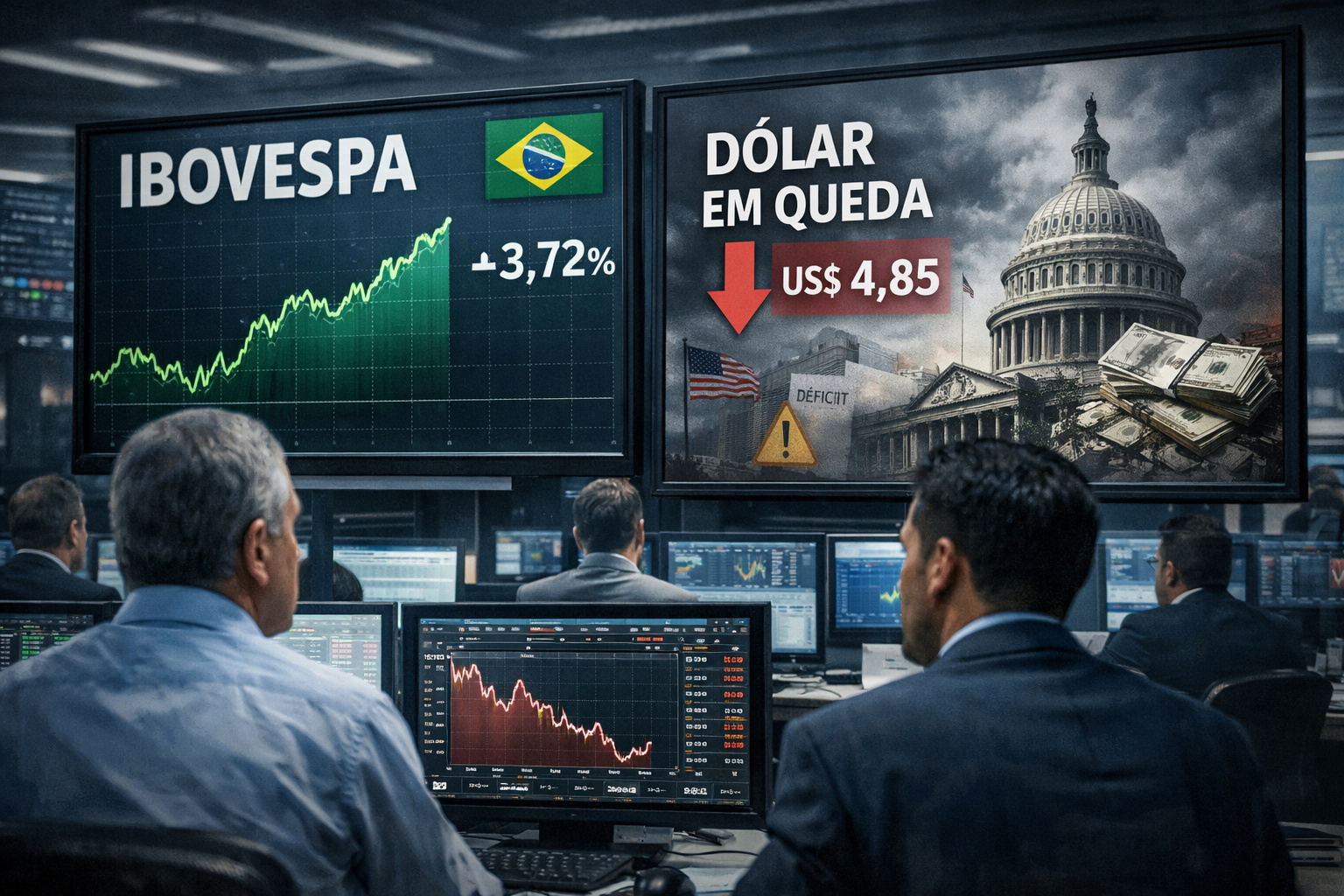
Brazilian Market Attracts Capital More For International Comparison Than For Structural Improvement Of Domestic Fundamentals
The Brazilian stock market has been reaching new highs and the dollar shows a downward trajectory in 2026, creating the feeling of a more favorable environment for local assets. However, behind the recent movement, asset managers are adopting a much less triumphant discourse. The prevailing evaluation is that Brazil is once again appearing in global portfolios not due to a structural change in its economic fundamentals, but mainly due to the deterioration of the external scenario and the scarcity of clear risk-return alternatives outside the country.
The information was disclosed by monthly letters from asset managers such as Opportunity, Genoa Capital, Adam Capital, Ibiuna Investimentos, and Kapitalo, which analyze the recent behavior of markets and point out important limits to an excessively optimistic reading of Brazilian assets.
Although the foreign inflow was intense at the beginning of the year, driving prices up and reducing premiums, the perception is that this movement is more associated with the relative comparison between markets than with a solid conviction about the medium and long term of the Brazilian economy.
-
A man went to the supermarket in China with the salary of a single day’s work, and what he put in the cart will make any Brazilian question why they pay so much to eat so little.

-
Louvre sees $102 million worth of jewels disappear in daring heist, and now the crime that shocked Paris will hit the screens

-
The claw machine may seem like a shopping mall game, but a man who started from scratch has 1,000 of them spread across Brazil and earns R$ 800,000 per month while the claw holds the entire business together.
-
INSS Consigned Loans: Bank to Refund Amounts After STJ Nullifies Loans Made by Illiterate Person at ATM and Decides That Password, Chip Card, and Even Use of Money Do Not Validate Contracts




Foreign Flows Support Prices, But Fiscal Fragility Remains The Main Structural Barrier
Brazil remains present in global allocations, but this space has been occupied due to the lack of alternatives abroad. In a more selective international environment, marked by high interest rates and increased risk aversion, the so-called “carry” still plays a relevant role in the attractiveness of local assets.
Opportunity highlights that this interest rate differential helps sustain positions in the short term, but notes that fiscal fragility limits a more constructive view in the longer term. Similarly, Genoa Capital assesses that the inflow observed for Brazil reflects much more the scarcity of attractive options outside the country than a consistent improvement in domestic fundamentals.
This diagnosis converges to a central point: the recent appreciation of Brazilian assets occurred at the same time as premiums decreased. With higher prices, the room for new highs becomes more restricted, especially in a context where fiscal uncertainties remain present and without clear signs of structural resolution.
Low Savings, High Cost Of Capital, And Doubts About Monetary Policy Increase Caution
Among the houses analyzed, Adam Capital takes the most critical tone regarding the domestic scenario. According to the manager, Brazil has one of the worst gross savings rates in relation to GDP, a level considered insufficient to sustain robust investment cycles without putting pressure on the balance of payments.
In the manager’s assessment, this scenario consolidates an environment of fiscal unanchoring, which raises the cost of capital and limits the potential for economic growth in the long term. Additionally, Adam questions the reading that the monetary policy is excessively restrictive.
According to the monthly letter, the data indicate an economy still operating with dynamism, which suggests that the current interest rate level exerts less restraint than part of the market believes. In this context, the manager states that the signal of monetary easing from the Copom may be ignoring the deterioration of internal fundamentals, which adds negative asymmetry to local assets.
This set of factors reinforces the perception that the recent market performance does not eliminate relevant structural risks, but rather temporarily shifts them to the background.
Uncertainties In The United States Are Not Fully Reflected In Global Prices
At the same time that Brazil benefits from the relative comparison, there is a growing assessment among managers that important risks in the United States are still not fully priced in. Despite the increase in fiscal and political uncertainties, the international market continues to operate under a relatively benign baseline scenario.
Ibiuna Investimentos, for example, questions whether a favorable external environment can continue to prevail over local fundamentals in the pricing of Brazilian assets. For the manager, the distribution of risks remains asymmetric, with the possibility of significant shocks still outside the price.
According to the reading of the houses, economic policy decisions in the U.S. still have the potential to provoke abrupt movements in global markets, which could directly affect flows to emerging countries, including Brazil.
Given this scenario, Kapitalo states it prioritizes structures that preserve capital in adverse environments, focusing on asymmetry and protection. In its letter, the manager emphasizes that portfolio reallocation processes rarely occur linearly.
“We believe that in these portfolio reallocation processes, price trends are not gradual,” states the firm. “The most likely outcome is that we will continue observing sequences of price jumps, interspersed with corrections along the way.”
In a scenario where the dollar can vary so drastically depending on the election results, is the Brazilian investor truly prepared to protect their wealth if the exchange rate heads to R$ 6 — or to seize opportunities if the currency retreats to around R$ 4.50?
With information from: InfoMoney








Be the first to react!