






 Portuguese
  Spanish
  3 min of reading
  0 comments


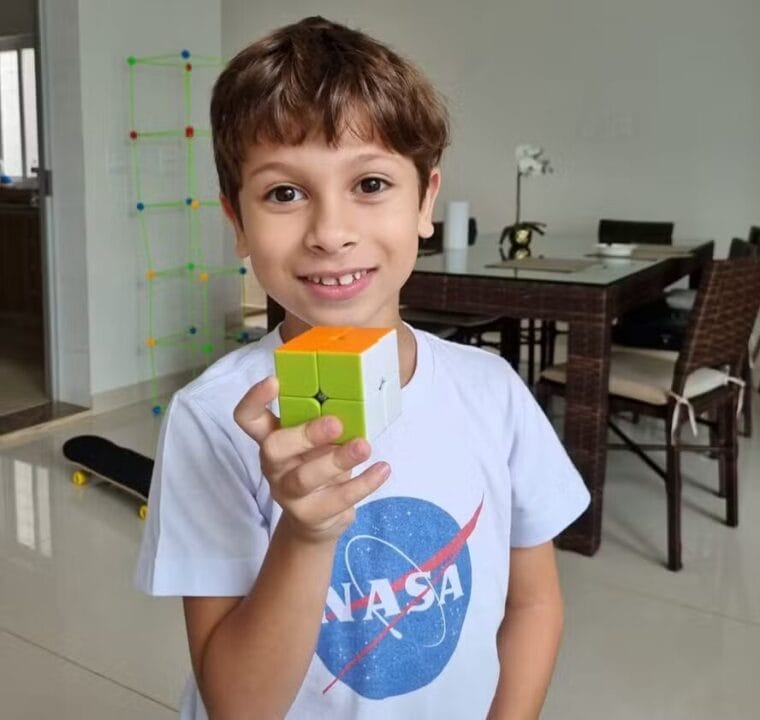
What Were You Doing At Seven Years Old? While many children of that age are still discovering the world around them, Arthur Ruiz, a young Brazilian prodigy, made an astronomical discovery that left scientists around the globe surprised.
Arthur identified a near-Mars asteroid with the potential to approach Earth, a remarkable feat that caught the attention of renowned institutions such as NASA, Harvard University, and the Smithsonian Planetarium.
It is important to highlight that Arthur, a member of Mensa Brazil, was not alone on this journey. He was part of a team called Theta Mensae, composed of five other young Brazilian talents: Bernardo Leitão Teixeira, Benício Zenha, Alexandre Franchini Woo, Paulo Augusto Tomadon, and Vitor Sena Ramos.
According to information published by O Globo, these young scientists use data provided by IASC/NASA, analyzing images and preparing detailed reports on their observations.
-
Fragment of the Moon found in Africa holds a mark of a giant impact from 3.5 billion years ago and may reveal what the solar system was like when life was beginning to emerge on Earth.

-
Alexa+ arrives in Brazil with generative AI in the ChatGPT style, promises to understand even the Brazilian way, costs R$ 99.90 outside of Prime, and can transform Amazon’s old assistant into a smart hub for conversations, tasks, connected home, emails, and even Uber requests.
-
Scientists are studying the creation of toothpaste from human hair capable of reconstructing tooth enamel: keratin forms a crystalline layer similar to natural protection and could change the fight against cavities in dentistry.

-
Maritime engine without diesel receives international certification and can deliver pure hydrogen to ships with power up to 2,670 kW, without CO₂, without sulfur, without soot, and with exhaust composed of water vapor.




The asteroid, provisionally named ‘2024 JB 29’, was discovered during an analysis of this data. Arthur’s team carefully analyzed the images provided by IASC/NASA, identifying the asteroid’s trajectory and determining its potential for approaching Earth.
The discovery was officially recognized and published in the Minor Planet Center and the NASA Astrophysics Data System, two of the most important astronomical databases in the world.
Recognition and Future of the Young Scientist
The discovery gained even more prominence during a live event organized by the Ministry of Science, Technology, and Innovation (MCTI), where Dr. Patrick Miller, founder of IASC/NASA, emphasized the importance of this achievement.
Arthur and his team were praised for their precision and dedication in analyzing the data, demonstrating exceptional skills for young people their age.
Arthur, who has shown an inclination towards science from a very early age, will be able to name the discovered asteroid once its orbit is fully mapped and confirmed.
This process may take three to five years, but the young scientist is already excited about the prospect of leaving his name in the history of astronomy.
The Asteroid Hunting Program and Citizen Science
The Asteroid Hunting Program, a citizen science initiative coordinated by MCTI and IASC/NASA, is fundamental for projects like Arthur’s.
This program offers young talents the opportunity to actively participate in astronomical research, analyzing real data and contributing to discoveries that can have a significant impact on the study of space.
The participation of young people in the program is an example of how citizen science can democratize access to knowledge and scientific discoveries.
In addition to fostering interest in astronomy and other sciences, the program promotes international collaboration and the use of cutting-edge technology to monitor celestial objects that may pose risks to the planet.
A Generation Inspired by the Discovery
The story of Arthur and his colleagues is inspiring for many young people who dream of pursuing a career in science.
The dedication and talent of these young scientists demonstrate that, with access to tools and incentive programs, anyone can contribute to the advancement of human knowledge.
This discovery not only expanded our understanding of space, but also highlighted the importance of investing in education and science from an early age.
And you, what do you think about this impressive discovery? Do you think Arthur should give what name to the asteroid? Share your opinion in the comments!






Be the first to react!