Portuguese
  Spanish


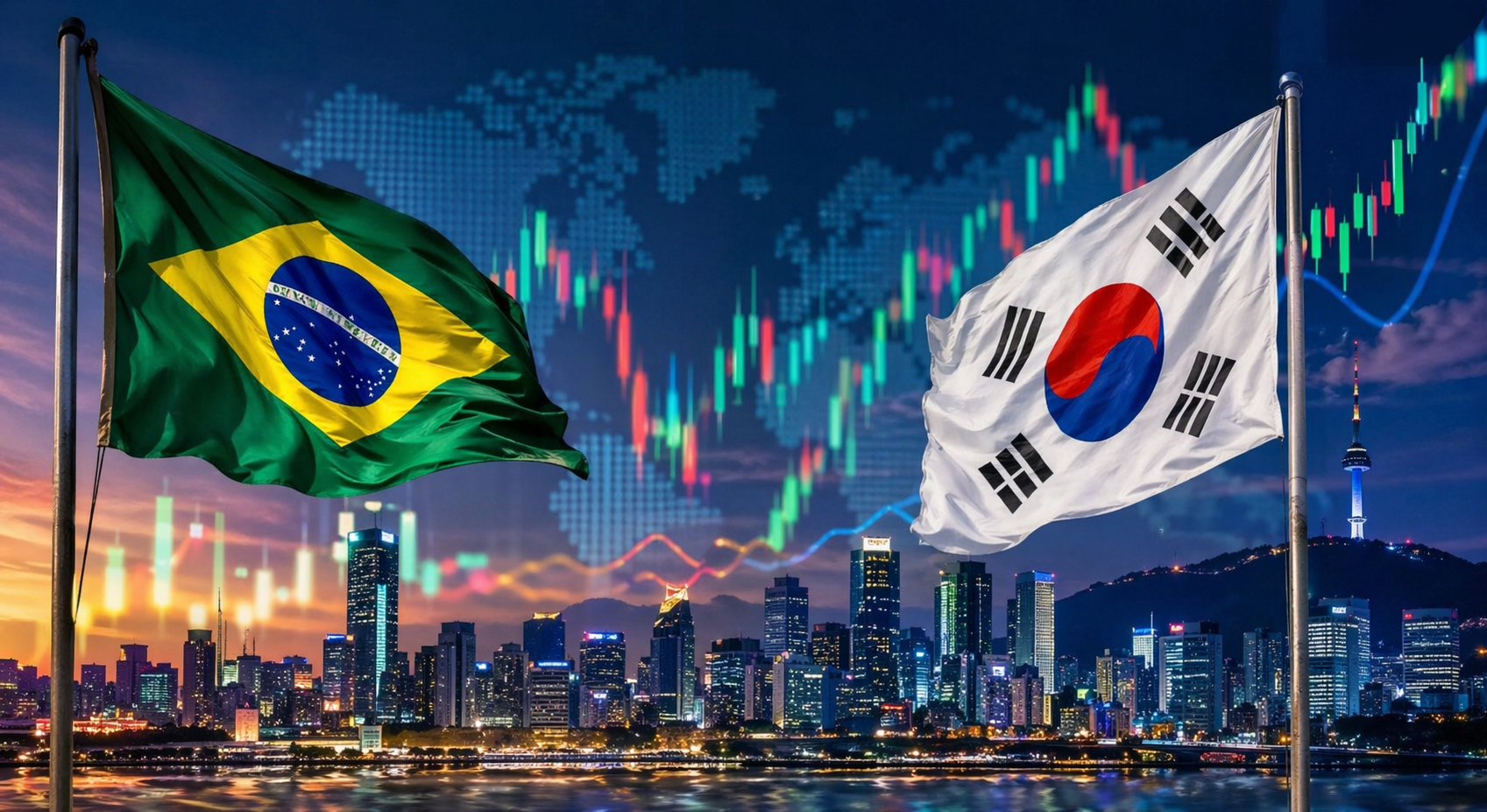

Assim, a Coreia do Sul se destaca como a principal escolha entre os investidores globais.
Além disso, a recuperação econômica e a inovação tecnológica têm sido fatores-chave para esse desempenho.
Enquanto isso, o Brasil continua a ser um mercado atrativo, mas enfrenta desafios para manter sua posição.
-
Brazil saved US$ 32.4 billion in 2025 by switching from fossil to renewable energy and only ranked behind China and the United States on the IRENA global podium.

-
A company from SC that moves R$ 125 billion in agribusiness is integrated into an international group, maintains its headquarters and jobs in Chapecó, and is preparing to expand software for cooperatives, grain companies, and industries while targeting new markets without leaving the western region of Santa Catarina.
-
Portugal “hides” gold reserves of 382 tons valued at 47 billion euros in an armored building, and the story involves gold from colonial Brazil, Nazi Germany, and a fortune that once amounted to 866 tons.

-
Truck drivers avoid deliveries to supermarkets due to waits that can hinder trips, increase costs, and leave vehicles idle, while the law limits loading and unloading to five hours and provides for payment for the excess time.




In this way, although relevant, Brazilian performance falls short of the Asian leaders.

South Korean stock market surges over 55% and consolidates leadership in 2026
Meanwhile, the South Korean stock market has seen a strong appreciation since January 2026.
According to the Market Data Monitor report from Itaú BBA, the index accumulated a rise of 191.5% in 12 months.

However, during the early conflict between Iran and the United States in 2026, there was significant volatility.
At that moment, the Kospi index fell by 12.1% in a single day, triggering the circuit breaker.
Even so, the market later recovered and consolidated its global leadership.
Furthermore, the performance was driven by the technology sector, especially semiconductors.
Thus, areas related to artificial intelligence and digitalization increased investor interest.
Structure of global funds favors Asian markets in 2026
Moreover, the composition of global funds reinforces the Asian advantage.
According to March 2026 data from MSCI Emerging Markets, South Korea represented 15.4% of the portfolio.
On the other hand, Brazil had only 5.15% participation in the same index.
Meanwhile, Taiwan led with 22.53%, concentrated mainly in the company TSMC, with 13% of the allocation.
Thus, Asian markets receive a greater structural volume of international capital.
Foreign investors buy stocks while Brazilians shift to fixed income
Finally, in contrast to foreign capital, Brazilian investors reduced their exposure to the stock market.
“`According to Itaú BBA, equity funds recorded a net outflow of R$ 7.14 billion in 2026.
Meanwhile, fixed income funds received R$ 154 billion in the same period.
Thus, the advance of the Ibovespa was mainly supported by international resources.
Therefore, local investors remained more conservative, prioritizing lower-risk assets.
In this scenario, with foreigners buying and Brazilians shifting to fixed income, will Brazil be able to maintain this pace without global leadership?