






 Portuguese
  Spanish


In Porto Alegre, designer Marina Anderle Giongo created CÓS Costura Consciente, which transforms discarded umbrella nylon into jackets and other fashion pieces. The collective brings together 101 seamstresses, has already produced 19,500 pieces, and earned R$ 240,000, giving new use to thousands of broken umbrellas.
In Rio Grande do Sul, a broken umbrella stopped being trash to become clothing. In Porto Alegre, CÓS Costura Consciente transforms the nylon from damaged umbrellas into waterproof jackets and accessories, proving that it’s possible to unite fashion, income, and reuse. The story was told by Projeto Draft.
Leading the project is designer Marina Anderle Giongo, a PhD in design with research in sustainable fashion. She created a network that now includes 101 seamstresses and has already produced 19,500 pieces from fabric that would otherwise go to waste.
The numbers show a real business. According to Projeto Draft, CÓS earned R$ 240,000 in 2024 and, after the flood that hit the state that year, reused 5,777 umbrellas that would be discarded, diverting hundreds of kilos of waste from landfills.
-
“Dinosaur-Era ‘Zombie’ Tree Rediscovered Alive in Secret Australian Canyon, Astonishing Scientists”

-
Two Design Students from Brazil Turn Recycled Plastic into Fashionable Eyewear, Earning $10 Million in a Year

-
Self-Taught Brazilian Innovator Brings Solar Power to Shantytowns Using Scrap, Solar Panels, and Phone Batteries
-
Brazil Pioneers Innovative Project to Transform Used Baby Diapers into Sustainable Solutions for Schools and Cities


The process combines dismantling, industrial washing, and sewing, transforming the waterproof nylon into stylish jackets. Next, see who Marina is, how an old umbrella becomes a jacket, and why this initiative from Rio Grande do Sul is so relevant to Brazil.
Who is Marina Anderle Giongo, the designer behind CÓS
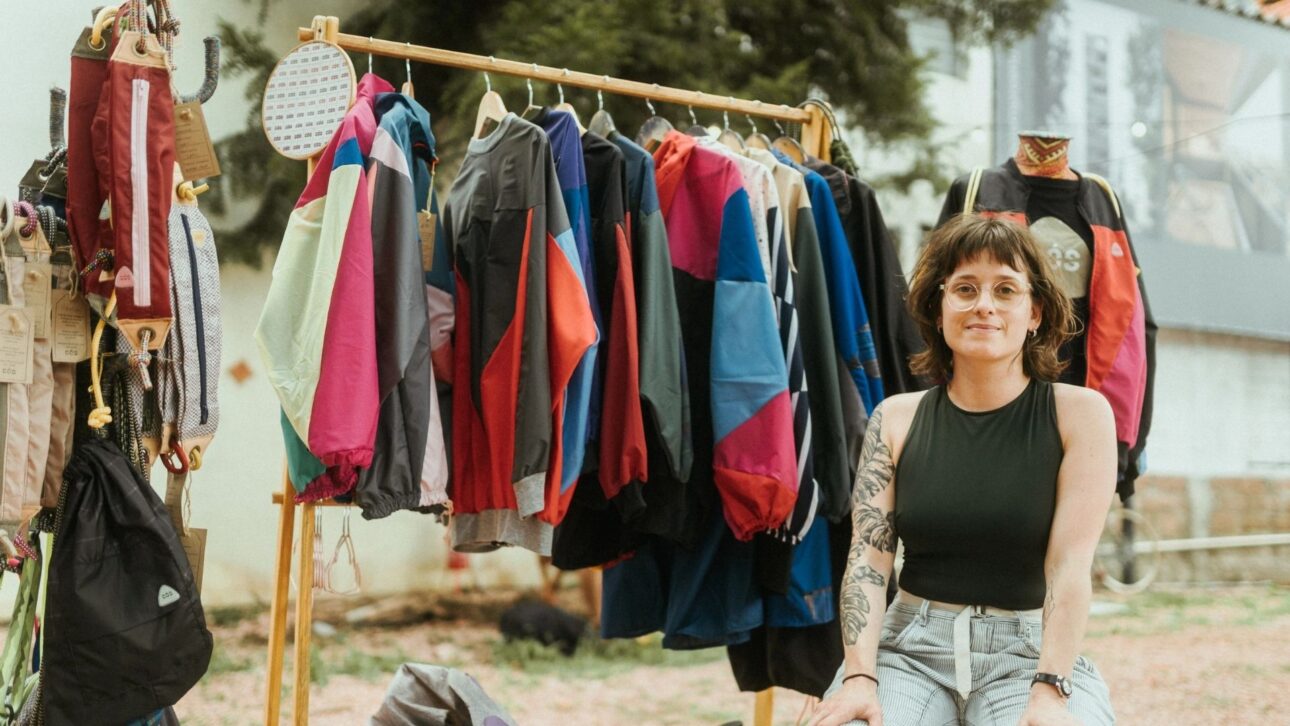
The protagonist of the story has ample training in the field. According to Projeto Draft, Marina Anderle Giongo, 37, holds a doctorate in design, with research focused on sustainable fashion brands. It was this background that led her to see value where most see only waste.
The path began before the brand. In 2018, Marina accepted the challenge of setting up a unit of Banco de Tecido in Porto Alegre, an initiative that reuses fabric scraps from the industry. From there, the idea of transforming textile waste into products began to take shape and became a collective of seamstresses.
CÓS was born as a project and later became a company. The initiative emerged around 2019, linked to university extension, and was formalized as a business in 2021, when a donation of defective umbrellas revealed a concrete market opportunity.
That’s when the turning point happened. “As there were already brands ordering products for the group, we saw that there was an opportunity,” Marina told Projeto Draft. From providing sewing services for third parties, CÓS began to create its own jackets and accessories, with identity and environmental proposal.
It’s worth understanding what Banco de Tecido is. It is an initiative that collects fabric scraps from the fashion industry and puts them back into use, preventing them from becoming waste. It was in this universe of reuse that Marina developed the method that she would later apply to umbrellas.
How umbrella nylon becomes a jacket
The secret lies in seeing the umbrella as raw material. When it breaks, the object usually goes straight to the trash, but the fabric part remains good. It is precisely this waterproof nylon that CÓS recovers to transform into clothing.
The process has well-defined stages. The damaged umbrellas are dismantled, the nylon undergoes industrial washing, and the sanitized fabric is cut and sewn. In the end, the material that protected from the rain becomes a ready-to-wear windbreaker jacket.
Each piece ends up being unique. Since the fabric comes from different umbrellas, the jackets combine panels of various colors, giving each model an exclusive appearance. This mix, typical of reuse, has become a trademark of the fashion made by CÓS.
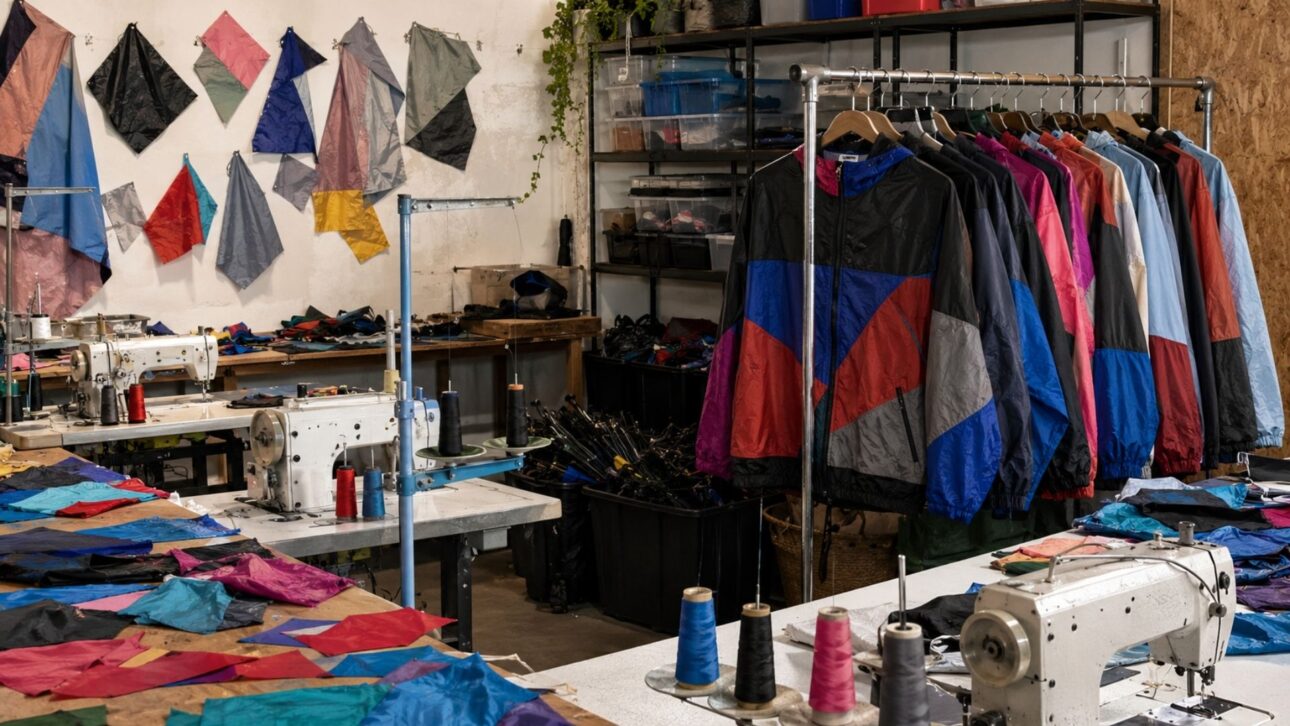
Creativity doesn’t stop at the umbrella. The collective also works with other waste, such as kitesurf kite scraps, and even tests the use of parachutes as raw material. The logic is always the same: transforming discarded technical material into fashion.
Working with this type of fabric has its challenges. The nylon from umbrellas usually has seams, rods, and reinforcements that need to be removed before cutting, and requires careful cleaning. Once these steps are overcome, the material proves to be lightweight, durable, and waterproof, ideal for a jacket.
The numbers of the collective: 101 seamstresses and 19,500 pieces
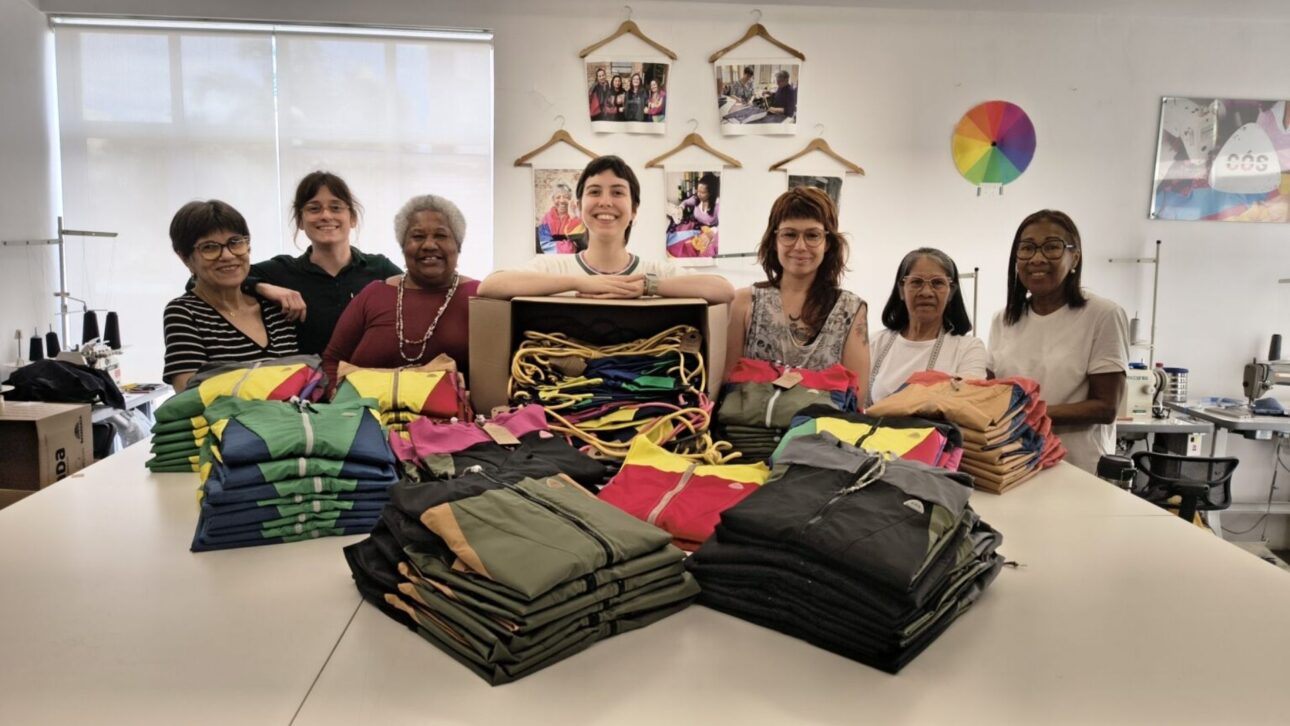
Behind the jackets there is a network of people. CÓS brings together 101 registered seamstresses who participate in the production of pieces made with umbrella nylon and other textile waste. This team handles the demand.
The accumulated production is impressive. According to the same source, the collective has already produced 19,500 pieces since 2019, including jackets, accessories, and other items. The volume shows that the proposal went beyond the drawing board and achieved real production scale.
The environmental impact also appears in the numbers. Since 2019, CÓS has prevented the disposal of about a thousand kilos of textile waste, meaning a ton of material that didn’t end up in the trash. Each reused umbrella slightly reduces this waste.
These data give dimension to the work. It’s not about a showcase piece made to attract attention, but a continuous operation, with seamstresses, goals, and mass production. Sustainable fashion here has become a routine in the atelier.
To put it into perspective, a thousand kilos of textile waste is equivalent to the weight of an entire compact car in fabric that didn’t go to the landfill. Spread over the years and thousands of pieces, this volume helps to understand why the work of the seamstresses makes a real difference.
A network that generates income for the seamstresses
The central point of the project is income generation. More than recycling nylon, CÓS organizes a work model for seamstresses in Porto Alegre, who find in the network a way to make money with what they know how to do.
The operation is flexible. According to Projeto Draft, the seamstresses register through a form and choose their work hours via WhatsApp, within the available shifts, generally with a few slots per week. Payment is made per piece produced.
There is also room for growth. According to the report, the seamstresses progress from basic tasks to more complex stages, such as modeling, and even participate in the creative process of the pieces. The idea is to develop skills, not just outsource labor.
This design brings fashion and work together in a concrete way. By distributing production among 101 seamstresses, CÓS transforms the reuse of umbrellas into occupation and income, showing that a sustainable fashion brand can drive an entire local chain.
The flexibility of shifts has a practical effect. By choosing hours according to their own routine, many seamstresses manage to balance work at CÓS with other daily tasks. This broadens access to income and makes the network fit into the real lives of participants, without relying on a fixed schedule.
The 2024 Flood and the Scale Shift
The year 2024 marked a change in level. The flood that hit Rio Grande do Sul caused enormous damage in the state, and the gaucho umbrella manufacturer Fazzoletti had its stock damaged by the waters, according to Jornal do Comércio.
Instead of becoming waste, the material was rescued. Faced with the risk of disposal, the CÓS team took action and recovered 5,777 umbrellas, which represented about 485 kilograms of waste diverted from landfills. It was the largest volume of raw material the collective had ever gathered at once.
The initial amount was even larger. The partner company offered about 30,000 damaged umbrellas, of which the collective managed to select and utilize a portion. The rest exceeded the available sorting and sanitization capacity at that time.
The atelier itself had been affected. The CÓS space was flooded with 1.10 meters of water and suffered a loss of about R$ 40,000, which forced the team to reorganize before tackling the new batch of nylon.
The recovery required collective effort. According to Jornal do Comércio, the sorting and sanitization process cost around R$ 17,000, funded by a collective financing that gathered more than a hundred supporters. This is how the umbrellas could become jackets in greater quantity.
After the most difficult phase, the material found a new destination. Cleaned and separated, the nylon from the rescued umbrellas became the base for new collections, transforming a stock doomed to the trash into a product. It was this turnaround that took the project to a new level of scale.
R$ 240 thousand in one year: the business behind recycled fashion
Recycling turned into revenue. According to Projeto Draft, CÓS recorded R$ 240 thousand in 2024, a result that shows the strength of a model based on recycled nylon, work by seamstresses, and fashion with purpose. It is a significant number for a local collective.
The way of selling also avoids waste. According to the report, CÓS bets on pre-sales through crowdfunding, producing according to demand, which reduces the risk of idle stock. Thus, each jacket made from umbrella usually already has a destined buyer.
This pre-sale model has a clear advantage. Since the pieces are made to order, CÓS does not accumulate jackets sitting in stock, which reduces cost and waste. The customer, in turn, helps finance the production even before the piece is ready.
This balance is the great asset of the project. By combining recycling, income, and planned sales, the brand shows that sustainable fashion can be financially healthy. Profit does not come despite the environmental proposal, but because of it.
It is worth remembering where it all started. Transforming a broken umbrella into a revenue of R$ 240 thousand is an example of circular economy in practice, where the disposal of one becomes the input of another. The nylon, once trash, became the base of a business.
What makes the umbrella jacket different?
The answer starts with the material. The nylon from umbrella is made to withstand rain and wind, which makes it ideal for windbreaker jackets. In other words, the fabric is already designed for the function that the final piece will perform, just in a new form.
The second differentiator is the aesthetics. Since each umbrella has its own color, CÓS’s jackets gain combinations that do not repeat, with colorful panels sewn side by side. This turns a limitation of recycling into a visual identity of fashion.
There is also the value of the story. Wearing a jacket made from recycled umbrellas, produced by a network of seamstresses, carries a meaning that a common piece does not have. The product also becomes a gesture of more conscious consumption.
Finally, there is the artisanal character. As they pass through the hands of seamstresses who participate in the creation, each jacket has a careful finish and an authorial touch. It is fashion thought piece by piece, and not anonymous mass production.
From a practical point of view, there is also durability. By using nylon made to withstand rain and sun, the jacket tends to resist well to daily use and time. It is a case where the origin of the material, an umbrella, ends up reinforcing the quality of the final product.
What does this have to do with Brazil
Brazil deals with a mountain of textile waste. Discarded clothes and fabrics accumulate in landfills every year, and items like broken umbrellas are almost never recycled. Projects like CÓS show a way to change this scenario.
The logic is that of the circular economy. Instead of treating used nylon as the end of the line, CÓS transforms it into jackets, proving that the waste of one process can be the raw material for another. It is a model that the country needs to expand to reduce waste.
There is also a message about income and work. By generating employment for 101 seamstresses, the initiative combines environmental and social agendas, something valuable in a country seeking jobs and income alternatives. In this case, sustainable fashion is also job creation.
Finally, the experience from Rio Grande do Sul inspires replicas. If a collective from Porto Alegre can transform an umbrella into a jacket and profit from it, other Brazilian cities can adopt similar ideas. Reusing discarded material is an opportunity spread throughout Brazil.
The size of the challenge is large. Brazil is among the largest generators of textile waste in Latin America, driven by the fast pace of fashion and the constant disposal of clothes and accessories. In this scenario, reusing even an umbrella ceases to be a detail and becomes part of the solution.
And you, would you wear a jacket made from an umbrella?
The trajectory of CÓS shows how creativity and purpose can transform waste into opportunity. Born in Porto Alegre, the brand of designer Marina Anderle Giongo already gathers 101 seamstresses, produced 19,500 pieces, and earned R$ 240,000, giving nylon from umbrellas a second life in the form of a jacket.
More than a fashion case, it is an example of circular economy and income generation in Brazil, born from a simple idea and taken seriously year after year. By reusing 5,777 umbrellas that would be discarded, the collective showed that sustainability and business can walk together, with feet on the ground and real results.
And you, would you wear a jacket made from the nylon of a reused umbrella? Do you think more fashion brands should invest in reusing discarded material and generating income for seamstresses? Share your opinion here in the comments and share with those who like sustainable fashion.


