






 Portuguese
  Spanish


A scientific proposal explores the use of gravity at great depths to store renewable energy for long periods, with an operation based on mass, cables, ships, and submarine relief.
Researchers have proposed a system capable of using the depth difference between the continental shelf and the ocean floor to store energy through gravity.
The technology, called Deep Ocean Gravity Energy Storage, or DOGES, was described in an article published in the Latin American Journal of Energy Research journal and involves transporting large volumes of heavy material between shallow areas and deep sea regions.
The study was authored by Julian David Hunt, Andreas Nascimento, Joao Paulo Reus Rodrigues Leite, Diego Nascimento, Wenxuan Tong, Marcos Aurelio Vasconcelos de Freitas, and Mohd Amro.
-
Chile’s Plan for a 20,000 km Undersea Cable to Hong Kong Halted by U.S. Pressure, Highlighting the Silent Data Control Battle in Latin America

-
In Somaliland’s Desert, Greenhouse Uses Sun and Seawater to Grow Lettuce, Cucumbers, and Tomatoes Without Rain: 1-Hectare Project Cools Crops, Desalinates Water, and Converts Brine into Commercial Salt
-
Trump Unveils $400 Million Boeing 747 Donated by Qatar as Temporary Air Force One Amid Boeing Delays, Sparking Debate on National Security, Costs, and Foreign Influence
-
Chinese Company Unveils Robotic Toilet That Comes to You, Featuring Lidar Sensors, Voice Command, Bidet, Hot Air Drying, UV Light, and Self-Cleaning Waste Disposal


The work was received on May 13, 2025, accepted on June 23, and published online on August 3 of the same year.
The proposal is based on a known physical principle: when a mass is elevated, it stores potential energy; when it descends, this energy can be converted into electricity.
In the case of DOGES, this logic would be applied at sea, with rocks, gravel, or mining waste functioning as the “weight” moved between two storage points.
In the model analyzed by the authors, a plant installed in an area with 4 km depth could offer storage at US$ 1.30 per kWh, with a power cost of US$ 3,947 per kW.
The article’s summary rounds this second value to about US$ 4,000 per kW.
How the gravitational battery works in the ocean
The system would not turn the ocean into a chemical battery, like those used in cell phones, electric cars, or stationary lithium systems.
Seawater would serve as an operational environment for a gravitational battery, in which energy is stored by the position of a mass relative to another depth.
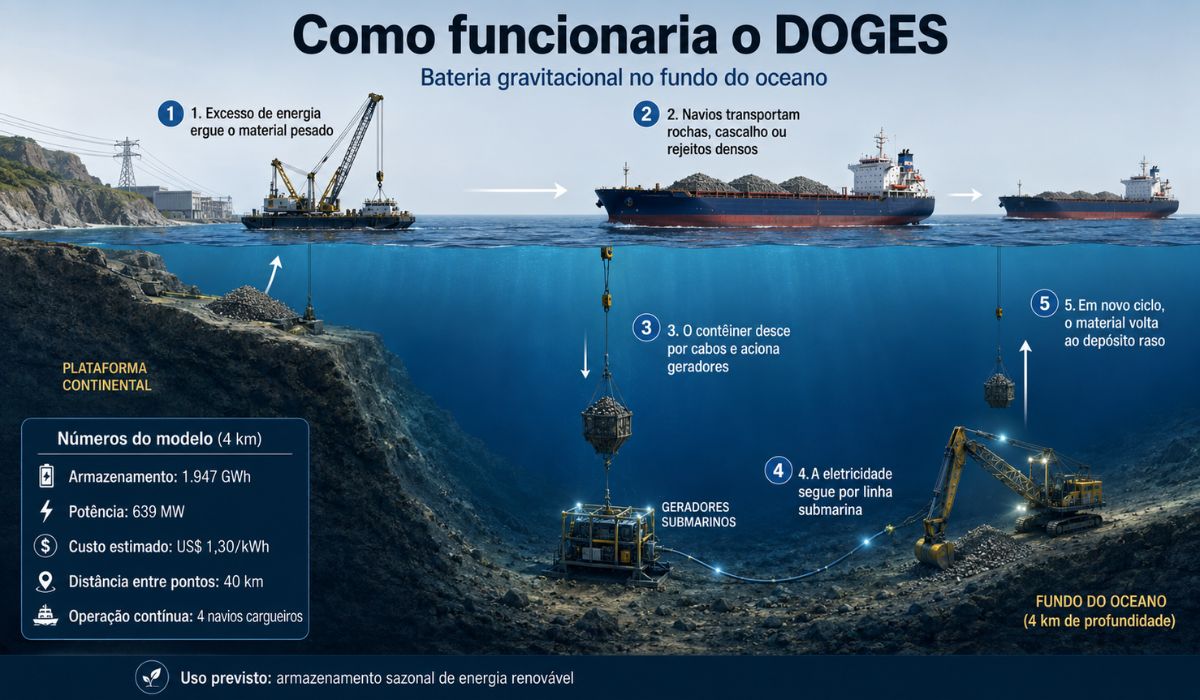
In practice, the heavy material would remain in a shallower deposit, near the edge of the continental shelf, when the system is charged.
To generate electricity, this material would be taken to a deeper area and lowered by cables, a movement that would activate generators during the descent.
When there was an electricity surplus in the grid, the process could be reversed.
The available energy would be used to lift the material from the deepest point back to the upper storage location, leaving the system ready for another cycle.
According to the article, the structure would have two storage locations, generator ships positioned over each point, cargo vessels to transport the material, cables, containers, bucket underwater excavators, and an underwater transmission line connected to the onshore power grid or offshore wind farms.
The difference from a conventional battery lies in the type of storage.
Instead of relying on chemical reactions, the DOGES would use mass, depth, and gravity to conserve energy for longer periods, according to the study.
Why DOGES targets renewable energy for long periods
The research was presented in the context of the expansion of renewable sources, especially solar and wind, whose generation varies according to the time of day, weather, and season.
According to the authors, this scenario increases the demand for technologies capable of storing energy for long cycles, such as weeks, months, or seasons.
DOGES is not presented in the article as a direct replacement for batteries used for short-term storage.
The researchers state that gravitational systems should not be considered for cycles shorter than 12 hours, because batteries tend to be more practical and cheaper in this range of use.
The intended function for the technology is different.
The model considers operation in seasonal cycles, with six months of storage and six months of generation, to meet prolonged periods of surplus or scarcity of renewable energy.
This type of application seeks to address a recurring limitation in the electric sector.
Solar energy can produce more at certain times of the day and year, while wind energy depends on wind patterns.
Therefore, long-duration systems are studied as a complement to the expansion of renewable sources.
Cargo ships, rocks, and underwater excavators
The reference material used in the study has a density similar to that of granite.
According to the authors, denser materials reduce the volume needed to store the same amount of energy and decrease part of the cost associated with transportation by ships.
The sand was discarded in the analysis because very fine particles could be carried away by underwater currents.
The article points out that this loss would reduce the generation potential and could affect the environment around the storage sites.
In the 4 km depth scenario, the researchers consider a distance of 40 km between the shallow point and the deep point.
To maintain continuous operation, four cargo ships would be needed: one loading, one unloading, one navigating to the lower point, and another returning to the upper point.
The scale described in the article involves 350 million tons of material, 400 thousand containers lowered per year and storage capacity of 1,947 GWh, with an installed power of 639 MW in the case of 4 km depth.
Each container considered in the model would have 12 meters by 6 meters by 6 meters.
In the largest operation configuration, the study estimates that a container would reach the lower point every 28 seconds, with a projected vertical speed of 0.87 m/s.
The article also calculates the water resistance on the containers.
Based on the assumptions adopted, the drag force would be equivalent to 0.4% of the submerged weight of the container, which is why the authors consider this loss small within the model.
Where DOGES technology could be applied
The viability of the technology depends on a central geographical condition: coastal areas where the seabed deepens rapidly.
The shorter the distance between the continental shelf and great depths, the shorter the journey of the ships and cables needed for the operation tends to be.
According to the study, there is potential in coastal areas of Europe, the Americas, Asia, Oceania, and Africa.
The list cited by the authors includes Portugal, Spain, France, Ireland, the United Kingdom, Italy, Greece, Cyprus, and Turkey, as well as Chile, Peru, Ecuador, Brazil, Central America, Mexico, and the United States.
The article also mentions potential in regions such as Indonesia, the Philippines, Taiwan, Papua New Guinea, China, Japan, Russia, Pacific islands, Iran, Oman, Yemen, Georgia, Australia, and New Zealand.
In the African case, the authors state that there are areas with some potential around coastal countries.
This dependence on bathymetry limits the application in locations with an extensive continental shelf and more gradual depth drop.
In these areas, the distance between storage points could increase costs, raise ship consumption, and reduce the overall efficiency of the system.
The researchers cite possible applications on islands with high renewable generation, coastal regions without significant availability of hydroelectric reservoirs, and offshore wind farms that already require electrical infrastructure at sea.
The proposal, however, remains in the field of technical study and there is no indication, in the article, of a commercial plant in operation.
Challenges to Bringing the Submarine Battery to Practice
The DOGES requires large-scale maritime equipment, continuous underwater operation, and planning similar to that of large-scale port and mining activities.
Cables, motors, containers, and excavators would be subject to pressure, corrosion, currents, and mechanical failures in hard-to-reach areas.
The authors themselves point out that future research should develop more accurate models to predict environmental impacts, especially on marine ecosystems.
The article also mentions the need to improve the efficiency and durability of underwater components and to evaluate regulatory structures for potential integration of the system into national energy strategies.
At the current stage of the proposal, the study presents a technical and economic estimate, not an implementation announcement.
There is no information in the consulted publication about a full-scale prototype, environmental license, construction schedule, or company contracted to execute a DOGES project.
The central idea, according to the researchers, is to use a natural depth difference as an alternative for seasonal energy storage.
Instead of building a large structure on land to create a height difference, the system would take advantage of the existing submarine terrain in certain regions of the planet.


Be the first to react!