






 Portuguese
  Spanish


The floodable square Benthemplein was opened in Rotterdam on December 4, 2013. Designed by De Urbanisten, it brings together three basins, stainless steel gutters, a sports court, bleachers, and leisure areas to store 1.7 million liters of rainwater during intense urban storms visibly to the public.
The floodable square Benthemplein, in Rotterdam, Netherlands, was created to do something that seems contradictory: partially disappear under water on purpose. When it rains heavily, its three lowered basins capture rainwater; when the weather is dry, the same space functions as a court, theater, seating area, and urban meeting point.
According to the Resilient Cities Network, the square can collect 1.7 million liters of water from the surrounding area, marked by concrete, pavement, and little natural drainage. The project was completed in 2013 and became an international example of how flood infrastructure can be visible, useful, and integrated into the city’s daily life.
Rotterdam transformed drainage into public space
Rotterdam is located in a water-vulnerable region and part of the city is below sea level. Therefore, the management of rain, canals, drainage, and floods is not just a technical issue: it is part of urban survival itself.
-
U.S. National Park Deploys Robotic Birds Near Wyoming Airport to Protect Endangered Species: Dancing and Sound-Emitting Replicas Aim to Lure Real Birds to a 100-Acre Restored Area Away from Runways After 32 Aircraft-Related Deaths

-
Russia and India Lift 320-Ton Pressure Vessel into Kudankulam Nuclear Plant Reactor, Advancing Project That Has Already Prevented 112 Million Tons of CO2 Emissions

-
Brazilian Student Wins Global Science Fair in the U.S. with Sound Wave Method to Alter Alzheimer’s-Linked Genes
-
Bosch Unveils Revolutionary 2.3 kg Hub Motor for E-Bikes with 45 Nm Torque and 400 Watts Power, Eliminating Resistance Above 25 km/h in Historic Shift for German Manufacturer


The floodable square emerged precisely from this logic. Instead of hiding all the water in expensive and invisible underground reservoirs, the city decided to create open infrastructure where residents, students, and workers could see how water is stored and directed.
Benthemplein was officially opened in 2013
According to the De Urbanisten office, responsible for the project, the Watersquare Benthemplein had its design developed between 2011 and 2012 and was completed in 2013. The official opening took place on December 4 of that year.
The project had as its client the Rotterdam Climate Initiative and the city of Rotterdam, with support from the Waterboard Schieland & Krimpenerwaard. The work also involved collaboration from the city’s engineering bureau and various professionals related to landscape, construction, steel, colors, and social participation.
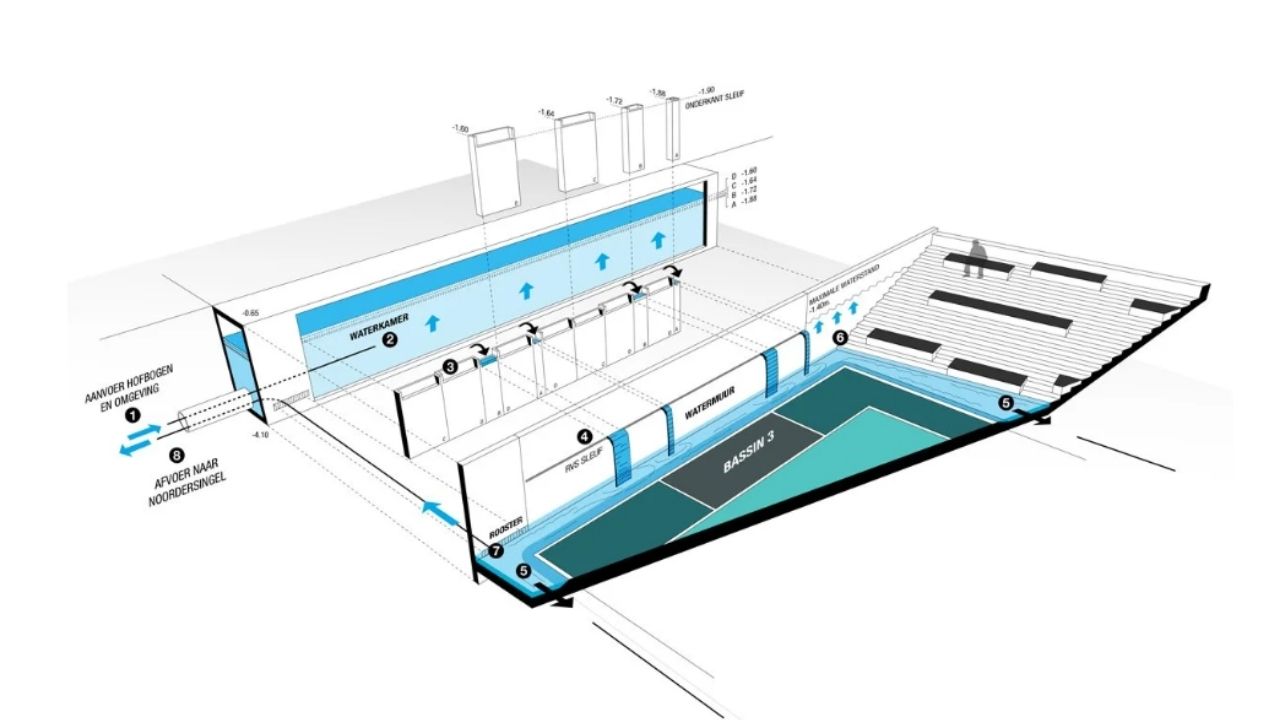
Three basins receive rainwater
The square has three drainage basins. Two are shallower and receive water from nearby areas whenever it rains. The third, deeper one, receives water when the rain persists longer and the collected volume is greater.
This third basin is the most striking part of the project. When dry, it functions as a sports court and open-air theater, with bleachers around. When it rains heavily, the same urban design changes function and acts as a temporary reservoir.
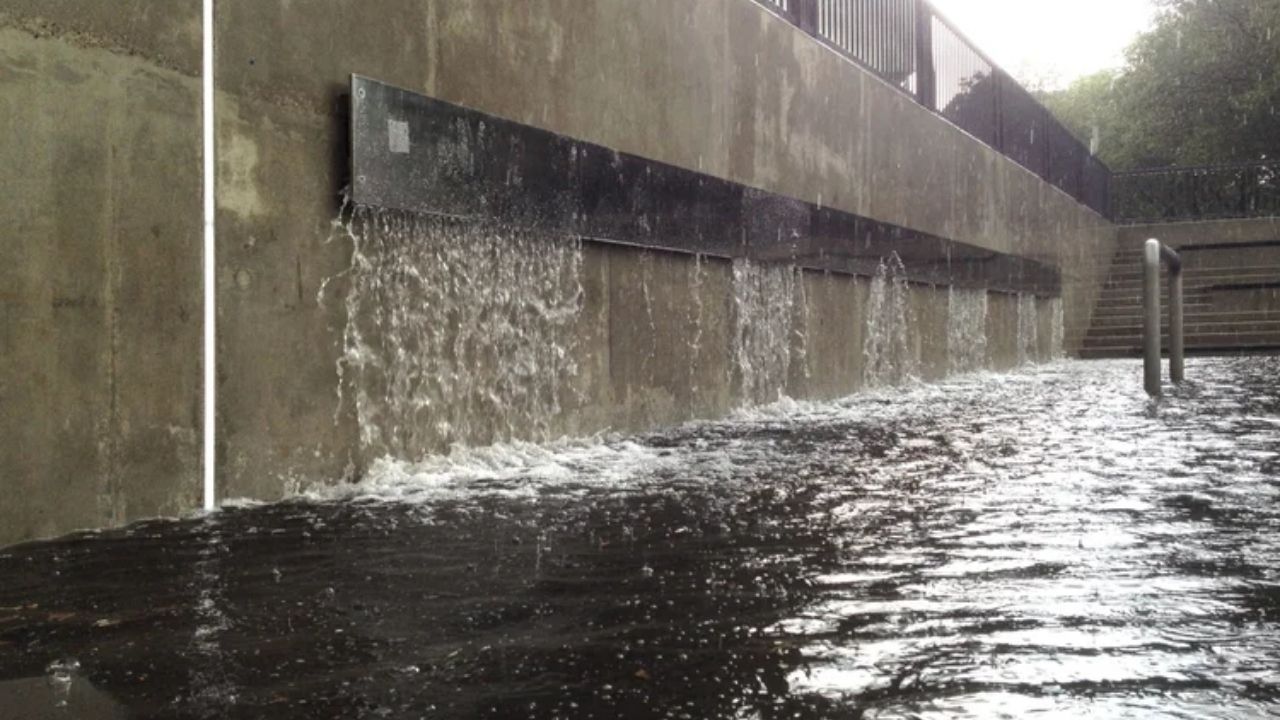
Water runs through stainless steel gutters

The water that falls on the square does not disappear invisibly. It travels through large stainless steel gutters, which direct the flow to the lowered basins.
This detail is important because it makes drainage part of the urban experience. The water’s path is visible, almost like a live demonstration of urban engineering. The floodable square teaches, in practice, how the city handles storms.
Almost 2 million liters stay above ground
The Stormwater Report informed, in March 2014, that Benthemplein can retain almost 2 million liters of water, equivalent to 528,344 gallons. The Resilient Cities Network details the volume as 1.7 million liters collected from the surrounding area.
This volume is especially relevant because the region was considered high risk for flooding. The impermeable surfaces of Rotterdam quickly channel water to drainage systems, canals, and sewers, which can become overwhelmed during intense rain events.
Dry space becomes court, theater, and leisure area
The great difference of Benthemplein is that it does not wait for the rain to be useful. During dry weather, the space functions as an area for socializing, leisure, sports, and relaxation.
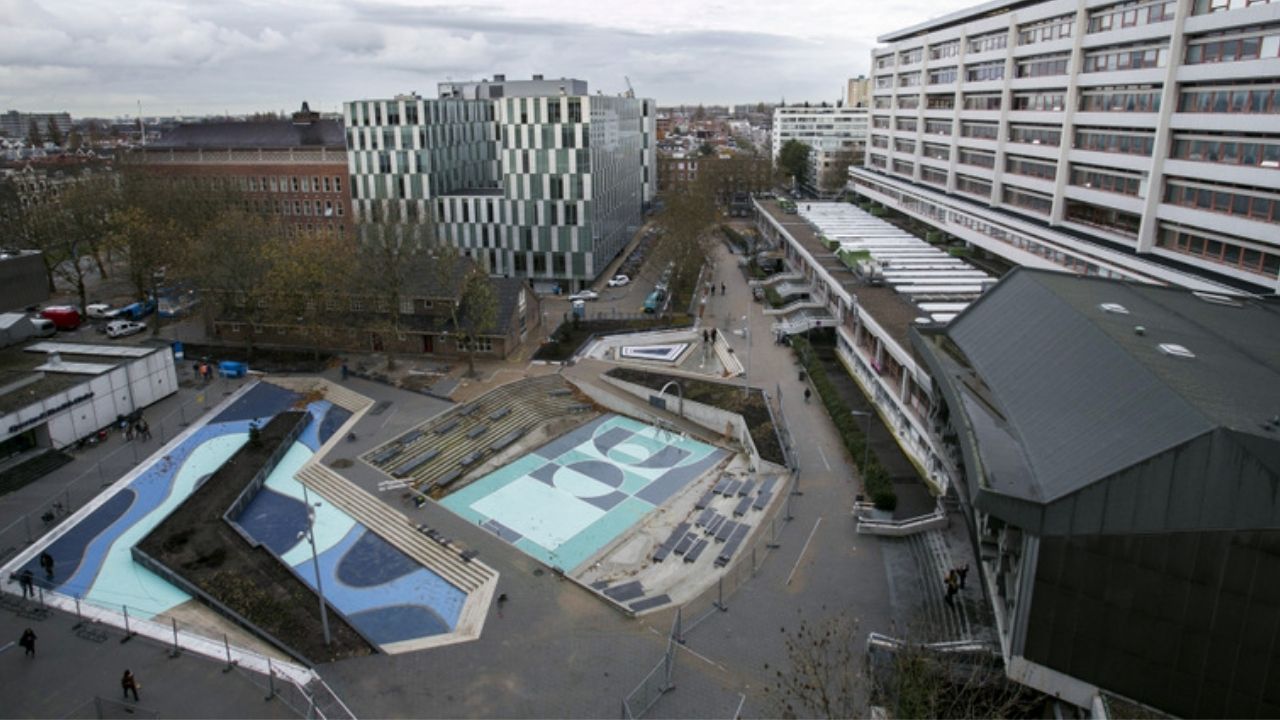
The largest basin becomes a court surrounded by amphitheater-style seating. One of the smaller basins has a raised area in the middle, designed for small performances. The other offers flat sections that can be used by children and young people on wheels.
Project involved residents and students
De Urbanisten reports that the design was built in dialogue with people who would use the space. Students and teachers from Zadkine College and the Graphic Lyceum, members of a nearby church, youth theater, gym, and residents of the Agniese neighborhood participated.
In three workshops, participants discussed possible uses, desired atmospheres, and how water could influence the square. The decision was not just technical: the project sought to combine urban drainage with community life.
Blue marks everything that can flood
In the project, everything that can receive water was painted in shades of blue. The elements that transport water received a shiny stainless steel finish.
This choice helps to read the square intuitively. The user understands which areas can flood and which elements conduct the rain. The floodable square does not hide its hydraulic function; on the contrary, it uses color, shape, and material to make the system understandable.
Area once dull became an urban reference
The Resilient Cities Network describes Benthemplein as a transformation from a previously uninviting space, between educational and commercial buildings, into a central community point.
The square brought color, vegetation, seating areas, and public functions to a place that needed to deal with flood risk. The result is an infrastructure that not only serves to prevent damage but also to create meeting points, identity, and everyday use.
Water is released slowly after the rain
After capturing the water, the system does not simply abandon it in the drainage network. According to the Resilient Cities Network, the stored volume is slowly released to a nearby canal and also to the groundwater.
This process reduces the immediate pressure on urban infrastructure during storms. Instead of all the water rushing at once to streets, basements, and overloaded systems, the floodable square absorbs part of the impact and distributes the runoff at a different pace.
Idea was born before the final work
De Urbanisten reports that the water square typology was invented in 2005, during the International Architecture Biennale Rotterdam, in research related to the theme of floods.
After that, there were studies between 2006 and 2007, inclusion of the idea in the Rotterdam Waterplan 2 in 2007, a pilot study between 2008 and 2009, preliminary design in 2011, final design in 2012, and construction completed in 2013. The final work was the result of years of research, urban policy, and concept testing.
Project became an international example


The Stormwater Report stated that Benthemplein was the first full-scale water square opened in Rotterdam. The work attracted international attention for combining flood control with public space.
The approach also reinforced Rotterdam’s image as a city that experiments with solutions for climate adaptation. The Resilient Cities Network itself cites the square as one of the city’s most popular interventions in resilient water management.
Solution influenced other cities
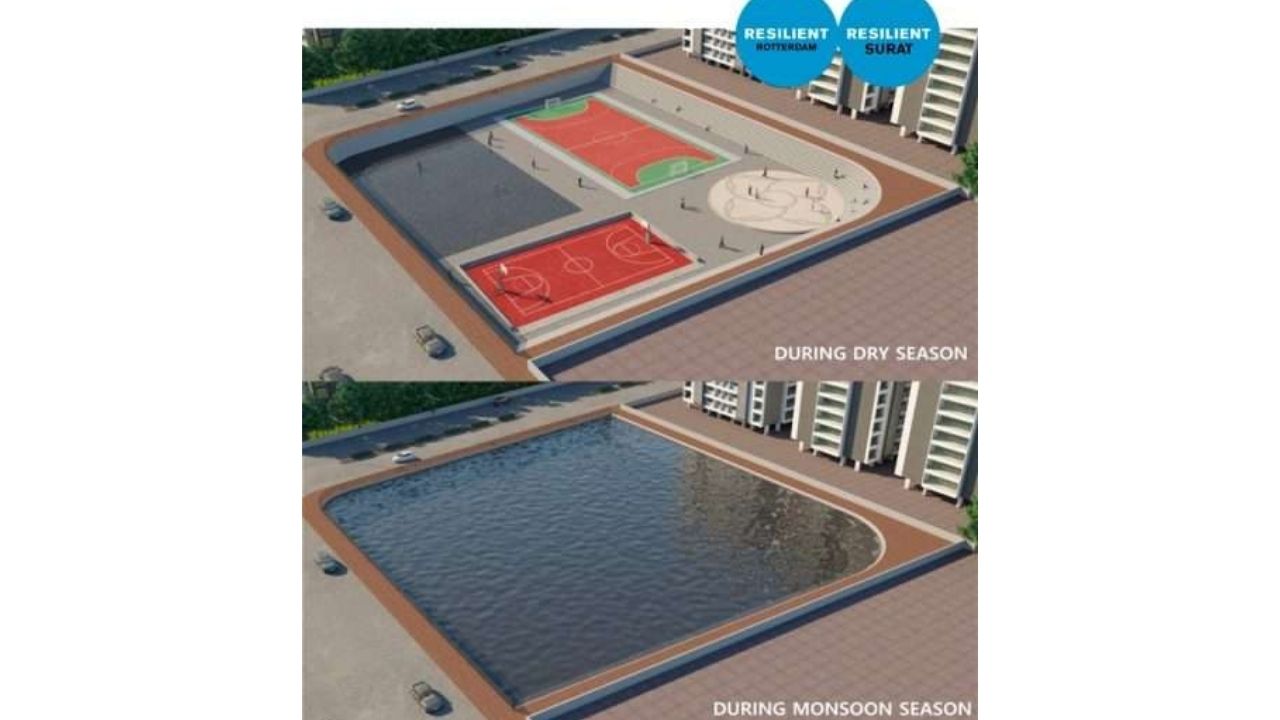
The experience of Rotterdam has begun to be observed by other cities. The Resilient Cities Network highlights that Surat, in India, studied Rotterdam’s projects, including water plazas, multifunctional roofs, and underground water storage.
Surat started developing its own water plaza, adapted to the context of monsoons, heavy rains, Tapi river pollution, and the need to capture rainwater. The case shows that Benthemplein was not restricted to the Netherlands: it became a reference for thinking about urban drainage in other countries.
Plaza shows a new way to tackle flooding
The Benthemplein draws attention because it replaces the idea of hidden infrastructure with an open and multifunctional solution. The reservoir is not buried and invisible: it is a plaza used by students, residents, children, athletes, and visitors.
This model helps change the way cities approach water. Instead of treating rain only as a threat, Rotterdam created a space that accepts water, organizes its path, and transforms the risk into part of the urban design.
When the city learns to live with water
Rotterdam’s floodable plaza shows that climate adaptation can go beyond gray works, grids, pipes, and underground tanks. In Benthemplein, water appears, occupies space, changes the landscape, and then leaves in a controlled manner.
The question that remains is direct: should Brazilian cities prone to flooding invest more in floodable plazas, draining parks, and public areas capable of retaining rain, or does it still make more sense to hide everything in underground works? Leave your opinion in the comments.




Be the first to react!