






 Portuguese
  Spanish


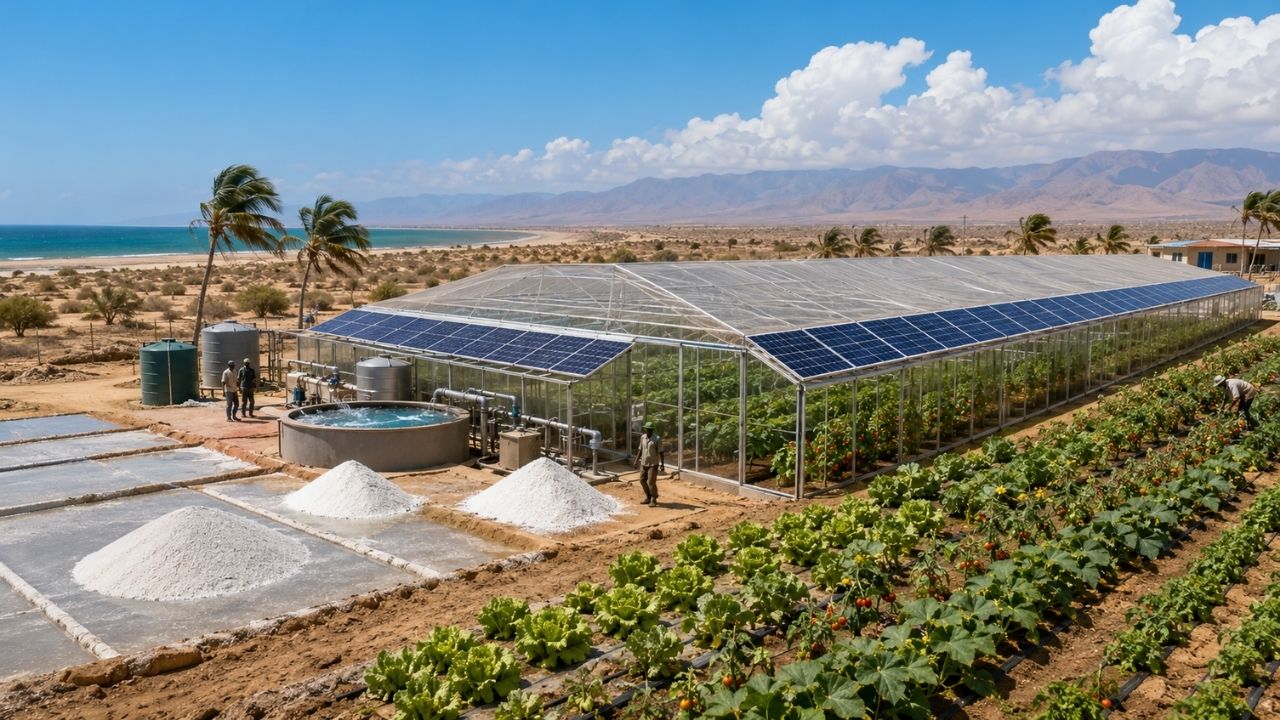
According to WIRED, the Seawater Greenhouse project in Somaliland uses seawater, solar energy, and evaporative cooling in a 1-hectare greenhouse near Berbera. The structure desalinates irrigation, reduces internal temperatures, grows lettuce, cucumber, and tomato, and repurposes brine to produce commercial salt in the coastal desert.
Seawater became the starting point for an unusual agricultural experiment in the Somaliland desert, in the Horn of Africa. In a region marked by drought, extreme heat, and dependence on imported food, Seawater Greenhouse created a sun and saltwater-powered greenhouse to grow vegetables without directly relying on rain.
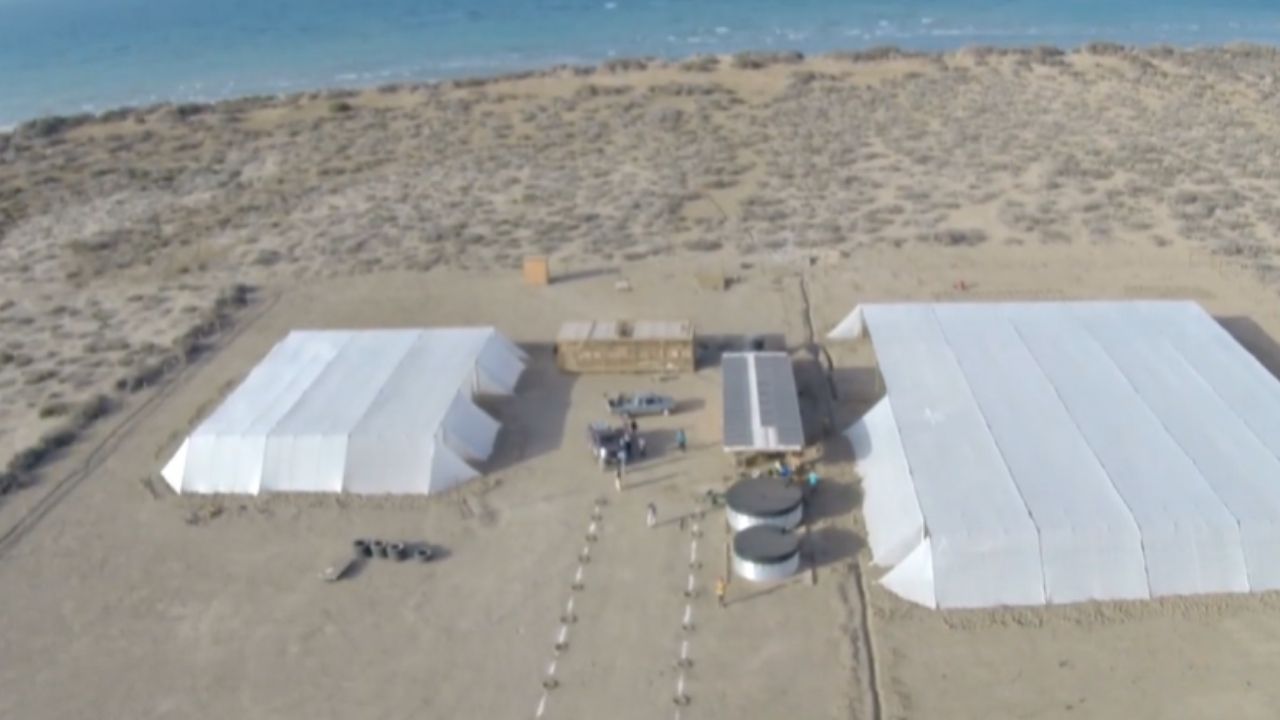
According to a WIRED report published on March 20, 2018, the project was led by Charlie Paton, founder of Seawater Greenhouse. The 1-hectare structure, installed near Berbera and about 200 meters from the Gulf of Aden, produced the first harvest of lettuce, cucumber, and tomato in January, less than a year after its launch.
Greenhouse uses sun and saltwater where rain is scarce
The proposal of Seawater Greenhouse starts from a simple yet technically challenging idea: to harness two abundant resources in arid coastal areas, the sun and saltwater, to create a cooler and irrigated growing environment.
-
Trump Unveils $400 Million Boeing 747 Donated by Qatar as Temporary Air Force One Amid Boeing Delays, Sparking Debate on National Security, Costs, and Foreign Influence

-
Chinese Company Unveils Robotic Toilet That Comes to You, Featuring Lidar Sensors, Voice Command, Bidet, Hot Air Drying, UV Light, and Self-Cleaning Waste Disposal
-
Rotterdam Develops Floodable Square to Absorb Nearly 2 Million Liters of Rainwater, Doubling as Sports, Theater, and Leisure Space When Dry to Combat Urban Flooding
-
U.S. National Park Deploys Robotic Birds Near Wyoming Airport to Protect Endangered Species: Dancing and Sound-Emitting Replicas Aim to Lure Real Birds to a 100-Acre Restored Area Away from Runways After 32 Aircraft-Related Deaths



Seawater is pumped from the coast and used in two ways. One part helps to cool and humidify the interior of the greenhouse through evaporation; another goes through desalination to become fresh water used for irrigation. The goal is to reduce dependence on rain in a region where drought compromises local production.
Project is located near Berbera, in the Gulf of Aden
The installation described by WIRED is located on a desert terrain near the coast, in the Berbera region, Somaliland. The institutional page of Seawater Greenhouse Somaliland also presents the project as a 1-hectare pilot farm near Berbera.
The location is strategic because it combines arid terrain, intense sunlight, and access to the sea. For Charlie Paton, this type of scenario sums up the problem he tries to tackle: the water exists, but it is salty and in the wrong place for conventional agriculture.
Technology was born from decades of testing
Paton has been working with the concept of greenhouses powered by seawater for over two decades. According to WIRED, the first prototype was built in Tenerife, Canary Islands, in 1994, after studies with mechanical engineer Philip Davies.
Then came projects in Abu Dhabi, in 2000, and in Oman, in 2004. The experience also inspired a large enterprise in southern Australia, near Port Augusta, which later became associated with Sundrop Farms. The Somaliland greenhouse is a simpler version adapted to a more challenging territory.
Design was reduced to the essential
WIRED reports that Paton, Chris Rothera, and Karl Fletcher began work in Somaliland in early 2017, with a £518,000 grant from Innovate UK. The construction faced challenges such as heat, strong winds, and complex local conditions.
To function in the Horn of Africa, the project needed to be cheaper and more resilient. The result was described by Paton as a kind of “adult Bedouin tent”: a 1-hectare solar greenhouse made with lightweight photoselective shading net, capable of reflecting part of the infrared heat and protecting the plants.
Desert wind helps cool the cultivation
Instead of relying on traditional fans, which would make the system more expensive, the team decided to take advantage of the prevailing summer and winter winds. The idea was to use the air movement itself to push water vapor through the interior of the greenhouse.
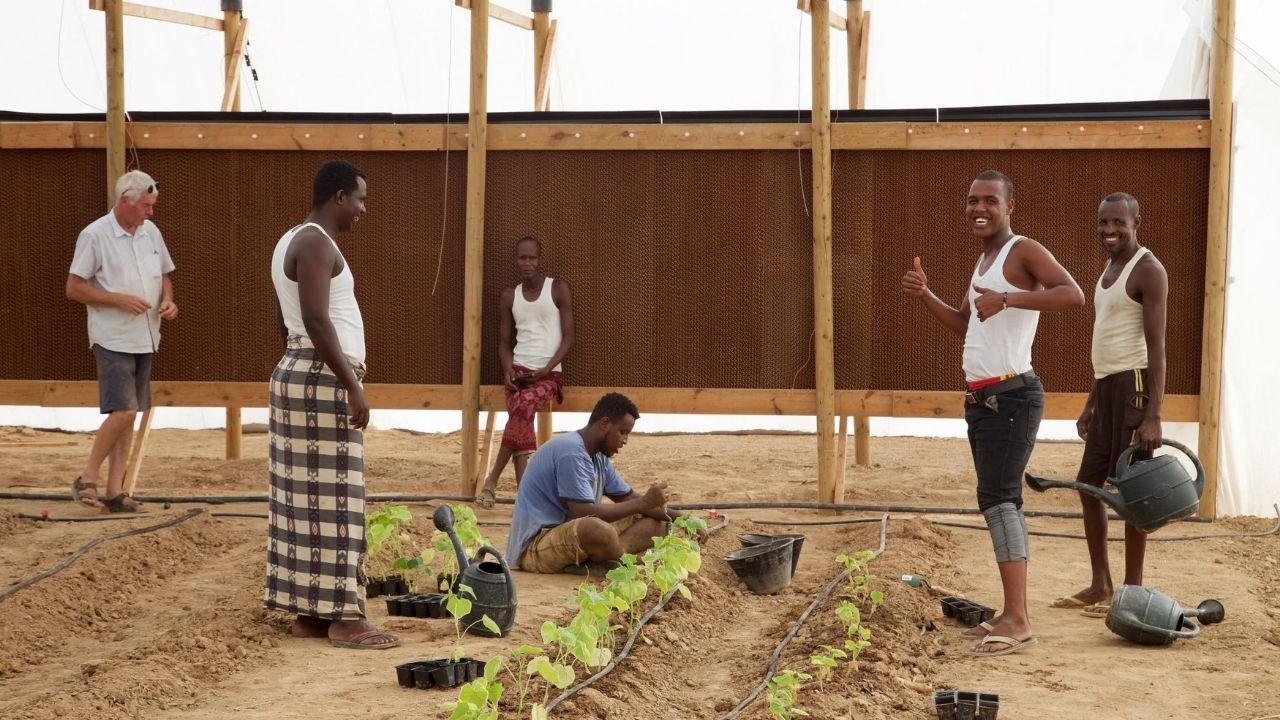
At the ends of the structure, 1.5-meter walls made with layers of porous material were installed, designed to receive seawater regularly. When the hot, dry wind passes through these wet walls, part of the water evaporates, cooling and humidifying the internal space.
Internal temperature drops by 10 to 15 °C
According to the report, this system reduces the internal temperature by 10 to 15 °C. The drop is crucial because, in arid regions, the heat increases plant transpiration and causes them to lose much more water.
Paton told WIRED that, inside the greenhouse, crops lose only 1 to 2 liters of water per square meter per day through transpiration. Outside it, the loss could reach 15 liters per square meter per day. The main gain is not just creating fresh water, but making each liter go further.
Solar desalinator produces water for irrigation


Besides evaporative cooling, the project includes a solar-powered desalination machine. According to Paton, the equipment is about the size of a washing machine and costs around £6,000.
For every liter of seawater processed, 30% is turned into fresh water. This liquid is used for plant irrigation. The technology aims to create a local circuit where sun, sea, and agricultural structure work together to produce vegetables in a naturally unfavorable environment.
Brine turns into salt instead of returning to the sea
One of the common problems of desalination processes is the fate of the brine, the remaining water with a much higher salt concentration. Many plants discard this waste back into the sea, which can cause environmental impact.
In the Somaliland greenhouse, the brine is evaporated in trays, leaving a crust of salt. According to WIRED, this salt was the plant’s first product, developed for sale in Somaliland itself and in Ethiopia. The attempt is to turn a difficult waste into a commercial product.
First harvest included lettuce, cucumber, and tomato
The WIRED report states that in January, less than a year after the launch, the greenhouse produced its first harvest of lettuce, cucumber, and tomato. The choice of these foods is relevant because the region imports a large part of the fruits and vegetables consumed.
Amsale Shibeshi, from the organization Pastoral and Environmental Network in the Horn of Africa, a project partner, told WIRED that Somaliland still needs to import most fruits and vegetables from neighboring countries. The project aims to address precisely this gap in local production.
Drought-resistant agriculture still faces doubts

Despite the technical potential, the report itself shows that the proposal is not free of challenges. Seawater Greenhouse still needed to understand how to supply the local vegetable market, and Paton acknowledged that production would likely have a lower yield per square meter than the Australian project.
There was also skepticism about economic viability. John Mathews, a management professor at Macquarie University, told WIRED that the concept of a greenhouse with seawater belonged to an alternative technology logic, while controlled environment agriculture was moving towards large corporate investments.
Project aims to train local farmers
Even with external doubts, Paton argued that the goal was not to compete with large agritech operations, but to enable production in places where agriculture seemed unlikely. The idea was to help local pastoral farmers adopt plots of 1 to 5 hectares.
According to WIRED, Paton planned to build a training center on-site to teach farmers how to grow vegetables in greenhouses. The vision was to create a network of drought-resistant farms, connected and adapted to the country’s climate.
Region copes with drought and food insecurity
The regional context helps to understand why the solution attracted attention. WIRED reports that Somalia suffered severe water shortages in 2016 and 2017, and that the Horn of Africa region faces cycles of drought, famine, and dependence on food aid.
Somaliland maintains a different political situation from neighboring Somalia, but still relies on food imports, especially fruits and vegetables. In this scenario, using seawater to produce food near the coast appears as an attempt to reduce a structural vulnerability.
Greenhouse can alter the surrounding microclimate
In addition to agricultural production, Paton sees a possible long-term restorative effect. According to WIRED, Philip Davies’ climate model indicated that the greenhouse could generate a plume of cooler and more humid air around the structure.
The hypothesis is that, with more vegetation, shared shade, and moisture, arid areas could recover some of the plant cover over time. This idea is still ambitious, but it shows how the project goes beyond irrigation: it attempts to test whether coastal agriculture can help regenerate dry environments.
When the sea becomes a tool against drought
The Seawater Greenhouse in Somaliland shows how agricultural technology can combine sun, wind, evaporation, desalination, and brine management in one system. The project still faces economic and logistical challenges, but it presents a concrete alternative for arid coastal areas.
The question that remains is straightforward: can using seawater to produce vegetables in the desert become a real solution against dependency on rain and imports, or does it still seem like an expensive and difficult-to-scale bet? Leave your opinion in the comments.


Be the first to react!